Introduction
Ten years ago, selling online was something only big companies did. Today, even a small business from Surat or Coimbatore can take orders from customers in Delhi, Bengaluru, or Mumbai—without a single physical store.
That is what eCommerce has made possible.
But it is not all smooth sailing. Ask any D2C founder or marketplace seller, and they will tell you—logistics headaches, rising ad costs, and high return rates are very real problems. Many businesses go online with a lot of excitement and then struggle to stay profitable because they were not prepared for the operational side.
In India, the market is still growing fast. According to Mordor Intelligence, the eCommerce market here is estimated at USD 137 billion in 2025 and is expected to hit USD 363 billion by 2030—a CAGR of 21.5%. That is a massive opportunity. But it is also a crowded, competitive space.
This article breaks down the real advantages and disadvantages of eCommerce—so you can go in with eyes open.
In short—These are some of the biggest pros and cons of eCommerce that Indian businesses must consider. Pros include global reach, lower costs, 24/7 selling, and data-driven decision-making. A few cons include high competition, rising customer acquisition costs, logistics complexity, and high return rates—especially in COD-heavy markets like India.
What is eCommerce?
Simply put, eCommerce is selling products or services online. No physical shop needed. You can sell through your own website, on marketplaces like Amazon or Meesho, through a mobile app, or even on Instagram and WhatsApp these days.
The core idea is straightforward—reach customers wherever they are, and let them buy on their own terms.
Why eCommerce Matters for Indian Businesses Right Now
A few years ago, eCommerce was optional. For most businesses now, it is not.
Customers are searching online before they buy anything. If your business is not visible online, you are losing sales to someone who is. And with 806 million internet users in India as of early 2025—many of them in smaller towns and cities—the potential customer base is larger than ever before.
Sell Across India Without Opening New Stores
A business in Ahmedabad can now take orders from Patna or Nagpur without setting up a warehouse or office there. With the right logistics strategy, you can deliver reliably across hundreds of pin codes.
Customers Shop When It's Convenient for Them
Most online orders in India are placed in the evening or late at night—when physical stores are closed. An online store captures this demand automatically, without any extra effort on your part.
Smaller Cities Are the New Growth Engine
Metro cities are already well-served. The real growth is coming from Tier-2 and Tier-3 cities—places like Indore, Lucknow, Vadodara, and Coimbatore. These customers are getting online fast, and they are actively looking for products that were previously only available in big cities.
Advantages of eCommerce for Businesses in India
1. Reach More Customers Without More Stores
This is the most obvious benefit—and it is a big one. One website or marketplace listing can get your product in front of customers all over India. You do not need to open new shops, hire local staff, or sign long lease agreements.
2. Your Operating Costs Are Much Lower
Running a physical store is expensive. Rent, electricity, staff salaries, security—it adds up fast. An online store cuts most of these costs significantly. That difference in cost can go back into your product, your marketing, or your margins.
3. You Never Have to Close
Unlike a shop with fixed hours, your online store takes orders around the clock. A customer at 11 PM on a Sunday can still complete a purchase. That sale happens without you doing anything.
4. Scaling Is Easier
When a physical business grows, you need more space, more staff, more everything. With eCommerce, scaling is more flexible. Technology and third-party logistics partners can absorb a lot of the growth without you having to dramatically increase your team or infrastructure.
5. Data Tells You What Is Actually Working
This is something physical retail simply cannot match. Online, you can see exactly which products are getting clicks, where customers are dropping off, which ads are converting, and which cities are ordering most. Tools for data analytics help you use this data to make smarter decisions—faster.
6. Show Customers What They Are Most Likely to Buy
Using product recommendation tools, you can suggest relevant products based on what a customer is browsing or has bought before. This increases the size of each order and encourages repeat purchases—without any manual effort.
7. Getting Started Is Faster Than You Think
Opening a physical store can take months—finding a location, fitting it out, hiring staff. An online store can go live in a few weeks. For new businesses, this means you can start testing the market quickly and make changes based on real feedback.
Disadvantages of eCommerce: Challenges for Indian Businesses
1. Everyone Else Is Online Too
Low entry barriers mean a lot of competition. Whatever you are selling, there is a good chance someone else is selling something similar—often cheaper. Standing out without constantly cutting prices is one of the hardest things about eCommerce.
2. Getting Customers Is Getting Expensive
A few years ago, running ads on Google and Meta was relatively affordable. That has changed. According to Mordor Intelligence, Google Ads costs rose 30–100% across eCommerce categories in 2024, with customer acquisition costs reaching INR 800–1,200 per new customer. For businesses with thin margins, that number can make the whole model unviable if it is not kept in check.
3. Logistics Is Harder Than It Looks
This is where many eCommerce businesses run into trouble. Coordinating with courier partners, dealing with failed deliveries, handling NDRs—it takes real time and attention. And the numbers are not encouraging: COD return rates rose to 20.3% in FY23, with RTO rates averaging 20-25% across the industry according to YourStory. Every failed delivery costs you money on both the forward and return shipment. Having a solid plan to reduce RTO is not optional—it directly affects how profitable your business is.
4. Customers Cannot Feel or Try the Product
This is a genuine limitation, especially for categories like clothing, footwear, and home furnishings. A customer buying a kurta online cannot feel the fabric. A customer buying shoes cannot check the fit. This uncertainty leads to more returns and lower conversion rates compared to physical retail.
5. Returns Eat Into Your Profits
India's eCommerce market hit USD 125 billion in 2024—and returns have scaled right along with it. In fashion and apparel, return rates between 25–40% are common. Each return means paying for forward shipping, paying for return shipping, checking the product, and restocking it. For a high-volume business, this adds up to a significant cost every single month.
6. If Technology Fails, So Does Your Business
Your website going down during a sale, a payment gateway error at checkout, or an inventory sync failure—these are not hypothetical problems. They happen, and when they do, you lose sales and customer trust. eCommerce businesses are completely dependent on their technology working correctly.
7. Fraud and Payment Risks Are Real
Online transactions come with risks that physical stores do not face in the same way. Payment fraud, fake orders, disputed transactions—these are ongoing issues, particularly for businesses with COD orders and no verification process in place.
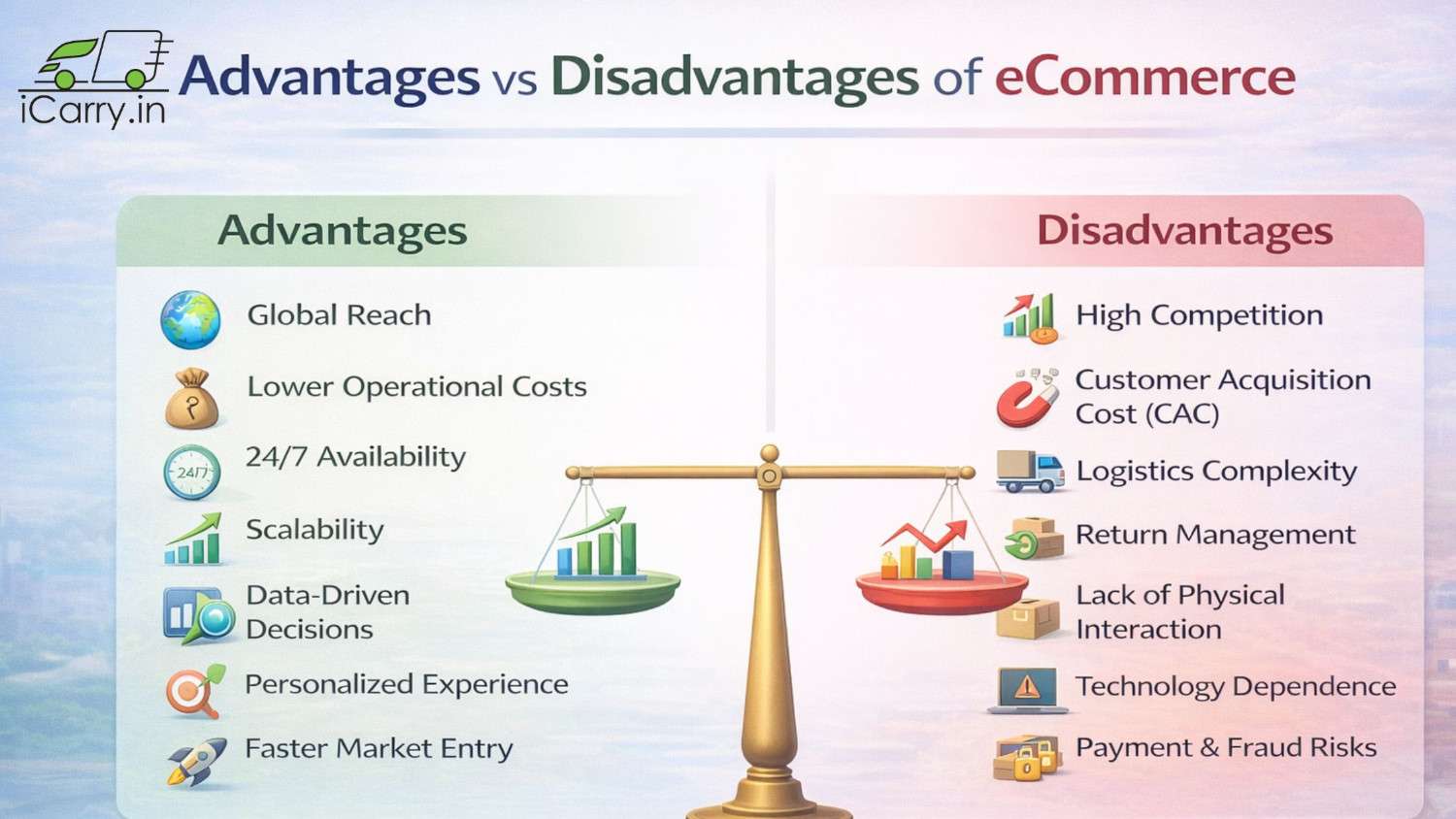
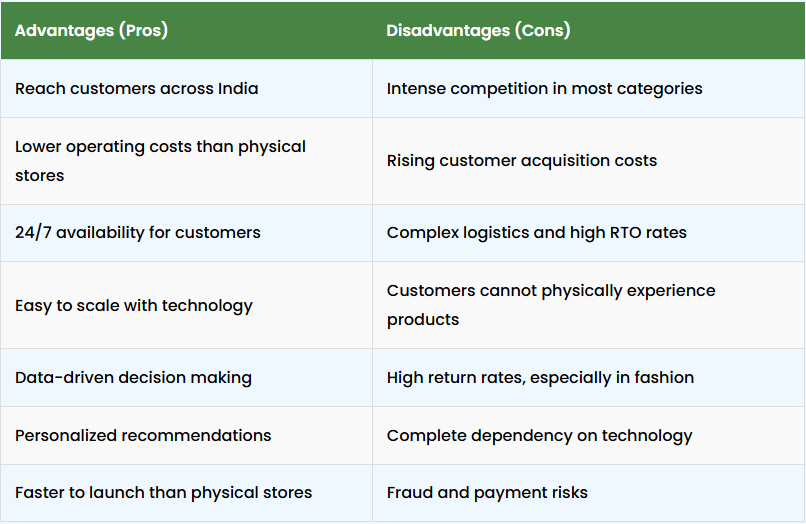
eCommerce Pros and Cons: Quick Summary
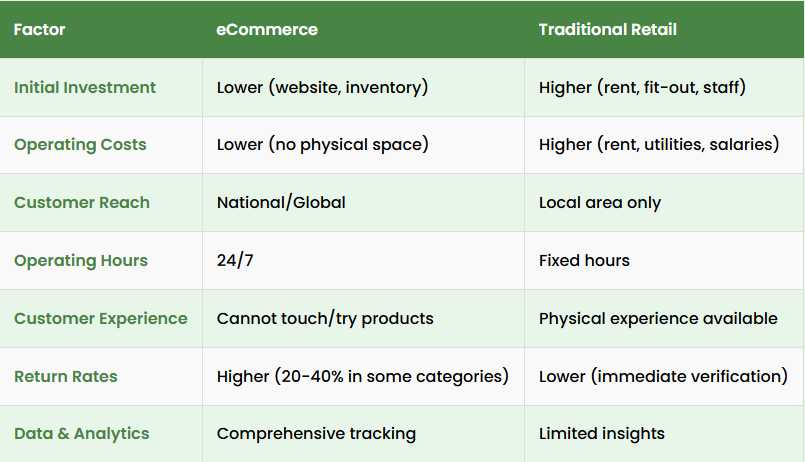
eCommerce vs. Traditional Retail
Real-World Examples
D2C Brands
Brands like Mamaearth, boAt, and Licious built large customer bases entirely online before touching offline retail. They used eCommerce to test products, gather feedback, and grow fast without the overhead of physical stores. India's D2C market is projected to cross USD 100 billion in 2025—which shows just how much room there is in this space.
Marketplace Sellers
Thousands of small businesses across India—from handicraft sellers in Rajasthan to electronics resellers in Chennai—are doing serious business on Amazon and Flipkart without their own website or delivery fleet.
Omnichannel Brands
Many established retail brands—think apparel chains or electronics retailers—now run both online and offline. They use online data to understand what customers want and stock their physical stores accordingly.
Is eCommerce Right for Your Business?
Honestly, for most product businesses in India today, the question is not whether to go online—it is how to do it well.
eCommerce gives you access to a much larger market than a physical store ever could. But going online without sorting out your logistics, your marketing costs, and your return management is a recipe for frustration.
When It Works Well
- Your product is clearly differentiated—customers have a reason to choose you over the competition
- You have worked out a logistics setup that keeps RTO rates low and delivery reliable
- Your marketing is bringing in customers at a cost that still leaves room for profit
When It Gets Difficult
- Orders are coming in but a large percentage are returning—bleeding money on every shipment
- Ad costs are rising but conversion rates are not keeping up
- Your product is similar to dozens of others, and the only way to compete is on price
Best Practices for eCommerce Success
1. Treat Delivery Like It Is Part of Your Product
Because customers experience it that way. A late delivery or a damaged package reflects on your brand—not the courier. Investing in a seamless delivery experience is one of the fastest ways to improve your ratings and reduce returns.
2. Do Not Leave Logistics on Autopilot
Many businesses set up a courier partner early on and never revisit it. But as your volumes grow and your delivery areas expand, what worked initially may not be the most efficient setup. Review your logistics regularly.
3. Build Something People Recognise
In a market full of look-alike products, a brand that customers remember and trust is a real competitive advantage. It takes time to build, but it reduces how much you need to spend on ads to get the same results.
4. Actually Look at Your Data
Most eCommerce platforms give you a lot of information—but many business owners do not look at it regularly. Which products have the highest return rates? Which cities have the most failed deliveries? Which ad campaigns are bringing in repeat buyers vs. one-time customers? The answers are there—you just need to check.
5. Do Not Rely on One Courier
Single-courier dependency is risky and often expensive. A multi-courier allocation system lets you route each order through the best available option—saving on cost and improving delivery performance at the same time.
The Future of eCommerce in India
The growth story here is far from over. India became the second-largest e-retail market in the world in 2024, with 270 million online shoppers—and that number is on track to hit 500 million by 2030.
What is driving this:
- First-time internet users from smaller cities and rural areas coming online
- Affordable smartphones making mobile commerce accessible to more people
- D2C brands reaching customers directly, without middlemen
- Social commerce taking off on Instagram, WhatsApp, and YouTube
- Customers in smaller towns now expecting the same fast delivery that metro customers get
The businesses that build strong operations now—good logistics, smart marketing, reliable tech—will be in the best position to benefit as this market grows.
How iCarry Helps eCommerce Businesses
Here is a problem that almost every growing eCommerce business runs into: managing multiple courier partners is a mess.
You have different rates, different service areas, different performance levels—and you are trying to track all of it manually while also running your actual business. At low volumes, it is manageable. But as orders scale, the cracks start to show. Missed deliveries, high RTOs, and logistics costs that are eating into your margins.
Platforms like iCarry® are designed to solve this problem by helping businesses remove the pain around logistics. It is a logistics management platform for all businesses in India and helps you:
- Pick the right courier automatically for every order—based on pincode, cost, and past delivery performance
- Bring your shipping costs down by routing orders through the most cost-effective partner
- Improve delivery success rates so fewer orders come back as RTOs
- See all your orders in one dashboard—no logging into five different courier portals
- Protect your margins by reducing failed deliveries and return shipping costs
The goal is simple: less time firefighting logistics, more time building your business.
See how iCarry solves courier and RTO challenges →
Conclusion
eCommerce is a genuine growth opportunity for Indian businesses—the market is large, it is growing, and getting started is more accessible than ever.
But it rewards businesses that are prepared. The ones that understand their costs, manage logistics carefully, and build something customers actually want to come back to.
Going online is the easy part. Building a profitable eCommerce operation takes work—and the right tools make a real difference.
If logistics is one of the things slowing you down, iCarry is worth looking at. It is designed specifically for the Indian eCommerce market, where COD, RTO, and multi-courier complexity are everyday realities.
Frequently Asked Questions
What are the main advantages of eCommerce for businesses?
The biggest one is reach—you can sell to customers anywhere in India without opening new stores. Beyond that, operating costs are significantly lower than physical retail, you can take orders around the clock, and you get access to real data that helps you understand what is working and what is not.
What are the biggest disadvantages of eCommerce?
Competition is fierce, and getting customers through paid ads is becoming more expensive every year. Logistics—especially managing RTO on COD orders—is a major operational challenge. And if your tech goes down, so do your sales. These are manageable problems, but they need attention.
Is eCommerce profitable for Indian businesses?
It can be, yes—but it depends heavily on how well you manage your costs. Businesses that keep their logistics costs low, maintain healthy margins, and build repeat customer behaviour tend to do well. Those that rely entirely on paid ads and have high return rates often struggle.
What are the biggest challenges in running an eCommerce business in India?
High RTO rates on COD orders, rising customer acquisition costs, and logistics management are the three most common pain points we hear from Indian sellers. Add intense competition in most product categories, and you have a challenging but not impossible environment to navigate.
How can businesses improve their eCommerce operations?
Start with logistics—it is the one area where small improvements have an outsized impact on profitability. Using a multi-courier platform, tracking your RTO rates by pin code and product category, and making it easier for customers to pay prepaid rather than COD are all practical starting points.
Is eCommerce better than traditional retail?
eCommerce offers wider reach and lower costs, while traditional retail provides physical experience. Most businesses today use a mix of both.
eCommerce in India offers significant advantages including nationwide reach without physical stores, lower operating costs, 24/7 availability, easier scaling, data-driven insights, and faster launch—but faces challenges including intense competition, rising customer acquisition costs (INR 800-1,200 per customer), complex logistics with 20-25% RTO rates, high return rates (25-40% in fashion), technology dependency, and payment fraud risks—making success dependent on managing logistics carefully, maintaining healthy margins, and building repeat customer behaviour.