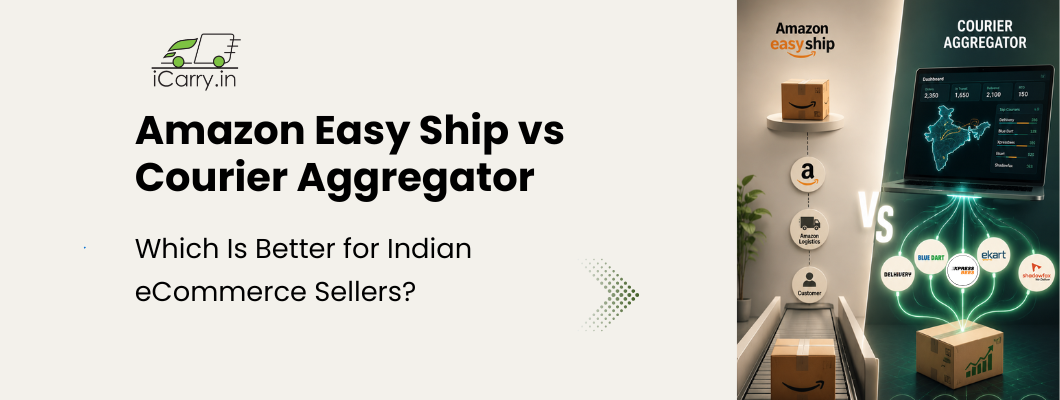
You're selling on Amazon India and processing 80 orders a day. Currently using Easy Ship. The orders are going out, deliveries are mostly happening, and the logistics are running on autopilot. But your margins feel tight, your RTO rate is creeping up, you have no visibility into why deliveries are failing, and you can't figure out why certain pincodes keep generating complaints. You've heard about courier aggregators. You're wondering whether switching - or at least splitting your volume - makes sense. It's one of the most common logistics decisions Amazon MFN sellers and self-ship courier users in India face in 2026. This breakdown compares Amazon Easy Ship and courier aggregators on the factors that actually matter - not just per-shipment rate, but total cost, COD flexibility, delivery failure handling, weight discrepancy exposure, and what happens when things go wrong.
Table of Contents
- What Is the Difference Between Amazon Easy Ship and a Courier Aggregator?
- How to Choose Between Amazon Easy Ship and a Courier Aggregator (5-Step Check)
- What Is Amazon Easy Ship?
- What Is a Courier Aggregator?
- Amazon Easy Ship vs Courier Aggregator - Full Comparison
- Cost Comparison: What You Actually Pay
- COD: Where the Biggest Difference Lies
- Amazon SLA Compliance When Using a Courier Aggregator
- Multi-Channel: Where Aggregators Have No Competition
- When Amazon Easy Ship Is the Right Choice
- When a Courier Aggregator Is the Right Choice
- Can You Use Both Simultaneously?
- Delivery Performance Monitoring - Both Models
- The Bottom Line: Which One Should You Choose?
- Conclusion
- Frequently Asked Questions (FAQs)
What Is the Difference Between Amazon Easy Ship and a Courier Aggregator?
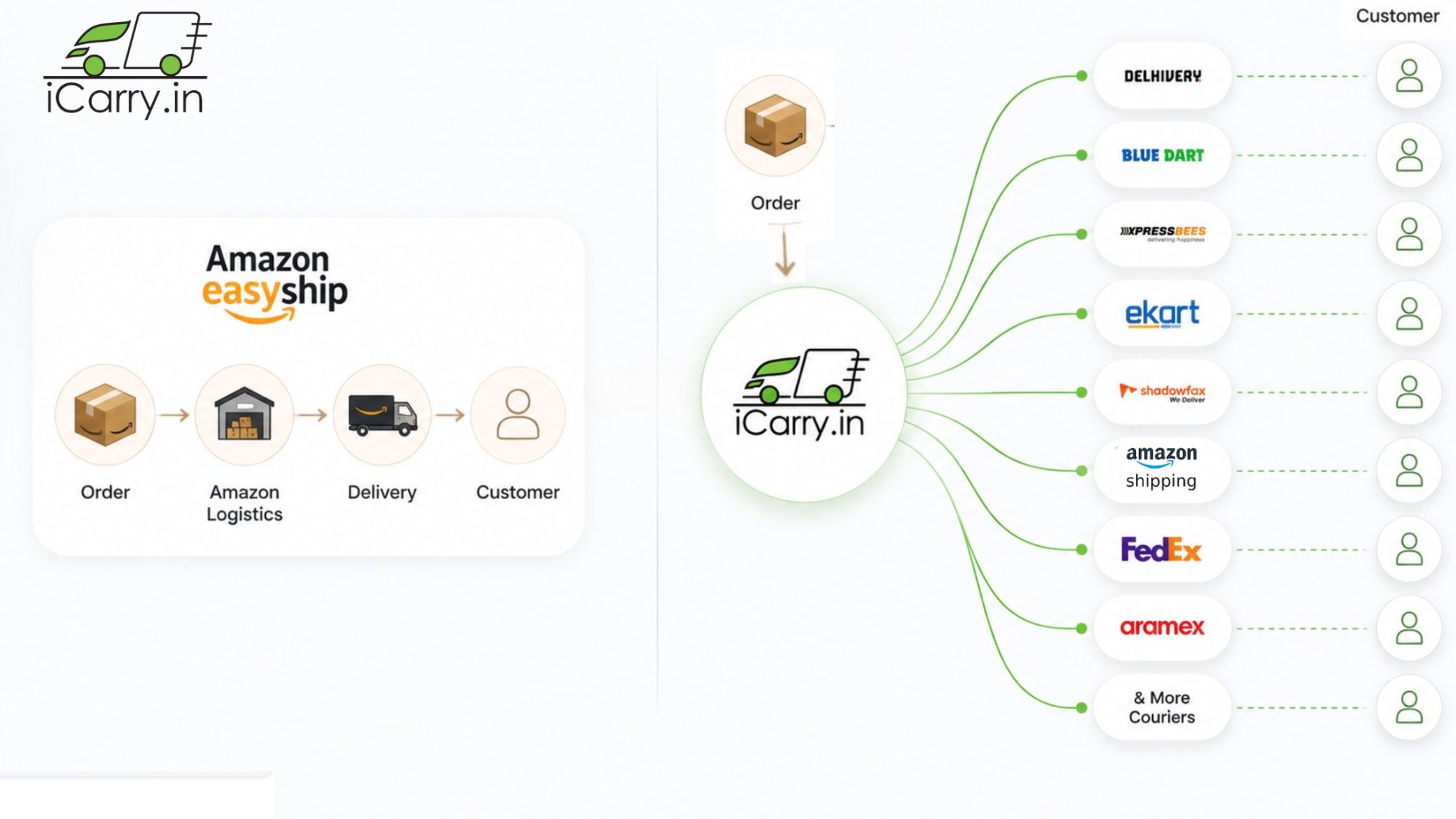
Amazon Easy Ship is Amazon's own logistics service - available only for Amazon India marketplace orders, with Amazon Logistics handling pickup and delivery. A courier aggregator like iCarry® is an independent digital platform that gives sellers access to multiple courier partners from one dashboard, works across Amazon MFN, Shopify, Flipkart, and any other channel, and includes tools for Early COD remittance, RTO management, weight discrepancy handling and many more that Easy Ship does not offer.
How to Choose Between Amazon Easy Ship and a Courier Aggregator (5-Step Check)
Run through these five questions. Your answers will point to the right model for your business.
- Are you selling on more than one channel? If yes - Easy Ship will not cover Shopify, Flipkart, or your own website orders. You need an aggregator.
- Is more than 40% of your orders COD? COD remittance timing directly affects your working capital. Easy Ship follows Amazon's standard 7-day cycle with no flexibility.
- Is your delivery failure rate above 15%? Active NDR tools like Delivery Boost and WhatsApp Engagement are only available through a courier aggregator - not Easy Ship.
- Do you need a specific courier for certain orders? Blue Dart for high-value shipments, Xpressbees for Tier-2 COD, Amazon Shipping for lightweight metro - none of this is possible with Easy Ship.
- Are you seeing repeated delivery failures at specific pincodes? An aggregator lets you reroute those pincodes to a better-performing courier. Easy Ship gives you Amazon Logistics - or nothing.
What Is Amazon Easy Ship?
Amazon Easy Ship is Amazon's logistics service for its marketplace sellers in India. You store inventory at your own location, pack orders yourself, and Amazon Logistics picks up from your address and handles delivery to the customer. You don't need to arrange your own courier - Amazon's delivery network manages the entire dispatch-to-delivery chain. Key characteristics of Easy Ship:
- Available exclusively for Amazon India marketplace orders - not usable for Shopify, WooCommerce, or other channels
- Amazon Logistics handles pickup, transit, and last-mile delivery
- Shipping charges are deducted from your seller payout by Amazon
- Eligible for Easy Ship Prime with faster delivery badges for qualifying sellers
- Amazon sets and enforces the delivery SLA - Late Shipment Rate and Valid Tracking Rate metrics apply
- COD is supported - remittance follows Amazon's standard payout cycle
- No courier choice - Amazon Logistics is the only option
What Is a Courier Aggregator?
A courier aggregator is a platform that gives sellers access to multiple courier partners from one dashboard - rate comparison, booking, label printing, tracking, and shipment management across all couriers in one place. Sellers choose the courier for each order based on rate, serviceability, and performance. Key characteristics of a courier aggregator such as iCarry®:
- Works for Amazon MFN orders, Shopify, WooCommerce, Flipkart, and any other channel simultaneously
- Access to multiple courier partners - Delhivery, Blue Dart, XpressBees, Ekart, Amazon Shipping, Shadowfax, Shree Maruti, DTDC, FedEx, Aramex
- Seller chooses courier per order - manually or through automated routing rules
- COD remittance managed at platform level - iCarry® offers free daily T+7 and early remittance from T+0
- Active RTO management tools - NDR dashboard, Delivery Boost, WhatsApp Engagement
- Full REST API and no-code platform connectors for automation
- For Amazon specifically: tab-delimited TXT file upload syncs unshipped orders for bulk booking
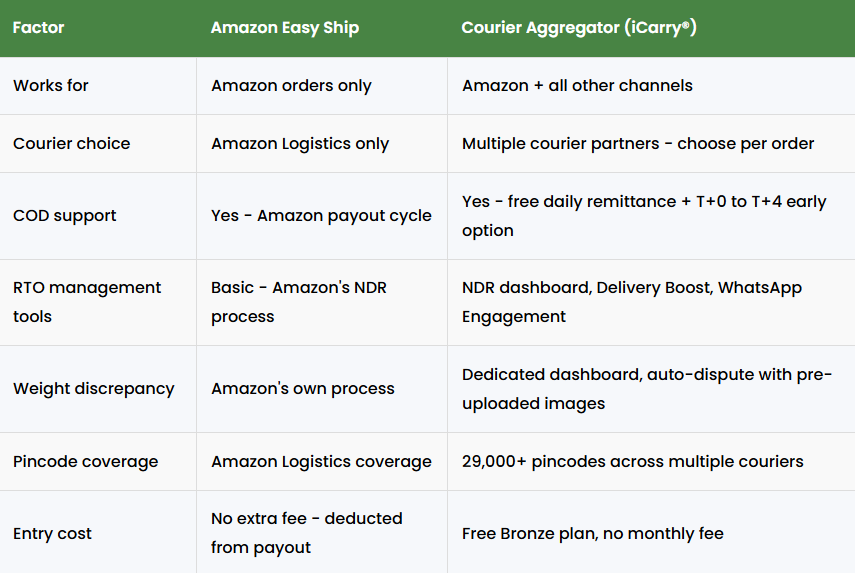
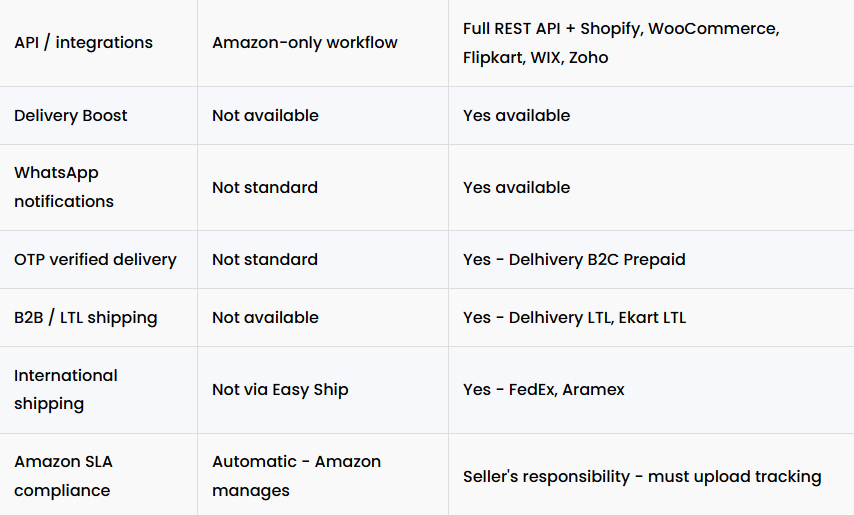
Amazon Easy Ship vs Courier Aggregator - Full Comparison
Cost Comparison: What You Actually Pay
The per-shipment rate comparison between Easy Ship and an aggregator is more nuanced than it first appears. Easy Ship deducts a fixed shipping fee from your payout based on product weight and delivery zone. An aggregator charges you the courier rate at booking, and you recover this through your product pricing.
But per-shipment rate is only one dimension of cost. The total cost comparison must include:
Easy Ship - Total Cost Per Order
- Amazon shipping fee (deducted from payout)
- Amazon referral fee (separate - applies regardless of shipping model)
- RTO cost when delivery fails - Amazon charges return freight, and you absorb the revenue loss
- No early COD remittance - money locked in Amazon's payout cycle, typically 7 days after delivery
- Limited weight discrepancy visibility - billing adjustments can appear without clear itemisation
Courier Aggregator - Total Cost Per Order
- Courier freight rate (pre-negotiated bulk rates through aggregator)
- Amazon referral fee (same as above - channel fee separate from logistics)
- RTO cost when delivery fails - forward + return freight, but with active NDR tools to prevent it
- COD remittance timing flexible - free T+7 daily, or early remittance from T+0 at a nominal fee
- Weight discrepancy disputes manageable through dedicated dashboard
For sellers with meaningful COD volume and RTO rates above 15%, the total cost of courier aggregator shipping is often lower than Easy Ship when RTO freight savings and earlier COD access are factored in.
According to ecommerce industry trends, logistics costs and COD remittance timings are among the top operational challenges for Amazon marketplace sellers in India - particularly those with COD ratios above 40%.
Video: How to Estimate Shipping Costs Across All Courier Partners on iCarry®
COD: Where the Biggest Difference Lies
COD accounts for over 60% of eCommerce orders in India. For Amazon sellers with significant COD volume, the COD handling comparison between Easy Ship and a courier aggregator is often the deciding factor.
Easy Ship COD
COD is available through Easy Ship and Amazon Logistics manages collection. However, COD payouts follow Amazon's standard seller payment cycle - typically 7 days after delivery confirmation, with no early remittance option. For high-COD sellers, this means significant working capital is permanently locked in Amazon's payout pipeline.
Courier Aggregator COD
iCarry® processes COD remittance every business day (Monday to Saturday) automatically on the T+7 cycle at zero cost for all plans. Sellers who need money faster can opt for early remittance from T+4 to T+0 to get paid even sooner. and iCarry® advances the payment from its own working capital even before the courier settles.
RTO Management: The Most Important Operational Difference
RTO is the largest controllable cost in Indian eCommerce logistics. A seller with 25% RTO on 100 COD orders per day is paying double freight on 25 shipments daily - that is a significant and largely preventable loss.
Easy Ship RTO Management
When an Easy Ship delivery fails, Amazon generates an NDR. Sellers can view the status in Seller Central and take limited action - typically updating address notes or requesting a reattempt. Sellers have limited direct visibility into why specific deliveries are failing or which areas are generating disproportionate RTOs.
Courier Aggregator RTO Management
iCarry® provides a dedicated NDR dashboard where every failed delivery appears with the courier's stated reason. Sellers can update instructions and request reattempts within 24 hours for each shipment. Using NDR data to improve delivery success rates explains how this data reveals systemic patterns that targeted intervention can fix. Beyond the dashboard, iCarry®'s Delivery Boost deploys trained agents who call customers on the seller's behalf, audit courier delivery claims, and open tickets for fake delivery attempts - the single biggest source of preventable RTO in Indian eCommerce. Easy Ship has no equivalent to this. Reducing RTO systematically is only possible with the tools and data to diagnose what is actually causing failures.
Sellers dealing with high delivery failure rates can explore how iCarry®'s Delivery Boost and NDR dashboard work in practice.
Weight Discrepancy Management
Weight discrepancy charges - where the courier bills a higher weight than declared - affect both Easy Ship and aggregator shipments. How they are handled differs significantly as explained below:
Easy Ship Weight Discrepancy
Amazon has its own weight discrepancy revision process through Seller Central. Sellers can file disputes, but the process goes through Amazon's internal system. Billing adjustments are applied as debits from your payout. Visibility into which specific shipments generated discrepancies and the timeline for resolution is more limited than through a dedicated aggregator dashboard.
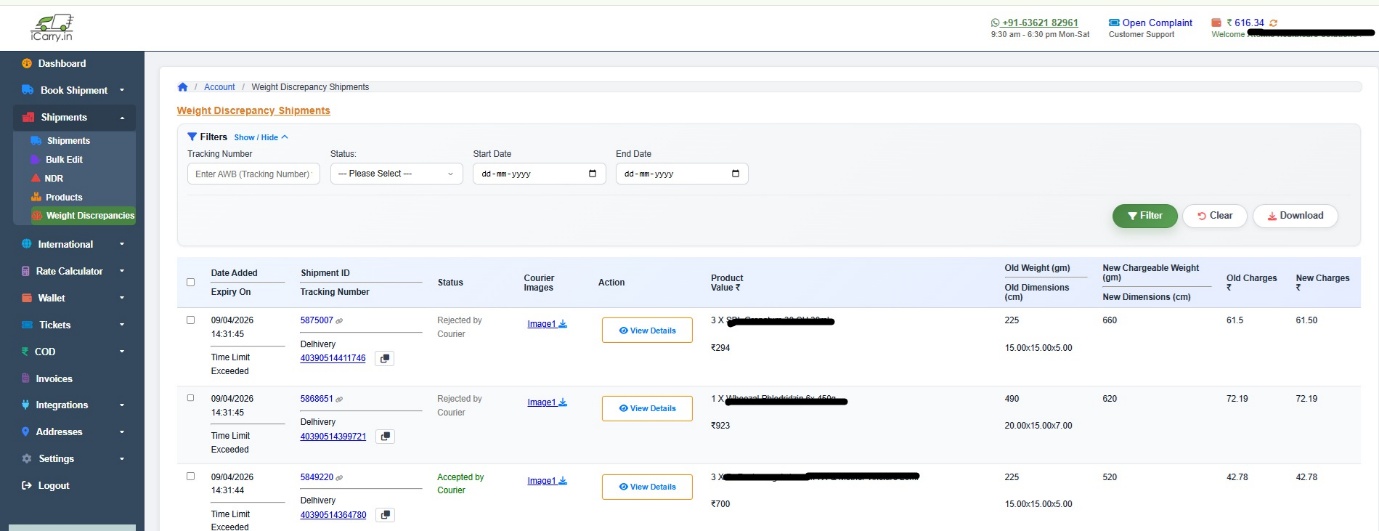
Courier Aggregator Weight Discrepancy
iCarry® has a dedicated Weight Discrepancies section where every disputed charge appears with old vs new weight side by side. Pre-uploading product images enables automatic dispute triggering and you can see which shipment has been rejected or accepted by the courier partner. How to reduce and dispute weight discrepancy charges gives the full process.
Amazon SLA Compliance When Using a Courier Aggregator
This is where the operational difference between Easy Ship and an aggregator is most visible for Amazon sellers. Easy Ship handles SLA compliance automatically - Amazon Logistics manages dispatch, tracking, and delivery within the promised window. The seller just needs to pack and be ready for pickup.
With a courier aggregator on Amazon MFN (Self Ship), the seller is responsible for:
- Dispatching within the Amazon-set SLA window - typically 24 to 48 hours from order placement
- Uploading valid tracking numbers to Amazon Seller Central within hours of pickup
- Maintaining Valid Tracking Rate above 95% and Late Shipment Rate below 4%
For sellers with high order volumes, this requires a structured morning dispatch routine:
- Export unshipped orders from Amazon Seller Central as tab-delimited TXT file
- Upload to iCarry® bulk booking section for automatic shipment creation
- Book shipments and print labels for all orders before the courier arrives
- Update tracking numbers in Amazon Seller Central after pickup confirmation
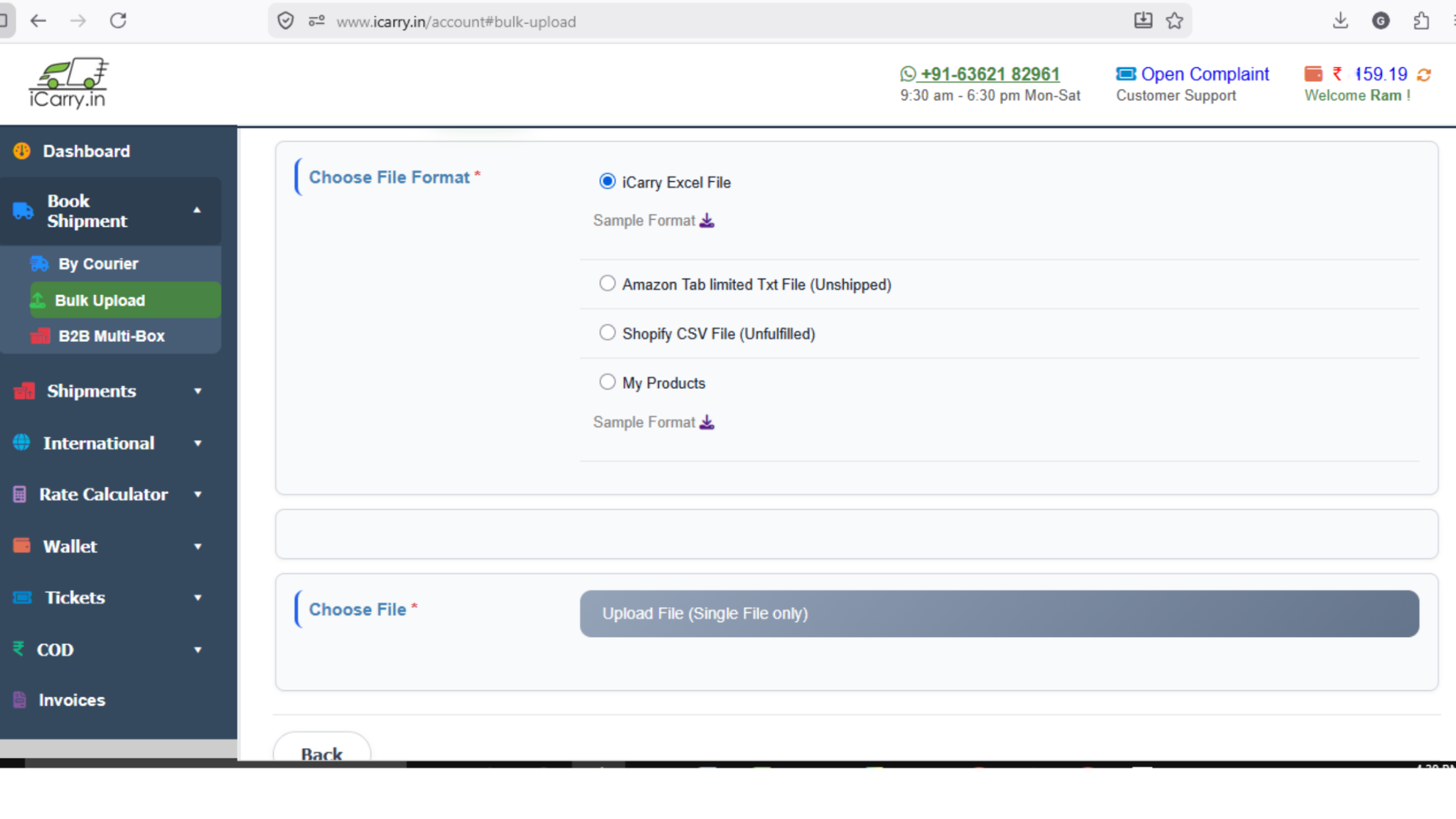
Video: How to Upload Amazon Tab-Delimited File and Book Shipments in Bulk on iCarry®
Important: iCarry® does not have a direct API connection with Amazon's order management system. The tab-delimited TXT file upload is the supported method for Amazon MFN order sync - simple, fast, and no developer setup required.
Multi-Channel: Where Aggregators Have No Competition
This is the clearest advantage of a courier aggregator for any seller who sells beyond Amazon alone.
Easy Ship works only for Amazon India orders. If you also sell on:
- Your own Shopify or WooCommerce store
- Flipkart through Self Ship
- WIX, Zoho Commerce, or OpenCart
- Instagram or WhatsApp direct orders
- B2B wholesale orders
Easy Ship covers none of these. You need a separate logistics arrangement for every other channel.
A courier aggregator like iCarry® handles all of these from one platform - Shopify and WooCommerce through API connectors that auto-sync orders, Flipkart through the Flipkart connector, and custom channels through the API or manual booking.
Video: How to Book a Shipment and Select the Best Courier on iCarry®
When Amazon Easy Ship Is the Right Choice
Easy Ship is genuinely the better option in specific situations. It's not a compromise - for the right seller profile, it's the most efficient path.
- Amazon-only sellers with low to moderate volume: If Amazon is your only channel and you are shipping under 100 orders a day, Easy Ship removes all logistics management overhead. You pack, Amazon delivers. The operational simplicity has real value
- Sellers who want automatic Amazon SLA compliance: Easy Ship removes the risk of Late Shipment Rate or Valid Tracking Rate violations - Amazon manages the entire dispatch and tracking workflow
- Sellers with low COD ratio: If most of your Amazon orders are prepaid, the COD remittance timing difference matters much less financially
- Sellers without an existing logistics setup: For brand-new sellers who have no courier relationships and no aggregator account, Easy Ship is the fastest path to shipping Amazon orders reliably
- Sellers in Easy Ship Prime program: If your products qualify for Easy Ship Prime and the conversion boost from the Prime badge is meaningful for your category, the value of that badge may outweigh the flexibility lost by not having courier choice
When a Courier Aggregator Is the Right Choice
- Multi-channel sellers: Any seller operating beyond Amazon alone needs an aggregator for unified logistics management
- High COD volume sellers: Free daily COD remittance and early remittance options make the cash flow advantage of an aggregator significant for COD-heavy operations
- Sellers with RTO above 15%: NDR management tools, Delivery Boost, and WhatsApp Engagement are only available through an aggregator - not through Easy Ship
- Sellers needing courier choice: Blue Dart for high-value products, Xpressbees for Tier-2 COD, Amazon Shipping for lightweight metro orders - none of this flexibility exists within Easy Ship
- Sellers experiencing repeated failures in specific pincodes: An aggregator lets you reroute problem pincodes to a different courier. Easy Ship gives you Amazon Logistics or nothing
- Sellers wanting shipping cost visibility: Aggregator rate comparison across multiple couriers before every booking means you always know the best available rate. Easy Ship charges are fixed by Amazon
Can You Use Both Simultaneously?
Yes - and many serious Amazon sellers do. A hybrid approach works well as follows:
- Easy Ship for standard Amazon orders: Where Amazon Logistics coverage is reliable, SLA management is automatic, and the per-shipment rate is competitive
- Courier Aggregator for: All non-Amazon channel orders, High-value orders (example - where Blue Dart is preferred), or at pincodes where Amazon Logistics performance is weak or for Tier-2 COD orders where a better courier exists
The hybrid approach gives you the operational simplicity of Easy Ship where it works well, and the flexibility of an aggregator where it does not. There is no exclusivity requirement - you can switch between Easy Ship and Self Ship at the order level in Seller Central.
Delivery Performance Monitoring - Both Models
Regardless of whether you use Easy Ship, an aggregator, or both, tracking delivery performance is essential for making the right routing decisions over time. The 7 logistics KPIs every eCommerce business should track gives the full monitoring framework - on-time delivery rate, first-attempt success, RTO rate, and weight discrepancy rate - applicable to both Easy Ship and MFN shipments.
Understanding how shipping experience drives customer retention on Amazon is equally important - because a poor delivery experience on your Amazon listing generates negative reviews and A-to-Z claims that hurt your account health regardless of which logistics model created the failure.
The Bottom Line: Which One Should You Choose?
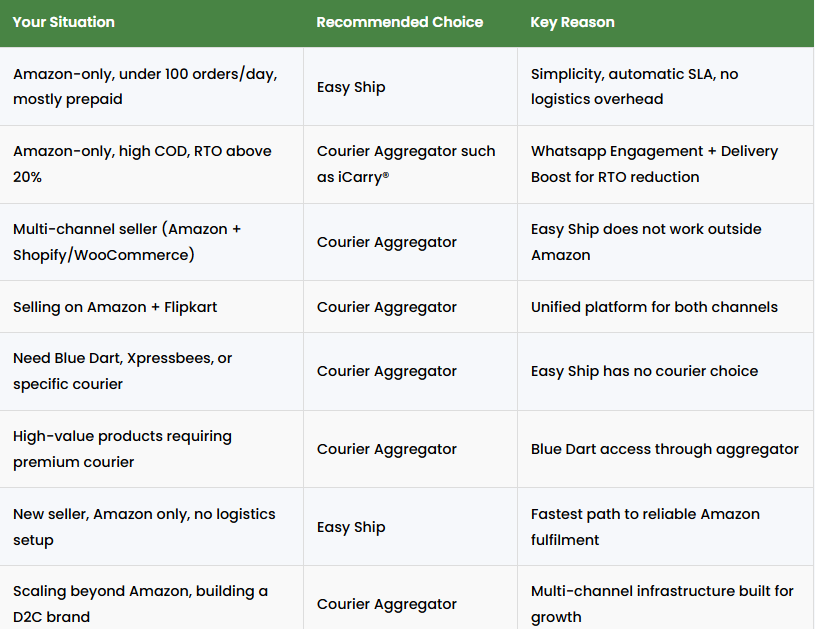
Amazon India's official Seller Fulfilled / MFN requirements and SLA obligations covers the specific metric thresholds sellers must maintain when shipping their own orders.
Conclusion
Amazon Easy Ship and a courier aggregator are not direct competitors - they serve different seller profiles and are often best used together. Easy Ship wins on simplicity and automatic Amazon SLA management. A courier aggregator wins on flexibility, COD remittance terms, RTO management tools, and multi-channel support. The question is not which one is objectively better. The question is which one matches where your business is today and where it's going. If you're selling only on Amazon and the current setup is working, Easy Ship is fine. If you're scaling beyond Amazon, experiencing RTO pain, carrying significant COD volume, or needing courier choice for different product types - a courier aggregator gives you the tools to manage logistics as a strategic operation rather than a cost centre. iCarry® gives Amazon MFN sellers access to multiple courier partners, free daily COD remittance, NDR management, Delivery Boost, and WhatsApp Engagement from one platform - with no minimum volume and no monthly fee on the Bronze plan.
Compare live rates before your next shipment and start shipping smarter on iCarry®
Video: How to Sign Up and Start Shipping with iCarry®
Frequently Asked Questions (FAQs)
What is Amazon Easy Ship?
Amazon Easy Ship is Amazon India's logistics service where marketplace sellers pack orders at their own location and Amazon Logistics handles pickup and delivery. It is available only for Amazon marketplace orders.
What is a courier aggregator?
A courier aggregator is a platform that provides access to multiple courier partners from one dashboard. Sellers compare rates, book shipments, and track deliveries across all couriers in one place. Works for Amazon MFN and all other sales channels.
Is Amazon Easy Ship cheaper than using a courier aggregator?
Per-shipment rate comparison alone does not tell the full story. Total cost must include RTO freight losses, COD remittance timing (working capital cost), and weight discrepancy handling. For sellers with high COD volume and RTO above 15%, the total cost of a courier aggregator is often lower than Easy Ship.
Can I use both Amazon Easy Ship and a courier aggregator?
Yes. Many Amazon sellers use Easy Ship for standard orders where Amazon Logistics performs well, and a courier aggregator for MFN Self Ship orders where they need courier choice, high-value product shipping (Blue Dart), or improved COD and RTO management.
Which is better for Amazon sellers: Easy Ship or Self Ship?
Easy Ship is better for Amazon-only sellers who want simple operations and automatic Amazon SLA compliance. Self Ship is better for sellers who need more flexibility - including courier choice, faster COD remittance, better RTO management, and support for Shopify, Flipkart, or other channels. Many growing sellers use both: Easy Ship for standard Amazon orders and Self Ship where more control is needed.
Does iCarry® integrate with Amazon India?
iCarry® supports Amazon MFN sellers through tab-delimited TXT file upload - export unshipped orders from Amazon Seller Central and import directly into iCarry® for bulk booking. iCarry® does not have a direct API connection with Amazon's order management system.
Which courier aggregator is best for Amazon sellers in India?
iCarry® is particularly well-suited for Amazon MFN sellers due to its multiple courier access, free daily COD remittance, NDR management dashboard, Delivery Boost for fake NDR reduction, WhatsApp Engagement, and free Bronze plan with no minimum volume. No monthly fee means the economics work even at lower order volumes.
Can I use Easy Ship for Shopify or WooCommerce orders?
No. Easy Ship is exclusively for Amazon India marketplace orders. For Shopify, WooCommerce, Flipkart, or any other channel, you need a separate logistics arrangement - a courier aggregator handles all channels from one platform.
What happens to my Amazon account metrics when using Self Ship?
With Self Ship (MFN), you are responsible for maintaining Late Shipment Rate below 4%, Valid Tracking Rate above 95%, and Cancellation Rate below 2.5%. You must upload tracking numbers to Seller Central within hours of pickup. Building a daily morning dispatch routine - export orders, bulk book on iCarry®, print labels, hand over to courier - is the most reliable way to maintain Amazon SLA compliance.
How does COD remittance compare between Easy Ship and iCarry®?
Amazon Easy Ship COD payouts follow Amazon's standard seller payment cycle - typically 7 days after delivery. iCarry® processes COD remittance automatically every 7 days (Monday to Saturday) at zero cost on the T+7 default. Early remittance from T+0 to T+4 is also available at a transparent fee, with iCarry® advancing payment from its own working capital.
Amazon Easy Ship and a courier aggregator are not direct competitors - they serve different seller profiles and are often best used together. Easy Ship wins on simplicity and automatic Amazon SLA management. A courier aggregator wins on flexibility, COD remittance terms, RTO management tools, and multi-channel support.