You accept COD because your customers ask for it. You accept prepaid because it reduces your RTO risk. And now UPI collect and payment links are creating a third path that sits somewhere between the two.
The payment method your customer uses is not just a checkout decision - it is a logistics variable. It determines your RTO rate, your working capital position, your COD handling fee, your cash flow cycle, and the probability that the order at your door gets accepted or refused.
In 2026, Indian sellers have more payment options than ever, and the strategic question of which to offer - and in what combination - directly affects per-order profitability. This guide breaks down each method honestly, including what the data says about conversion, RTO, and cash flow implications for Indian businesses.
What Is COD, UPI and Prepaid? The Three Payment Methods Explained
Cash on Delivery (COD)
The customer pays in cash when the delivery executive arrives at their door. The courier collects the cash, aggregates it across all deliveries, and remits it to the seller after a defined cycle - typically T+7 (seven business days after delivery).
Why it exists: Indian buyers - particularly in Tier 2 and Tier 3 cities - historically had low trust in online transactions and limited access to digital payment methods. COD removed the risk from the buyer's side: pay only when the product arrives.
Why it persists in 2026: Despite massive UPI adoption, COD remains dominant in fashion, lifestyle, and general merchandise categories, particularly outside metros. For many first-time buyers from new cities, COD remains the comfort zone. Removing it entirely often reduces conversion significantly.
UPI Prepaid - Pay Before Dispatch
The customer pays via UPI (GPay, PhonePe, Paytm, or any UPI app) at checkout or via a payment link before the order is dispatched. Funds are credited to the seller's account within seconds.
Why it grew: India's UPI infrastructure, developed by NPCI, has made instant digital payment ubiquitous. UPI processes over 10 billion transactions monthly as of 2026, with adoption extending well into Tier 2 and Tier 3 cities that were previously cash-only.
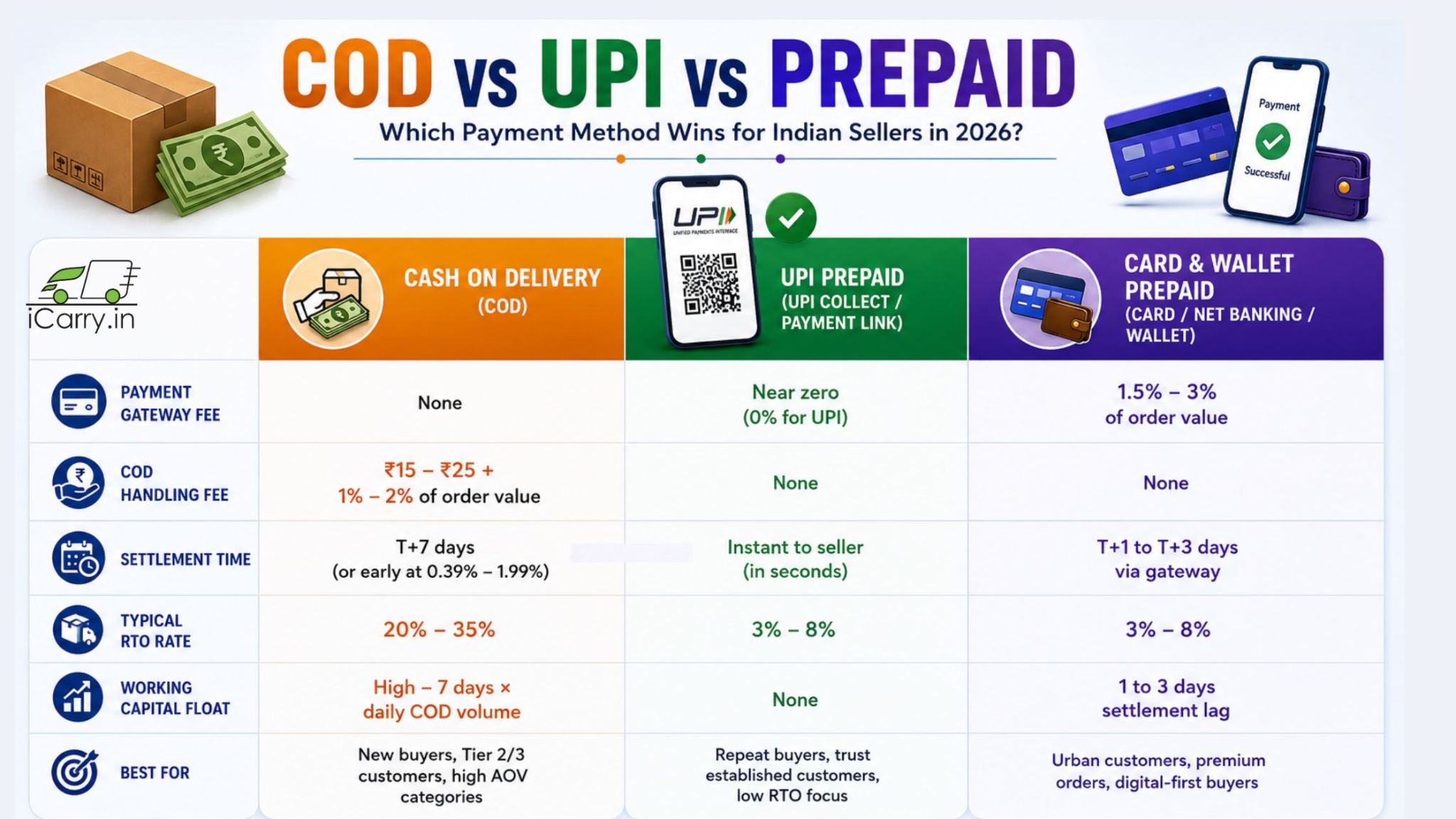
The difference from other prepaid: UPI is instant settlement with zero transaction fee for most use cases. Card payments and net banking have payment gateway fees of 1.5 to 3%. UPI's near-zero cost structure makes it the most margin-friendly prepaid option for sellers.
Card and Wallet Prepaid
Credit card, debit card, and wallet payments made at checkout via payment gateway. Funds are held by the payment gateway and settled to the seller's account in 1 to 3 business days after transaction confirmation.
Cost structure: Payment gateway charges 1.5 to 3% of transaction value as processing fee. MDR (Merchant Discount Rate) applies on most card transactions above a certain threshold. This fee directly reduces margin on every card order - something UPI largely avoids.
How to Understand Your Payment Profile First
- What percentage of your current orders are COD versus prepaid?
- Do you know your RTO rate separately for COD and prepaid orders?
- What is your average COD handling fee per month as a percentage of revenue?
- How much working capital is permanently locked in your T+7 COD remittance float?
- Have you tested a prepaid discount at checkout to measure its impact on COD-to-prepaid conversion?
The Real Cost Comparison - Per Order Economics
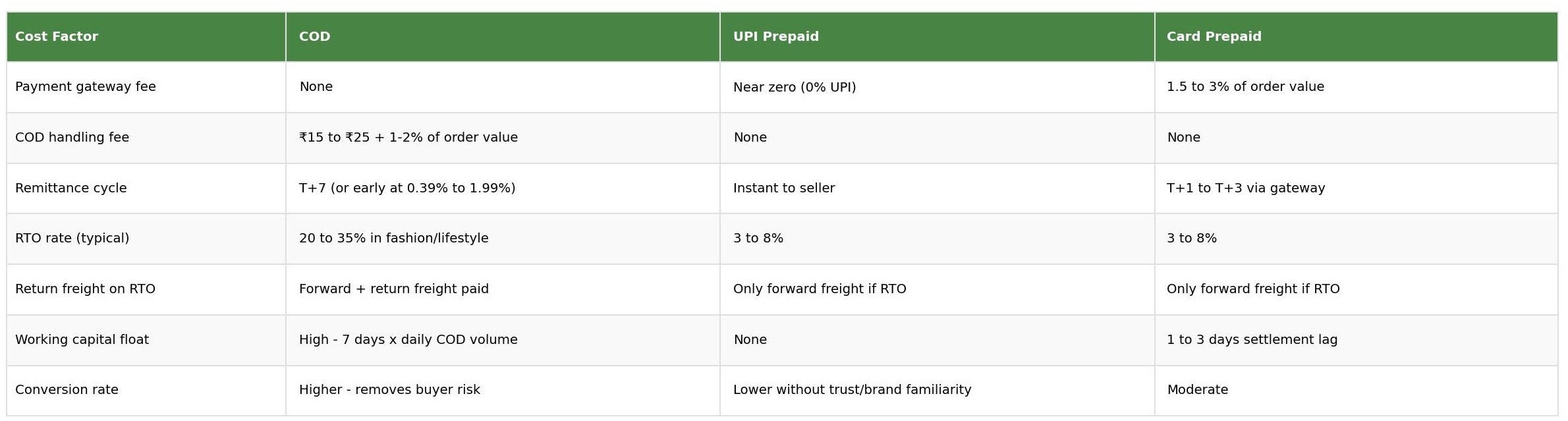
The table makes the economics clear: COD has the highest conversion rate but the highest total cost. Prepaid (especially UPI) has lower conversion but dramatically lower per-delivered-order cost once RTO, handling fees, and remittance float are included.
RTO Rate - The Most Important Difference
The single biggest reason prepaid orders cost less to fulfil is the RTO rate difference. This is not a small gap.

Every COD order that comes back as RTO costs forward freight plus return freight. A prepaid order that fails delivery typically costs only forward freight - the customer has already paid, so doorstep refusal is much rarer. This difference compounds across thousands of monthly orders into a significant margin gap between COD-heavy and prepaid-heavy operations.
Working Capital - The Hidden COD Advantage and Disadvantage
COD creates two opposite working capital effects that are frequently misunderstood:
The Disadvantage: Permanent Float
Under T+7 remittance, the cash your customers pay on delivery takes seven business days to reach your account. For a business delivering 300 COD orders per day at ₹700 average order value, that is ₹14.7 lakh permanently in transit - earned but inaccessible.
If you are borrowing to fund inventory purchases while waiting for COD to settle, the interest cost of that borrowing is a hidden logistics cost that never appears on your courier invoice but directly reduces your effective margin.
The Advantage: Customer Float Removed
COD customers do not need to have money in their digital account at the moment of ordering - they pay when the product arrives. This expands your addressable customer base to include buyers who prefer not to commit payment digitally before receiving goods. In India's market structure, this is a meaningful expansion, particularly in smaller cities.
Early Remittance as a Bridge
iCarry®'s early COD remittance options (T+0 to T+4) allow sellers to accelerate settlement at a nominal fee - with iCarry® advancing payment from its own capital before couriers settle. For sellers where the working capital cost of T+7 float exceeds the early remittance fee, this bridge eliminates the disadvantage while retaining COD's conversion benefit.
UPI in 2026 - The Game Changer
UPI has fundamentally changed the prepaid landscape for Indian sellers. The RBI's payment system data shows UPI now covers geographies and demographics that card payments never reached - including Tier 2 and Tier 3 buyers who previously had no practical prepaid option.
What this means for sellers in 2026:
A COD-only policy is no longer the only way to reach smaller-city buyers. UPI gives those buyers a frictionless prepaid option that was not available five years ago
The argument that 'my customers need COD' is increasingly segment-specific rather than universal. Analyse your customer geography before assuming
UPI's near-zero transaction fee makes it the most margin-friendly prepaid option. A seller offering UPI at checkout and removing card/wallet payments for sub-₹1,000 orders eliminates payment gateway fees on the majority of their order volume
UPI Collect - where the seller sends a payment request to the buyer's UPI ID - enables a COD-like confirmation flow that converts COD buyers to prepaid through a familiar UPI experience
Strategies to Shift COD Orders to Prepaid Without Losing Buyers
1. Prepaid Discount at Checkout
The most widely used conversion tactic. Offer ₹30 to ₹50 off for prepaid payment at checkout. The discount costs less than the COD handling fee it replaces, the RTO double-freight it prevents, and the working capital float it eliminates. For most businesses, this is net margin positive even before accounting for RTO reduction.
2. UPI Payment Link After COD Order Placement
Send a UPI payment link via WhatsApp within 30 minutes of every COD order placement. Frame it as: 'Pay now and get instant dispatch - your order ships today instead of tomorrow.' Some sellers see 20 to 35% COD-to-prepaid conversion through this tactic, particularly on higher-value orders where the buyer has greater motivation to ensure dispatch.
3. COD Minimum Order Value
Set a minimum order value below which COD is not available. At low order values, the COD handling fee as a percentage of order value is disproportionately high. A ₹299 order with a ₹20 COD handling fee plus 1.5% COD charge (₹24.50 total) has a 8% COD overhead. Setting COD minimum at ₹499 or ₹599 pushes low-value buyers toward UPI while retaining COD for higher-value orders where conversion benefit is greatest.
4. Free Shipping for Prepaid Only
Charge a shipping fee for COD orders and offer free shipping for prepaid. The shipping charge on COD is visible to the buyer at checkout and creates a direct financial incentive to switch. The psychological effect of 'free shipping' on prepaid is well-documented across Indian eCommerce platforms.
5. COD Confirmation Before Dispatch
For COD orders that do ship, sending a WhatsApp confirmation within 30 minutes of order placement and requiring customer reply before dispatch eliminates the lowest-intent COD buyers - the impulse orders that would have become doorstep refusals. This does not shift them to prepaid but removes the worst RTO-risk orders from the COD pool. Reducing COD RTO systematically combines this with Delivery Boost and two-way WhatsApp communication for the orders that do ship COD.
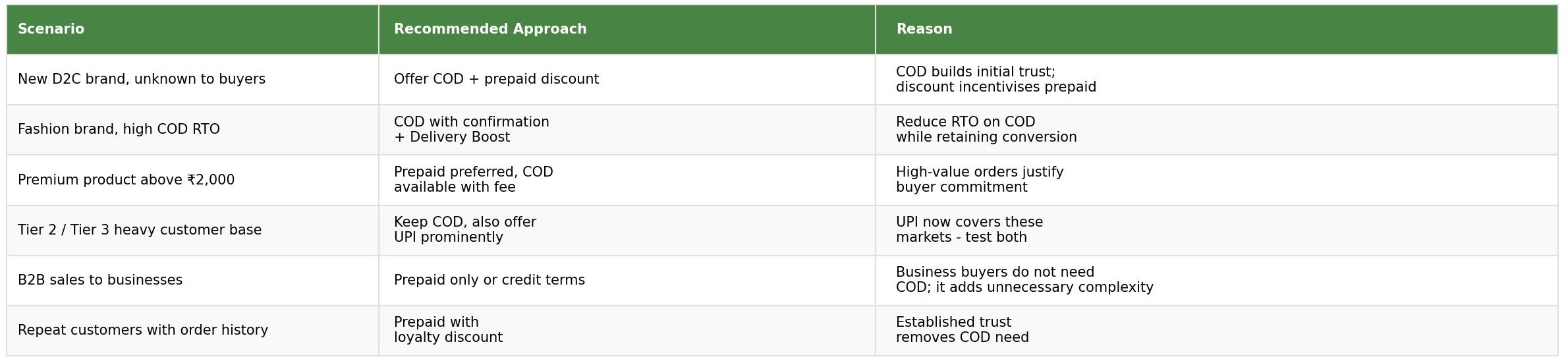
When to Keep COD - and When to Reduce It
How iCarry® Supports All Three Payment Models
iCarry® is a courier aggregator that supports COD, prepaid, and mixed payment order profiles from one platform:
COD remittance: Free automatic daily T+7 settlement for all plans. Early remittance from T+0 to T+4 at nominal fee for sellers needing faster cash access
Delivery Boost for COD orders: Trained agents reduce COD RTO by calling customers before delivery, auditing fake NDRs, and opening tickets for fraudulent non-deliveries
Two-way WhatsApp engagement: COD customers can confirm availability, reschedule, and update delivery details. Prepaid customers receive accountable delivery coordination. Full conversation visibility for the seller
OTP Verified Delivery: For high-value prepaid orders this feature eliminates fake delivery claims and creates irrefutable delivery records
Address Quality Scoring: Pre-dispatch address validation for all order types - catches bad addresses before dispatch regardless of payment method
COD destination account configuration: Choose bank account, auto-split bank and wallet, or wallet-only for COD remittance based on working capital preferences
iCarry® serves all Indian businesses - D2C brands, manufacturers, distributors, and growing sellers of all types. Free Bronze plan, no minimum volume. Get started with iCarry and simplify your shipping operations.
Final Thoughts
There is no single winner between COD, UPI, and card prepaid. The right answer is a mix - determined by your customer geography, product category, price point, and current RTO rate.
COD will remain essential for reaching the broadest Indian buyer base through 2026 and beyond. But accepting COD without actively managing its cost - COD handling fees, working capital float, and RTO double-freight - is leaving a significant margin on the table every month.
UPI has changed the calculus. The buyer who needed COD because they had no digital payment option in 2019 may happily pay via PhonePe in 2026 if you offer it prominently and incentivise it with a small discount. Test it, measure the conversion, and let your own data drive the mix.
iCarry® handles the logistics side of all three payment models with equal capability - and gives you the delivery management tools to protect margins regardless of which payment mix your customers choose. Register free at iCarry today.
Frequently Asked Questions (FAQs)
Which payment method has the lowest RTO rate in India?
Prepaid orders (UPI and card) have dramatically lower RTO rates than COD - typically 3 to 8% versus 20 to 35% for COD in fashion and lifestyle categories. The buyer who has already paid is far less likely to refuse at the door than a buyer who made a zero-commitment cash order.
What is the COD handling fee in India?
COD handling fees are charged by the courier for collecting cash and remitting it to the seller. Typically ₹15 to ₹25 fixed per order plus 1 to 2% of the order value. On a ₹700 order, this is ₹22 to ₹39 per COD order - a cost that disappears entirely with prepaid orders.
Is UPI better than COD for Indian sellers?
For margin and cash flow, yes - UPI is near-zero cost, instant settlement, and prepaid orders have far lower RTO rates. For conversion and reach, COD still wins in many segments and geographies. The right approach for most sellers is to offer both, with a visible prepaid incentive that converts COD buyers where possible.
How do I shift more customers from COD to prepaid?
Offer a ₹30 to ₹50 prepaid discount prominently at checkout. Send a UPI payment link via WhatsApp within 30 minutes of COD order placement. Set a COD minimum order value. Offer free shipping for prepaid only. Test each tactic and measure the COD-to-prepaid conversion rate change month-on-month.
How does iCarry® handle COD remittance?
iCarry® processes COD remittance automatically every business day on the T+7 default cycle at zero cost for all plans including the free Bronze plan. Early COD remittance from T+0 to T+4 is available at a nominal fee, with iCarry® advancing payment before couriers settle. Sellers can choose between bank account, wallet, or auto-split destination for COD collections.
What is T+7 COD remittance and why does it matter?
T+7 means COD collected by the courier is remitted to the seller seven business days after delivery. For a business with high daily COD delivery volume, this creates a permanent working capital float - money earned but inaccessible for a week. Early remittance options reduce this at a nominal fee; shifting volume to prepaid eliminates it entirely.
There is no single winner between COD, UPI, and card prepaid - the right answer is a mix determined by customer geography, product category, price point, and current RTO rate. COD remains essential for reaching the broadest Indian buyer base but carries the highest RTO rate (20-35% in fashion) and a permanent T+7 working capital float, while UPI's near-zero transaction fee and dramatically lower RTO rate (3-8%) make it the most margin-friendly option where buyer trust allows - the sellers who win are the ones who actively manage the mix through prepaid discounts, UPI payment links, and COD confirmation, rather than defaulting to one method universally.