Choosing a courier partner feels like a simple decision until you are managing 500 failed deliveries a month, waiting 14 days for COD remittance, or discovering that the courier you committed to does not actually service 30% of your customer pincodes at the rate you were quoted.
The courier partner decision is one of the most operationally significant choices an Indian business makes - and one of the most frequently made on incomplete information. Rate cards are compared. Transit time claims are taken at face value. And the factors that actually determine operational performance - RTO rate by geography, weight discrepancy, charge frequency, NDR management capability, technology integration quality - are rarely evaluated at all.
As India's logistics ecosystem - valued at roughly $317 billion in 2024 and projected to reach nearly $484 billion by 2029 (IBEF) - grows more sophisticated, the range of courier options and service models available to Indian businesses has expanded significantly. That makes the selection decision more consequential, not less. A courier partner that fits your business well reduces cost, improves customer experience, and scales with your growth. The wrong one creates compounding operational problems that are expensive and disruptive to fix later.
This checklist covers 12 factors every Indian business should evaluate before selecting a courier partner - with specific questions to ask, data to request, and red flags to watch for at each stage.
What Is a Courier Partner Selection Checklist?
A courier partner selection checklist is a structured set of operational factors - beyond rate and transit time - used to evaluate a courier before choosing or signing a courier contract. It covers measurable performance data such as RTO rate, COD remittance speed, and NDR handling, rather than relying on claims from a sales conversation.
Before You Start: Know Your Own Shipping Profile
Courier evaluation starts with self-knowledge. The right courier for a fashion brand in Bengaluru shipping COD orders to Tier 2 cities is different from the right courier for a pharmaceutical distributor in Mumbai shipping high-value prepaid orders to metro hospitals. Before evaluating any courier, define your own requirements:
- Geographic profile: What percentage of your orders go to metros, Tier 2 cities, Tier 3 towns, and rural pincodes? A courier must perform well where your customers actually are.
- Weight and dimension profile: What is your average shipment weight? Do you ship heavy items, oversized items, or predominantly lightweight parcels? Couriers have different strengths at different weight slabs.
- COD vs prepaid ratio: What percentage of your orders are COD? A business with 70% COD needs strong COD management capability. A 95% prepaid business needs different priorities.
- Product category: Fragile items, high-value goods, perishables, and regulated products all have specific courier handling requirements.
- Dispatch volume and frequency: Daily dispatch volume determines whether you need bulk pickup capability, dedicated support, and API integration.
The 12-Factor Courier Partner Selection Checklist
Factor 1: Pincode Coverage - Serviceable vs Actually Delivered
Every courier claims extensive pincode coverage. The relevant question is not which pincodes are listed as serviceable but which pincodes are actually delivered with reliable first-attempt success rates.
- Request the courier's serviceable pincode list and cross-reference against your actual customer delivery pincodes
- Ask specifically about Out of Delivery Area (ODA) pincodes in your customer geography - these attract surcharges and often have lower delivery success rates
- Ask for first-attempt delivery success rate data by zone or geography - not just total coverage claims
- Red flag: A courier that quotes coverage without being able to provide pincode-level delivery performance data is telling you they do not track it - which means you cannot hold them accountable for it
Factor 2: Rate Structure - All-In, Not Headline
The base freight rate is the starting point of the cost conversation, not the end. The true per-shipment cost includes multiple components that are not visible in a rate card.
- Request a complete rate card including base freight, fuel surcharge, COD handling fee, ODA surcharge, and weight discrepancy policy
- Calculate your expected total per-shipment cost using your actual order profile - typical weight, typical zone, COD ratio - not the best-case scenario
- Ask whether fuel surcharge is revised monthly and by how much it has changed in the last 6 months
- Red flag: A courier that provides only base freight rates without disclosing all surcharges is hiding the real cost. All components of shipping cost in India must be evaluated together
Factor 3: Delivery Performance - RTO Rate and First-Attempt Success
This is the most underweighted factor in most courier evaluations and the most important operationally. RTO rate and first-attempt delivery success rate determine the true economics of your logistics more than any rate difference.
- Request RTO rate data by category - overall, by zone, by payment type (COD vs prepaid)
- Ask for first-attempt delivery success rate by zone and by pincode tier (metro, Tier 2, Tier 3, rural)
- Ask specifically about fake NDR rate - the percentage of Non-Delivery Reports that are found to be invalid upon investigation
- Key calculation: A courier with ₹5 lower per-shipment rate but 8% higher RTO rate on COD orders costs significantly more in net terms. At ₹80 round-trip freight on 500 monthly COD orders, an 8% RTO difference is ₹32,000 per month in RTO freight alone - far exceeding any rate saving
- Red flag: Refusal to provide RTO data, or RTO data only as a blended number without geographic breakdown
This is exactly the kind of data most couriers won't volunteer for - a platform like iCarry® surfaces RTO and first-attempt rates by geography on the dashboard, so you're evaluating on data rather than a sales claim.
Factor 4: COD Management - Remittance Speed and Transparency
For businesses with significant COD volumes, the courier's COD management capability directly affects working capital. Evaluate rigorously.
- What is the standard COD remittance cycle - T+7, T+10, T+14? When does the T-count start - delivery date or collection date?
- Are early remittance options available, at what fee, and from what T-level?
- Does the courier advance payment before the COD is actually collected from all delivery agents, or do they wait until full reconciliation?
- What is the COD reconciliation process - how are shortfalls between collected and remitted amounts resolved?
- Is COD remittance consolidated across all couriers in one settlement if using an aggregator, or separate per courier?
- Red flag: A remittance cycle longer than T+10, or a remittance process that requires manual follow-up rather than automatic settlement
Factor 5: Weight Discrepancy Policy and Dispute Resolution
Weight and dimension discrepancies are a significant cost driver for high-volume shippers. Couriers measure shipped parcels and may charge at a higher weight than declared. The policy for handling disputes determines how much of this cost is recoverable.
- What is the courier's weight discrepancy dispute window - how many days after notification can you dispute?
- What evidence is required to dispute a weight discrepancy?
- What is the typical dispute resolution timeline and success rate?
- Is there an automatic dispute mechanism if you pre-upload product images?
- Red flag: A dispute window shorter than 5 business days, or a process that requires physical re-weighing rather than accepting photographic evidence
Factor 6: NDR Management and Reattempt Process
How a courier handles Non-Delivery Reports determines how many NDRs convert to successful reattempts versus RTOs. This is an operational capability, not just a policy.
- What is the reattempt timeline after an NDR - same day, next day, or 48 hours?
- How many reattempts does the courier make before triggering RTO?
- Can delivery instructions be updated after an NDR - new address details, preferred timing, access instructions?
- Does the courier provide real-time NDR notification or batch reporting?
- Is there a mechanism to escalate suspected fake NDRs and request investigation?
- Red flag: No real-time NDR notification, or a reattempt process that cannot be initiated within 24 hours of the failed attempt
Factor 7: Technology - Tracking, API, and Integration Quality
For businesses processing significant daily volumes, technology integration quality determines whether logistics scales smoothly or creates manual bottlenecks.
- Does the courier provide real-time tracking updates via API and webhook?
- What is the tracking event frequency - how many status updates per shipment?
- Is a REST API available for booking, label generation, status polling, and COD reconciliation?
- What integrations are available with Shopify, WooCommerce, Flipkart, Unicommerce, and other relevant platforms?
- What is the API uptime SLA and what support is available for integration issues?
- Red flag: Tracking that updates only at major milestones rather than in real-time, or API documentation that is outdated or poorly maintained
Factor 8: Customer Communication and Delivery Coordination
Modern courier operations include direct customer communication before and during delivery. Evaluate what the courier offers in this area.
- Does the courier send delivery notifications to consignees automatically?
- Are notifications one-directional (push) or two-way (consignee can respond)?
- What languages are delivery communications available in?
- Can consignees reschedule, update address details, or communicate delivery constraints directly?
- Key consideration: Two-way consignee communication - where the customer can reply to reschedule or update details - significantly improves first-attempt delivery success compared to one-directional notifications alone
Factor 9: Pickup Reliability and Dispatch SLA
A courier that consistently misses pickups or arrives outside the pickup window creates dispatch SLA failures on your side - with the consequences (marketplace penalties, customer delays) falling on your business, not the courier's.
- What is the committed pickup SLA - time window and maximum delay?
- What is the pickup SLA adherence rate - percentage of pickups within the committed window?
- Is bulk pickup capability available for high-volume dispatch days?
- What is the escalation process for missed pickups?
- Red flag: Pickup SLA adherence rate below 90%, or no committed pickup window - just 'sometime in the day'
Factor 10: Damage and Loss Rate
Physical damage to shipments during transit and outright loss are real costs that vary significantly between couriers and routes. Evaluate before committing.
- Request damage rate data by shipment type and zone
- Request loss rate data - what percentage of shipments are lost without delivery confirmation?
- What is the courier's claims process for damaged or lost shipments?
- What is the liability limit per kg and does it cover your typical product values?
- What is the typical claim resolution timeline and what evidence is required?
- Red flag: A courier that cannot provide damage and loss rate data, or a claims process with a resolution timeline longer than 30 days
Factor 11: Support Quality - Responsiveness and Escalation
When things go wrong - and in logistics, things go wrong - the quality of courier support determines how quickly issues are resolved and how much they cost your business.
- What are the support hours - Monday to Saturday, limited hours, or 24/7?
- What channels are available - phone, email, chat, dedicated account manager?
- What is the typical first-response time for a support query?
- Is there a dedicated escalation path for high-value or urgent shipment issues?
- What is the average resolution time for a typical delivery dispute?
- Red flag: Support only via email with no phone option, or no defined SLA for support response time
Factor 12: Contract Terms and Commitment Requirements
Courier contracts often include minimum volume commitments, rate revision clauses, and lock-in periods that limit your flexibility as your business grows or your needs change.
- Is there a minimum monthly volume commitment, and what is the penalty for falling below it?
- What is the rate revision notice period - how much notice before rates change?
- Is there a lock-in period and what are the exit terms?
- Are rate card discounts volume-tiered, and do rates reduce automatically as volume grows or only upon manual renegotiation?
- Red flag: Long lock-in periods (above 6 months) without performance-based exit clauses, or rate revision clauses that allow changes with less than 30 days notice
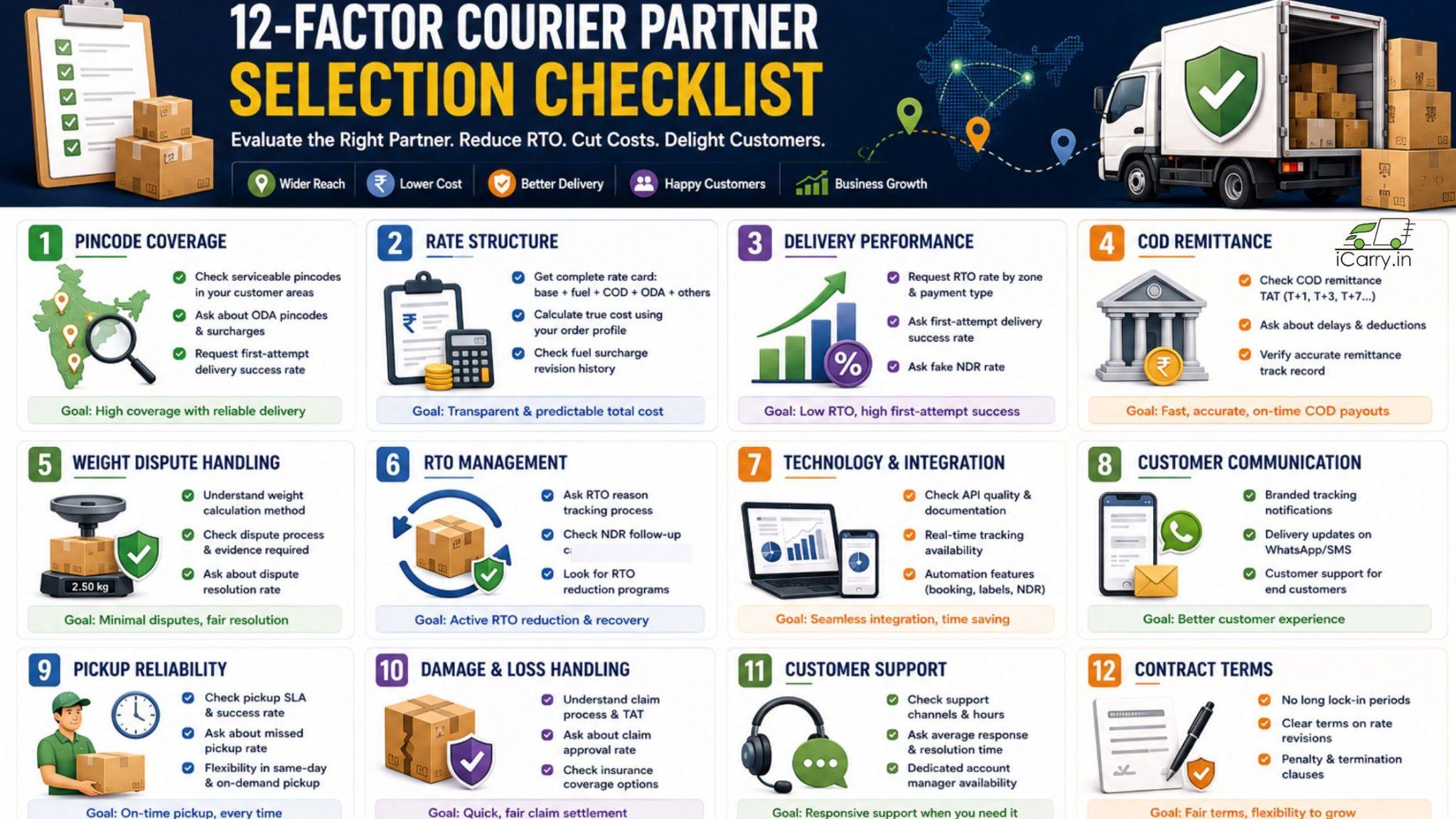
The Complete Courier Selection Scorecard
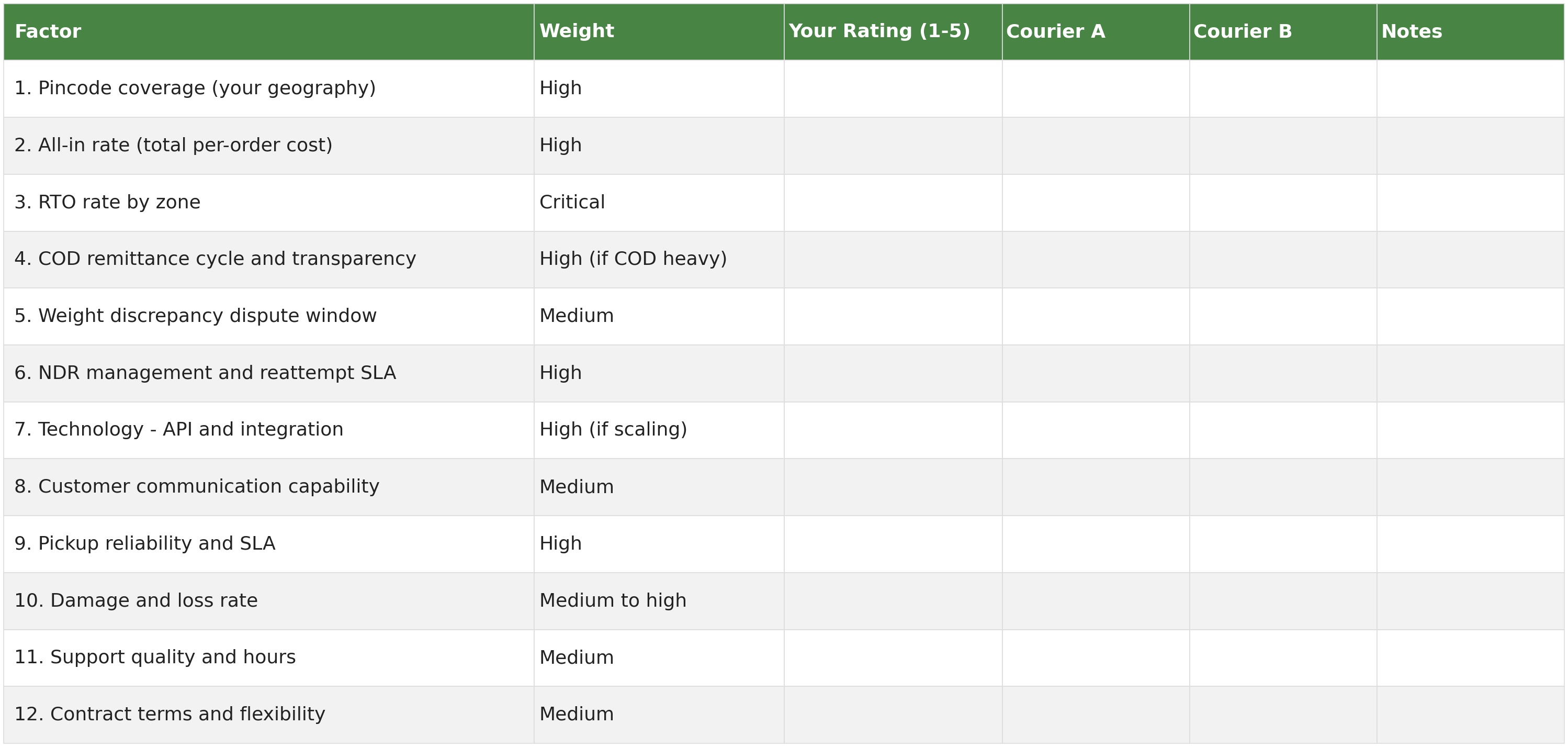
Score each courier 1 to 5 on each factor, weighted by importance for your specific business. The courier with the highest weighted total across all 12 factors - not the lowest headline rate - is the right choice.
Why Most Businesses Evaluate Only 2 of These 12 Factors
Most courier evaluations in India compare rate and transit time claim - factors 2 and a surface version of factor 1. The remaining 10 factors are either not considered or accepted at face value from the courier's marketing materials.
The result is predictable: a courier is selected on rate, operational problems emerge in the first month, and switching costs (retraining dispatch staff, reconfiguring integrations, communicating changes to customers) mean the business absorbs the performance problems for longer than it should before switching.
The 12-factor checklist in this guide takes 3 to 4 additional hours of evaluation effort upfront. That investment prevents months of avoidable operational pain and recoverable cost.
The Case for Multiple Couriers Rather Than One
The most effective courier strategy for most Indian businesses is not finding the single best courier - it is accessing multiple couriers and routing each order to the best available option for that specific destination, product type, and payment method. Multi-courier allocation - directing each order to the courier with the best track record for that pincode - consistently outperforms single-courier dependency on both cost and delivery success rate.
This is what a courier aggregator makes practical: access to multiple courier networks from one account, with rate comparison before every booking and performance data across all couriers from one dashboard.
How iCarry® Addresses All 12 Factors
iCarry® is a courier aggregator that gives Indian businesses access to multiple courier partners from one platform - with the tools to evaluate and act on all 12 checklist factors:
- Choosing the right courier partner is not just about comparing freight rates. It requires continuous visibility into delivery performance, shipping costs, COD cash flow, customer communication, and operational efficiency. iCarry brings these capabilities together on a single platform, helping manufacturers, exporters, wholesalers, retailers, eCommerce brands, and enterprises manage shipping more effectively.
- Pincode Coverage & Courier Selection: Access 29,000+ serviceable pincodes across multiple courier partners. Compare serviceability, estimated delivery timelines, and courier availability by pincode before every shipment, helping you choose the most suitable partner for each order.
- Live Rate Comparison: Compare pre-negotiated shipping rates across multiple courier partners before booking. Transparent, GST-inclusive pricing with no hidden charges helps businesses make cost-effective shipping decisions.
- Performance-Based Courier Selection: Compare courier performance using operational metrics such as delivery success rates, RTO trends, and shipping efficiency to select the best-performing courier for different regions and shipment types.
- RTO Management: Delivery Boost helps reduce COD RTO by proactively contacting customers, auditing suspected fake NDRs, coordinating reattempts in regional languages, and improving successful deliveries.
- COD Remittance & Early COD: Receive free automatic COD remittances with standard T+7 settlements, where payments are automatically transferred seven business days after successful delivery without manual follow-up. Businesses needing quicker cash flow can choose Early COD, with eligible settlements available from T+0 to T+4, depending on the selected plan and shipment eligibility.
- Weight Discrepancy Protection: Upload product images before dispatch and raise weight discrepancy disputes through a dedicated dashboard within the available dispute window, helping recover incorrect courier weight charges more efficiently.
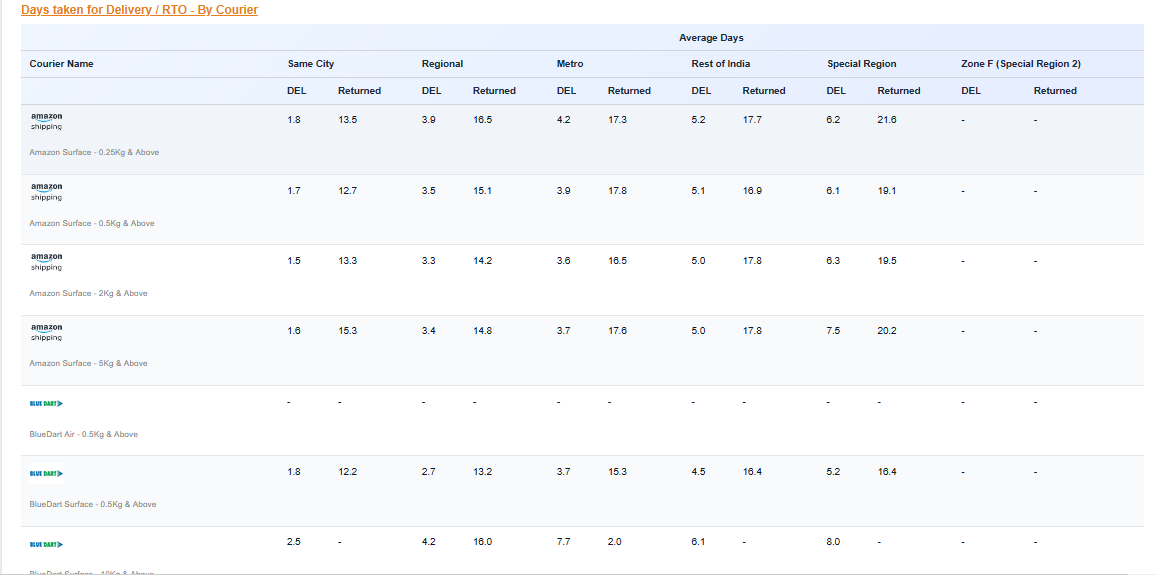
- NDR Management: Receive real-time Non-Delivery Report (NDR) notifications in the My Shipments dashboard, review failure reasons, provide updated delivery instructions, request reattempts, and monitor resolution progress from one place.
- Two-Way WhatsApp Engagement: Communicate with customers through two-way WhatsApp conversations where recipients can confirm deliveries, reschedule shipments, update addresses, or respond directly, while senders maintain complete visibility into every interaction.
- Technology & Integrations: Connect your business using REST APIs, webhooks, and integrations with platforms such as Shopify, WooCommerce, Flipkart, and other supported systems to automate booking, tracking, and shipping workflows.
- Pickup & Shipment Management: Schedule pickups, generate shipping labels, track shipments in real time, and manage multiple courier partners from a single dashboard without maintaining separate courier accounts.
- Dedicated Support: Access customer support from 9:30 AM to 6:30 PM, Monday to Saturday, with defined escalation paths to help resolve shipping, billing, and operational issues promptly.
- Flexible Plans: Start with the free Bronze plan, which includes no monthly subscription fee, no minimum shipment commitment, and no long-term contract, allowing businesses to scale their shipping operations as they grow.
iCarry® serves all Indian businesses - from growing brands to manufacturers, distributors, and large enterprises.
Final Thoughts
Courier partner selection is a business decision, not a procurement exercise. The checklist in this guide exists because the factors that determine operational performance are not visible in a rate card and are rarely discussed during sales conversations.
Evaluate all 12 factors. Prioritize them based on your business requirements, ask for measurable performance data instead of relying on marketing claims, and build a multi-courier strategy from the beginning. No single courier performs best across every route, product category, or customer geography in India's diverse logistics landscape.
Businesses that choose the right logistics approach spend less time resolving delivery issues and more time focusing on growth. Using a courier aggregator such as iCarry® makes this process more practical by bringing multiple courier partners, live rate comparison, performance insights, shipment tracking, COD management, and operational tools together on a single platform, allowing businesses to make informed shipping decisions as they scale.
Frequently Asked Questions (FAQs)
How do I choose the right courier partner for my business in India?
Evaluate across 12 factors: pincode coverage in your customer geography, all-in rate structure (not just headline rate), RTO rate by zone, COD remittance speed, weight discrepancy dispute window, NDR management process, technology and API quality, customer communication capability, pickup reliability, damage and loss rate, support quality, and contract flexibility. Weight each factor by your business priorities.
What is the most important factor in courier selection for Indian businesses?
RTO rate by geography is the most underweighted and most operationally important factor. A courier with a lower headline rate but 8% higher RTO rate on COD orders generates significantly more total cost than a higher-rate courier with better delivery success. At ₹80 round-trip freight on 500 monthly COD orders, an 8% RTO difference costs ₹32,000 per month - far exceeding any rate saving.
Should I use one courier or multiple couriers?
Multiple couriers, routed by pincode performance. No single courier in India is optimal across every geography, product type, and payment method. Using a courier aggregator gives access to multiple networks with rate comparison before every booking and performance data across all couriers from one dashboard.
What questions should I ask a courier before signing a contract?
Request: pincode-level delivery success rate data, RTO rate by zone and payment type, COD remittance cycle and early remittance options, weight discrepancy dispute window and process, NDR reattempt SLA, API documentation and integration options, damage and loss rate by shipment type, support hours and escalation process, and full contract terms including minimum volume, lock-in period, and rate revision notice.
What are the hidden costs to watch for in a courier contract?
Fuel surcharge (10 to 20% of base freight, revised monthly), COD handling fee (₹15 to ₹25 + 1 to 2% of order value), ODA surcharge (₹30 to ₹100 for remote pincodes), weight discrepancy charges (when courier measures higher than declared), and below-minimum volume penalties if applicable.
How does a courier aggregator help with courier selection?
A courier aggregator gives access to multiple courier networks from one account, with live rate comparison before every booking and performance tracking across all couriers from one dashboard. This makes multi-courier routing practical, gives negotiating leverage through aggregated volume, and allows performance-based routing decisions without managing separate courier relationships.
Courier partner selection is a business decision, not a procurement exercise - the factors that determine operational performance are not visible in a rate card and are rarely discussed during sales conversations. Evaluate all 12 factors, prioritize them based on your business requirements, ask for measurable performance data instead of relying on marketing claims, and build a multi-courier strategy from the beginning, since no single courier performs best across every route, product category, or customer geography in India's diverse logistics landscape.