Tracking shows the last update three days ago at a transit hub in Nagpur. The expected delivery was yesterday. The customer is messaging. The courier's customer care line rings without answer. And you have no idea if the parcel is stuck, lost, or delivered without a scan.
A missing shipment is one of the most stressful logistics events a seller faces - and one of the most procedurally confusing. Knowing what to do, in what order, with what evidence, is the difference between recovering the full declared value and absorbing the loss entirely.
In India's courier ecosystem, shipment losses do happen - particularly at high-volume transit hubs where sorting errors occur. Most losses are not outright theft but sorting errors, scan misses, and misrouted parcels that end up at the wrong facility. India's logistics market is projected to reach USD 159.54 billion by FY28 (IBEF), and at that scale, even a small error rate means thousands of parcels affected daily. Understanding how Indian logistics networks operate helps identify whether a shipment is genuinely missing or simply delayed - and shapes the right response at each stage.
What Should You Do When a Courier Shipment Goes Missing?
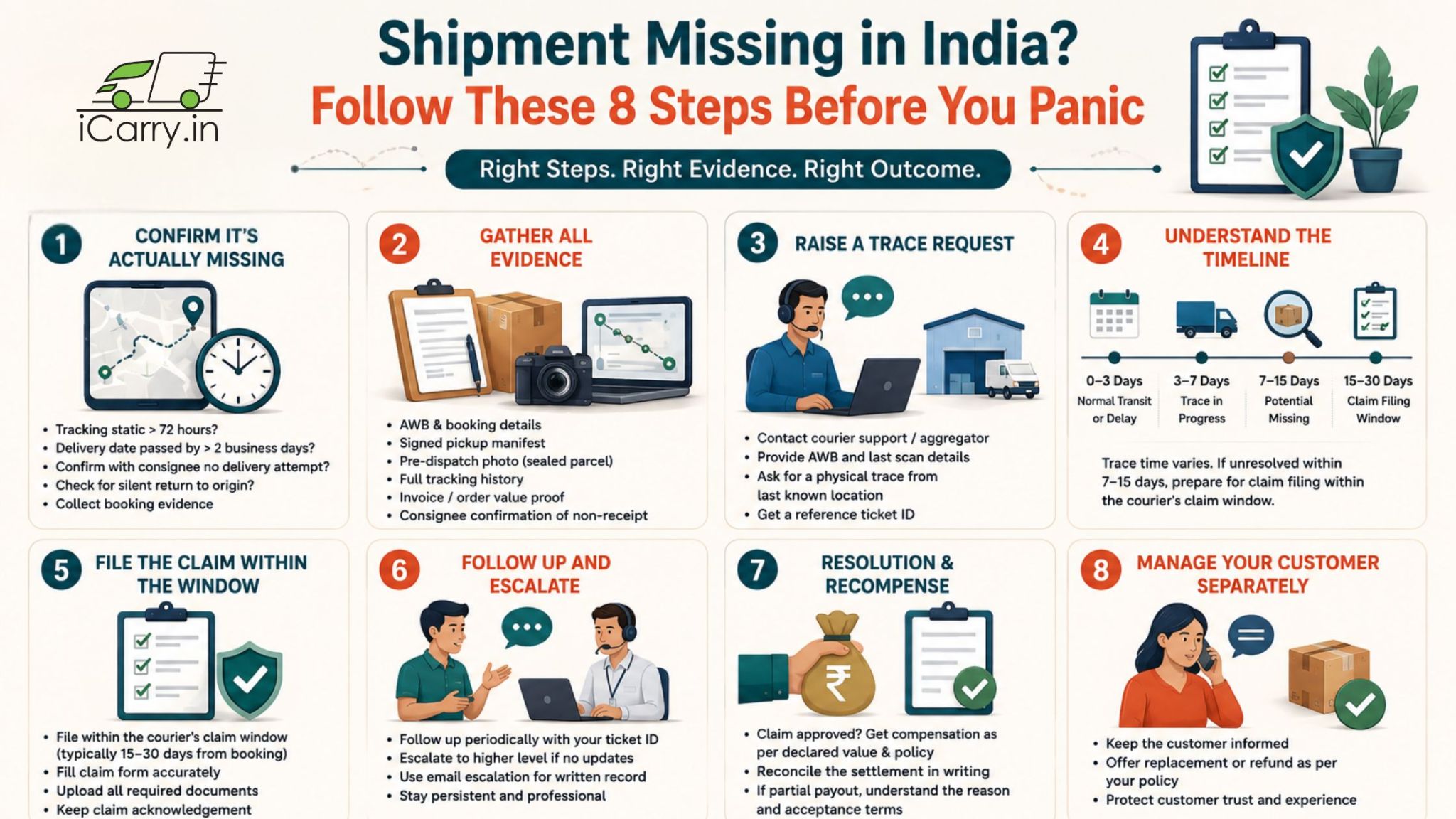
When a courier shipment goes missing in India, first confirm it is actually lost - tracking static for over 72 hours past expected delivery, with no hub scan update - rather than simply delayed. Then gather evidence (signed pickup manifest, pre-dispatch photo, full tracking history), raise a formal trace request with the courier, and file a loss claim within the courier's filing window if the trace does not resolve. Acting on evidence and deadlines, not phone calls alone, is what determines whether you recover the declared value.
How to Tell If Your Shipment Is Actually Missing
- Has tracking been static for more than 72 hours with no hub scan update?
- Has the expected delivery date passed by more than 2 business days?
- Have you confirmed with the consignee that no delivery was attempted at their address?
- Have you checked whether the shipment was silently returned to origin without delivery notification?
- Have you collected all booking evidence - AWB, signed manifest, pre-dispatch photo?
Step 1: Identify the Exact Situation
Scenario A: Tracking Stopped at a Transit Hub
The most common situation. The parcel scanned in at a hub and has not updated since. This is usually a scan miss or sorting backlog - the parcel is physically present but not scanned at the next point. Wait 48 to 72 hours from the last scan before treating this as a confirmed loss. Raise a trace request asking the courier to physically check from the last scanned location.
Scenario B: Marked as Delivered But Customer Denies Receipt
Not a missing shipment - this is a fake delivery claim or misdelivery. Request the Proof of Delivery (POD) immediately. The POD shows the signature, GPS coordinates, and timestamp. If delivery was to the wrong address or shows an unrecognised signature, escalate as a misdelivery claim with the POD as evidence.
Scenario C: No Scan After Pickup
The courier collected the parcel and it never scanned into their system. This is the most serious scenario. Open a trace request immediately with your signed pickup manifest as the primary evidence. Do not wait for additional time to pass.
Step 2: Gather Evidence Before Escalating
A missing shipment claim without documentation recovers nothing. Collect all of the following before raising any formal complaint:
- Booking confirmation: AWB number, booking date, declared value, origin and destination addresses, weight declared at booking
- Signed pickup manifest: The document the courier agent signed when collecting your parcels. This is proof the courier received the shipment from you - without it, the courier can deny ever collecting it
- Pre-dispatch photograph: Photo of the sealed parcel with the shipping label clearly visible. Ideally on a weighing scale showing the weight. Proves the parcel was properly sealed and labelled at handover
- Full tracking history screenshot: Every scan event from pickup to the last known location
- Commercial invoice or order value proof: Evidence of what was inside and its actual value
- Consignee confirmation of non-receipt: Written confirmation via WhatsApp or message that the customer has not received the order
Critical: The courier's liability is capped at your declared value at booking. If you declared ₹500 on a ₹4,000 product, recovery is limited to ₹500. Always declare accurate value and enable declared value coverage for shipments above ₹2,000.
Step 3: Raise a Formal Trace Request
A trace request asks the courier to physically locate your shipment within their network. This is not a loss claim - it can recover a parcel that is merely misrouted or scan-missed.
- Raise a support ticket through your courier aggregator account with the AWB number, last scan location, and expected delivery date
- State clearly: 'No tracking update for [X] days. Last scan at [location and date]. Request physical trace from this facility.'
- Attach signed pickup manifest and pre-dispatch parcel photograph
- Follow up if no response within 24 hours. Escalate to the courier's nodal officer if first-level support is unresponsive
- Request a trace resolution timeline - most couriers commit to 7 to 15 days for trace outcomes
Step 4: Know the Claim Window and File on Time
Every courier has a defined window for filing a loss claim. Filing after this window closes the claim regardless of evidence. This is the most common reason valid claims are rejected.
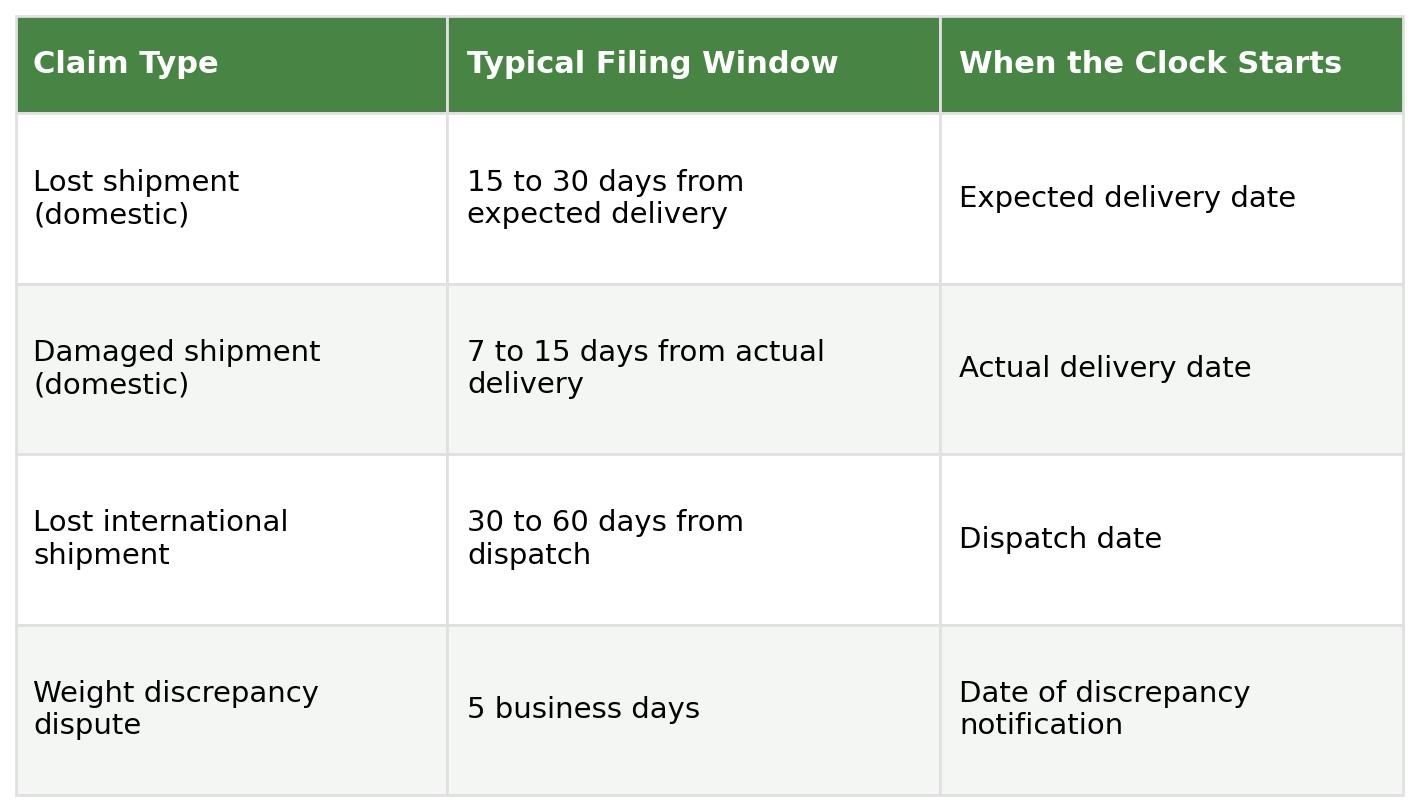
Do not wait. File the trace request immediately and file the formal loss claim as soon as the trace deadline passes without resolution - while still within the claim window.
Step 5: File the Formal Loss Claim
If the trace request does not locate the shipment within the resolution timeline, file a formal loss claim with:
- AWB number and complete booking details
- Signed pickup manifest
- Pre-dispatch parcel photograph with label visible
- Full tracking history showing last scan and no delivery confirmation
- Commercial invoice or order value documentation
- Written consignee confirmation of non-receipt
- Declared value coverage details if coverage was enabled at booking
Claims are typically reviewed in 15 to 45 days. Settlement is made up to the declared value at booking.
Step 6: Manage the Customer Separately From the Claim
A claim takes 30 to 45 days. Your customer cannot wait 45 days. Decide your approach before the claim is resolved.
- Reship immediately: Best for high-value customers. Reship a replacement and recover from the courier claim when it settles. Protects the customer relationship.
- Refund immediately: Process a full refund and pursue the claim as an internal recovery. Appropriate when restocking is not possible.
- Request customer patience (short window only): Only viable if the trace is likely to resolve in 7 to 10 days and the customer explicitly agrees. Do not apply this to new customers or high-value orders.
The courier's internal claim timeline is your business problem. Do not make it the customer's problem.
How to Prevent Shipment Losses - What Actually Works
- Photograph every parcel before handover: The pre-dispatch photo is your most important claim evidence. Make it non-negotiable for every shipment above ₹2,000.
- Always get a signed manifest: The courier agent must sign the manifest at collection. Without it, you cannot prove the courier received the shipment.
- Declare accurate value and enable coverage: The coverage fee on a ₹4,000 shipment is ₹20 to ₹60. The loss on an uncovered missing ₹4,000 shipment is ₹4,000. The math is straightforward.
- Use express couriers for high-value shipments: Fewer handling points means fewer opportunities for misrouting. For premium products, the express premium is worth the reduced loss risk.
- Monitor tracking within the first 48 hours after pickup: A parcel that does not scan within 24 hours of collection is more likely missing than one that scans and then goes quiet. Early detection enables faster trace requests.
How iCarry® Supports Missing Shipment Cases
iCarry® is a courier aggregator that provides centralised tracking and claim management across all courier partners from one platform:
- My Shipments dashboard: All shipments across all couriers in one view. Tracking anomalies - static scans, unexpected locations - are visible immediately without logging into multiple portals
- Support ticket management: Raise and track trace requests and loss claims directly against specific AWBs. All communication is logged and timestamped
- Declared value coverage: Enable at booking - the option is shown transparently before confirmation. Never miss this step on high-value shipments
- Pre-uploaded product images: Upload standard product images in the Products section to enable automatic evidence attachment on claims
- Delivery Boost: Reduces delivery failure risk for high-value shipments through proactive pre-delivery coordination - preventing the failed attempt that starts the loss chain
Free Bronze plan, no minimum volume. Register at iCarry®.
Final Thoughts
A missing shipment is stressful. The instinct is to call the courier repeatedly and wait. The right approach is systematic: identify the exact scenario, gather evidence immediately, raise a trace request with documentation, file within the claim window, and manage the customer independently from the courier's timeline.
The sellers who recover the most from missing shipment claims photograph every parcel before handover, always collect a signed manifest, and declare accurate value with coverage. These habits take two minutes per shipment. The shipment you lose without evidence is the one that teaches you exactly why they matter.
Frequently Asked Questions (FAQs)
What should I do first if my courier shipment goes missing in India?
Check tracking to confirm the last scan location and how long ago it was. If static for more than 72 hours past expected delivery, raise a formal trace request through your courier aggregator with the AWB number, signed pickup manifest, and pre-dispatch parcel photograph attached.
What is the difference between a trace request and a loss claim?
A trace request asks the courier to physically locate the shipment in their network - used when the parcel may be misrouted or scan-missed. A loss claim is filed when the trace fails and the shipment is confirmed lost. Always file the trace request first, then escalate to a loss claim if the trace is unsuccessful within the courier's resolution window.
How long does a courier loss claim take to resolve in India?
Trace requests take 7 to 15 days to resolve. Formal loss claims take 15 to 45 days from filing to settlement. The claim window to file is typically 15 to 30 days from expected delivery for domestic shipments. Filing after this window closes the claim regardless of evidence.
What if I did not take a pre-dispatch photograph?
Without a pre-dispatch photograph, your claim relies entirely on the signed manifest and tracking history. Some claims succeed without photos if the manifest evidence is strong, but recovery is less certain. For all future shipments above ₹2,000, make pre-dispatch photographs a mandatory step before courier handover.
Should I reship or refund the customer while waiting for the claim to settle?
Do not ask the customer to wait 30 to 45 days for claim resolution. For high-value relationships, reship immediately and recover from the claim. For other cases, refund immediately and pursue the claim as internal recovery. The courier's claim timeline is your business problem - the customer's experience should not be held to it.
A missing shipment is stressful. The instinct is to call the courier repeatedly and wait. The right approach is systematic: identify the exact scenario, gather evidence immediately, raise a trace request with documentation, file within the claim window, and manage the customer independently from the courier's timeline. The sellers who recover the most photograph every parcel before handover, always collect a signed manifest, and declare accurate value with coverage.