
Logistics runs on speed. But it also runs on compliance.
The Electronic Logging Device (ELD) mandate is a government regulation requiring commercial vehicles to use electronic systems to automatically record driving hours. Introduced to enforce Hours of Service (HOS) compliance and reduce driver fatigue, the ELD rule has significantly reshaped fleet management and logistics operations worldwide.
This guide explains what the ELD mandate is, who must comply, key rules, exemptions, penalties, and its operational impact on modern logistics companies.
ELD Mandate - Quick Summary
- Enforces Hours of Service (HOS) regulations
- Requires certified Electronic Logging Devices (ELDs) in commercial vehicles
- Replaces paper logbooks with digital logs
- Applies to most interstate trucking operations
- Enables digital roadside inspections
What Is an Electronic Logging Device (ELD)?
An Electronic Logging Device (ELD) is a digital system installed in commercial vehicles that automatically records:
- Driving time
- Engine hours
- Vehicle movement
- Location data
In simple words:
An ELD replaces paper logbooks with automatic, tamper-proof tracking of driver hours.
Its primary goal is road safety through accurate Hours of Service (HOS) tracking.
Why the Electronic Logging Device (ELD) Mandate Was Introduced
Before the implementation of Electronic Logging Devices (ELDs), truck drivers were required to manually record their driving hours in paper logbooks. These manual records were often inaccurate and, in many cases, intentionally manipulated to extend driving hours. This lack of reliable monitoring contributed to driver fatigue, which became a major factor in road accidents involving commercial vehicles.
To address these issues, regulatory authorities introduced the ELD mandate. The goal was to strictly enforce driving-hour limits, reduce accidents caused by driver fatigue, and create a level playing field among transportation companies. By automating driver log tracking and reducing manual intervention, the mandate also improves accountability and transparency across the logistics industry.
Who Must Comply with the ELD Mandate
The ELD mandate primarily applies to commercial motor vehicles and fleets that are required to maintain Hours of Service (HOS) records. This typically includes long-haul trucking operations and interstate freight carriers that operate under federal safety regulations.
However, certain exemptions exist. Short-haul drivers who operate within a limited radius, vehicles manufactured before the year 2000, and some agricultural transport operations may not be required to install ELD devices. These exemptions ensure that smaller or specialized operations are not unnecessarily burdened by the regulation.
ELD Mandate in the United States (FMCSA Rule Overview)
In the United States, the ELD mandate is enforced by the Federal Motor Carrier Safety Administration (FMCSA). The regulation was introduced under the ELD Final Rule and became mandatory in 2017 for most commercial fleets operating in interstate commerce.
The rule requires transport companies to use FMCSA-certified ELD devices that automatically record driving activity by synchronizing with the vehicle's engine. These devices must also allow digital data transfer during roadside inspections and securely retain driver logs for specified periods. By standardizing electronic logging across fleets, the regulation ensures consistent enforcement of Hours of Service rules and improves road safety nationwide.
Key Rules Under the ELD Mandate
The ELD mandate establishes several technical and operational requirements designed to ensure accurate and tamper-proof logging of driver activity. One of the most important requirements is automatic time recording, where ELD devices automatically track driving time along with on-duty and off-duty hours. Although drivers may request edits to logs, these changes are strictly monitored and recorded to prevent manipulation.
Another key requirement is engine integration. ELD devices must connect directly to the vehicle's engine to capture critical operational data such as engine start and stop times, vehicle movement, and mileage. This automatic synchronization prevents drivers from falsifying records and ensures accurate reporting of driving hours.
The regulation also emphasizes real-time data accessibility. Both drivers and enforcement officers can instantly view driver logs, and during inspections the data can be transferred electronically without the need for physical paperwork. This speeds up compliance checks and improves operational efficiency.
Finally, ELD devices must include tamper-resistant technology. They are designed to detect unauthorized modifications, maintain detailed audit trails, and protect data integrity. These safeguards ensure that driver logs remain reliable and verifiable, strengthening compliance across the trucking industry.
To prevent manipulation, ELDs must connect directly to the vehicle engine and follow strict technical specifications for data capture and integrity.
ELD Compliance Requirements (Operational View)
To remain compliant with the Electronic Logging Device (ELD) mandate, fleet operators must follow several operational requirements that ensure accurate monitoring of driver activity and adherence to safety regulations. One of the primary requirements is installing approved ELD devices that meet certification standards set by the Federal Motor Carrier Safety Administration. These devices automatically track driving hours and synchronize with the vehicle's engine to record essential operational data.
In addition to installing certified devices, fleets must properly train drivers and operational staff on how to use ELD systems. This includes understanding how to record duty status, manage electronic logs, and handle inspections. Proper training helps ensure that drivers can operate the devices correctly and remain compliant with regulations during everyday operations.
Fleet operators are also required to maintain and store driver log data for specific periods as mandated by regulation. These records must be easily accessible and organized so they can be reviewed during compliance audits or safety checks. Maintaining accurate digital records plays a critical role in demonstrating regulatory compliance.
Another key responsibility is following Hours of Service (HOS) regulations, which limit how long drivers can operate a vehicle without rest. ELD systems help automate this process by tracking on-duty, off-duty, and driving hours in real time, ensuring drivers do not exceed legal limits.
Finally, fleets must be prepared to respond to roadside inspections digitally. During an inspection, driver logs and compliance data must be transferable electronically to enforcement officers. This digital inspection process improves efficiency, reduces paperwork, and allows authorities to quickly verify compliance with safety regulations.
Compliance is both technical and behavioral - and failures often surface during documentation checks, shipment holds, or delivery rejections similar to challenges in shipping without proper GST documentation.
ELD vs Paper Logbooks: Compliance Comparison
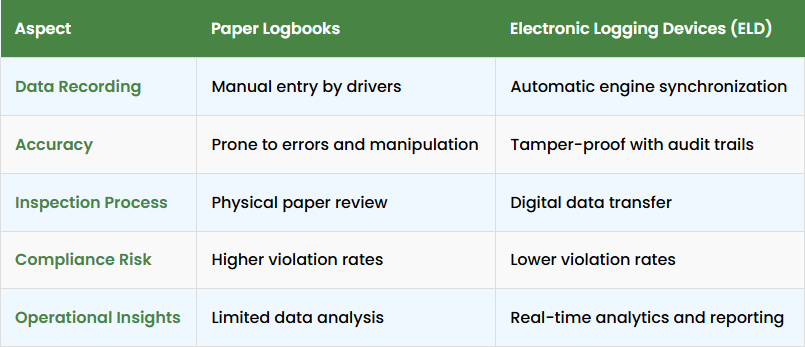
The shift from manual logs to electronic tracking reduces audit risks, improves inspection efficiency, and minimizes compliance violations during roadside checks. ELDs standardize enforcement.
Impact of the Electronic Logging Device (ELD) Mandate on Logistics Industry
1. Improved Road Safety
By enforcing rest periods, ELDs:
- Reduce driver fatigue (Studies from ITF-OECD on road safety have shown that fatigue contributes to a significant percentage of heavy vehicle accidents, making enforced HOS compliance critical for safety improvement.)
- Lower accident risks
Safety is the biggest win.
2. Increased Compliance Costs (Initially)
Initial compliance costs include certified ELD device procurement (solutions like Geotab ELD), engine synchronization setup, installation labor, driver onboarding, and system integration with existing fleet management tools.
However, costs reduce over time through efficiency gains.
3. Operational Discipline
ELDs force:
- Better trip planning
- Realistic delivery schedules
- Route optimization
Poor planning becomes visible quickly, especially when shipment status updates, delivery attempts, and exceptions are not tracked in real time - similar to challenges with NDR data management.
4. Reduced Flexibility for Drivers
Drivers lose the ability to:
- Extend driving hours unofficially
- "Adjust" logs
While this improves safety, it also impacts customer experience when delays, failed delivery attempts, or reattempt gaps aren't handled proactively.
5. Data-Driven Fleet Management
ELDs generate valuable data:
- Driver behavior
- Idle time
- Route efficiency
Smart fleets use ELD data beyond compliance, combining it with delivery success rates, RTO trends, and courier-level performance insights. Modern fleets integrate ELD data with route planning and performance analytics, a practice widely adopted in fleet telematics and optimization systems.
ELD Compliance Checklist for Fleets
Before achieving full compliance with the Electronic Logging Device (ELD) mandate, fleets must ensure that several technical and operational requirements are properly in place. One of the first steps is installing FMCSA-certified ELD devices approved by the Federal Motor Carrier Safety Administration. These devices must be correctly integrated with the vehicle's engine so that driving activity, engine status, and mileage are automatically captured without manual intervention.
Fleets must also verify that engine synchronization is functioning correctly and that driver logs are accurately recorded within the system. Proper training is another essential component of compliance. Drivers must understand how to manage Hours of Service (HOS) logs, review their duty status, and respond to roadside inspections using the ELD interface.
In addition, companies should test the device's digital data transfer capability to ensure logs can be shared electronically with enforcement officers during inspections. Establishing a clear audit log review process is also important, as it allows fleet managers to regularly monitor driver logs and identify potential compliance issues early. Finally, fleets should maintain backup documentation and contingency procedures in case of device malfunction or system outages.
Failure to meet these requirements can lead to serious operational and financial consequences for transportation companies.
ELD Mandate Penalties for Non-Compliance
Non-compliance with ELD regulations can result in significant penalties for fleet operators. Regulatory authorities may issue monetary fines for each violation, which can quickly accumulate if multiple compliance issues are discovered during inspections or audits.
In more serious cases, vehicles may receive out-of-service orders, preventing them from operating until the violation is resolved. Non-compliance can also negatively affect a fleet's Compliance, Safety, and Accountability (CSA) score, which is used by regulators to evaluate the safety performance of transportation companies. A poor CSA score may increase the likelihood of future audits and regulatory scrutiny.
Beyond regulatory penalties, failure to follow ELD rules can create legal and financial risks during accident investigations. If driver logs are found to be inaccurate or manipulated, companies may face legal liability and higher insurance costs. Although penalties vary by jurisdiction, the overall impact can significantly disrupt fleet operations and long-term profitability.
Challenges in Electronic Logging Device (ELD) Implementation
Despite the benefits of ELD technology, many fleets face challenges during implementation. One of the most common issues is driver resistance, as some drivers may initially feel that electronic monitoring reduces their flexibility or autonomy. Proper communication and training are essential to help drivers understand that ELD systems are designed to improve safety and regulatory compliance rather than restrict them.
Another challenge involves training gaps within fleet operations. Without adequate training, drivers and administrative staff may struggle to use the system correctly, leading to compliance errors or operational delays. Technical issues such as software glitches, device malfunctions, or connectivity problems can also occur, particularly in remote areas where network coverage is limited.
Because of these factors, successful ELD adoption requires effective change management. Companies must provide ongoing training, technical support, and clear operational policies to ensure smooth integration of ELD technology into daily fleet operations.
ELD Mandate and Supply Chain Planning
With fixed driving hours:
- Transit times become more predictable
- Delivery promises must be realistic
- Buffer planning improves
ELDs push logistics toward process maturity, improving overall shipping optimization.
ELD Adoption in Emerging Markets
While the mandate originated in developed markets, many countries are:
- Piloting digital log systems
- Exploring telematics-based compliance
- Aligning with global safety standards
Digital compliance is the future.
Many emerging markets are moving toward digital driving logs as part of broader global road safety and transport compliance initiatives.
How This Applies in India
India does not currently have a mandatory Electronic Logging Device (ELD) regulation similar to the United States. However, the logistics industry is gradually moving toward digital monitoring and compliance-driven operations. Fleet operators in India increasingly rely on GPS tracking, telematics systems, and manual log reporting to manage driver activity, but these systems are often fragmented and lack standardized enforcement.
One of the key challenges in India is the absence of strict Hours of Service (HOS) regulations, which leads to inconsistent driving practices, extended working hours, and higher operational risks. Unlike regulated markets, where driving limits are enforced digitally, Indian logistics still depends heavily on operational discipline and internal policies. This makes route planning, delivery commitments, and driver safety more difficult to manage at scale.
At the same time, the push toward digital logistics is accelerating. With the growth of eCommerce, faster delivery expectations, and increasing compliance awareness, Indian businesses are beginning to adopt integrated logistics systems that improve visibility and control. Centralized platforms like iCarry help businesses streamline shipment tracking, monitor courier performance, and bring more structure into logistics operations-even in the absence of strict regulatory frameworks.
As India continues to modernize its transport and logistics infrastructure, digital compliance systems similar to ELDs are likely to become more relevant. Businesses that adopt structured, data-driven logistics practices early will be better positioned to handle future regulatory changes and scale efficiently.

How Logistics Companies Can Maximise ELD Benefits
While many fleets adopt Electronic Logging Devices (ELDs) primarily to meet regulatory requirements, logistics companies can gain significantly more value by using the technology strategically. Instead of treating ELDs as just a compliance tool, companies can integrate ELD data with their Transportation Management System (TMS). This integration allows real-time tracking of driver hours, vehicle activity, and operational performance, helping businesses make better logistics decisions.
Another way to maximise ELD benefits is by using the collected data for route planning and operational analytics. By analyzing driving patterns, idle time, and route efficiency, logistics managers can identify opportunities to optimize delivery routes and reduce unnecessary fuel consumption. ELD data can also help monitor driver performance more fairly by providing objective insights into driving hours, rest breaks, and duty status.
In addition, ELD systems can significantly improve scheduling accuracy. Dispatchers can better plan trips based on available driver hours under Hours of Service regulations, reducing delays and minimizing compliance risks. Ultimately, ELDs are powerful operational tools, but the value they deliver depends on how effectively logistics companies use the data they generate.
ELD Mandate: Cost vs Long-Term Value
Implementing the ELD mandate can initially create financial and operational challenges for logistics companies. In the short term, fleets often face higher costs associated with purchasing ELD devices, installing them across vehicles, and training drivers and staff. Companies may also need to adjust their operational workflows as they transition from manual logging systems to automated digital tracking.
However, the long-term benefits often outweigh these initial challenges. With accurate monitoring of driving hours and improved compliance with safety regulations enforced by the Federal Motor Carrier Safety Administration, fleets can significantly reduce the risk of accidents caused by driver fatigue. Over time, ELD systems also help improve operational efficiency by enabling better route planning, optimized scheduling, and more transparent fleet management.
A strong compliance record can further benefit logistics companies by reducing regulatory scrutiny and strengthening their reputation with partners, regulators, and insurance providers. As a result, although the ELD mandate may appear costly in the beginning, it often delivers substantial operational and financial value in the long run.
Compliance today prevents penalties tomorrow - and strengthens long-term growth when shipping operations are designed for speed, transparency, and reliability through platforms like seamless delivery systems.
Final Thoughts
The Electronic Logging Device (ELD) mandate is not just a regulatory checkbox - it is a structural shift in how logistics operates.
By digitizing driving hours and enforcing Hours of Service (HOS) compliance, ELDs bring accountability into daily fleet operations. What was once dependent on manual logbooks and human judgment is now tracked, recorded, and verifiable in real time.
For logistics companies, this changes more than paperwork. It reshapes planning discipline, delivery commitments, and operational transparency. When driving hours are predictable, transit timelines become realistic. When compliance is embedded into the system, last-minute disruptions reduce.
The real impact of the ELD mandate lies in control. Control over driver schedules. Control over risk exposure. Control over delivery reliability.
Fleets that treat ELDs as a strategic tool - not just a compliance device - gain long-term operational stability. They move from reactive problem-solving to structured execution.
Modern logistics management systems increasingly combine compliance monitoring with broader operational visibility. Platforms such as iCarry enable businesses to connect shipment tracking, courier coordination, and performance insights within a single operational framework, helping teams manage logistics more efficiently while maintaining compliance standards.
Because in modern logistics, compliance is not friction. It is the foundation of scalable, predictable growth.
Frequently Asked Questions (FAQ)
Is the Electronic Logging Device (ELD) mandate mandatory for all trucks?
No. Certain exemptions apply including short-haul operations, older vehicles, and specific agricultural transport scenarios.
What is the difference between ELD and GPS tracking?
ELDs track driving hours for compliance. GPS systems track vehicle location. Many modern fleet telematics systems combine both.
Can drivers edit ELD logs?
Drivers can suggest edits, but all changes are recorded with audit trails.
What happens during an ELD roadside inspection?
Drivers must digitally transfer HOS data to enforcement officers for verification.
Is ELD compliance mandatory in India?
India currently has no such mandate, though the government is exploring digital driver-hour monitoring systems.
The Electronic Logging Device (ELD) mandate enforces Hours of Service compliance by requiring automatic, tamper-proof digital tracking of driving hours—replacing manual logbooks with engine-synchronized systems that improve road safety, reduce driver fatigue, enable real-time compliance checks, and provide data-driven fleet management insights for logistics operations.