A furniture brand receives a COD order for ₹8,499 from a new customer in Patna. No previous order history. No phone verification done before dispatch. The sofa ships. On delivery day, the customer is not home. Second attempt - refused. Third attempt - no answer. RTO triggered. ₹8,499 worth of furniture comes back. Forward and return freight: ₹320. Packaging cost: ₹85. The business absorbed over ₹400 in logistics cost on a product that generated zero revenue.
High-value COD orders amplify every risk that exists in standard COD shipping. The product cost at stake is higher. The RTO freight cost is higher. The cash collection risk at the doorstep is higher. And the probability of a deliberate fraudulent order - placed with no intention to pay - increases at higher order values.
Despite these risks, COD at high order values remains a commercial reality in India. Large portions of Indian consumer demand - Tier 2+ cities alone accounted for around 65% of India's incremental online shoppers in 2025 - particularly outside metro cities - require COD to convert. The answer is not to remove COD but to manage it with a verification and delivery framework that reduces risk to an acceptable level before the order ships.
This guide covers exactly how to do that.
What Is a High-Value COD Order?
A high-value COD order is a cash-on-delivery order where the product cost, freight, and fraud risk are all high enough that a failed delivery causes a meaningful loss - typically ₹1,500 and above, though the right threshold depends on your margin and category. Unlike a low-value COD order, where a refusal or RTO is a minor cost of doing business, a high-value COD failure can wipe out the profit from several successful orders at once.
Things to Check - Before Shipping Any High-Value COD Order
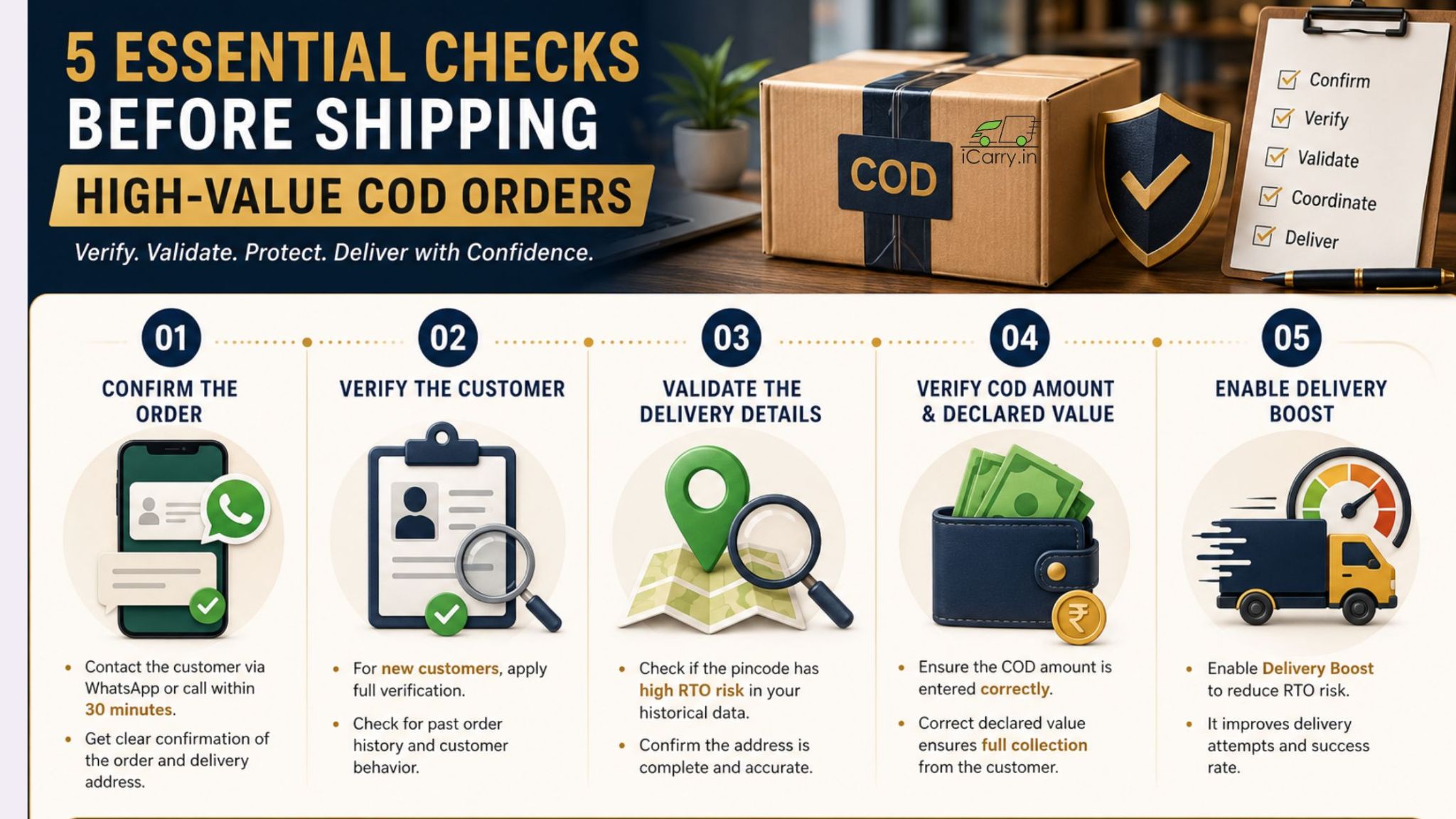
- Has the customer confirmed the order via WhatsApp or phone call within 30 minutes of placement?
- Is this a new customer with no previous order history? If yes, apply full verification protocol.
- Is the delivery pincode a high-RTO pincode based on your historical data?
- Is Delivery Boost enabled for this order?
- Is the declared value entered correctly so the courier collects the full order amount?
- Has the parcel been photographed before sealing - including with the AWB visible?
- Is the e-way bill generated if the order value exceeds ₹50,000?
Why High-Value COD Is Different From Standard COD
Most COD risk frameworks treat all COD orders the same. They should not. The economics of a high-value COD order failure are fundamentally different.
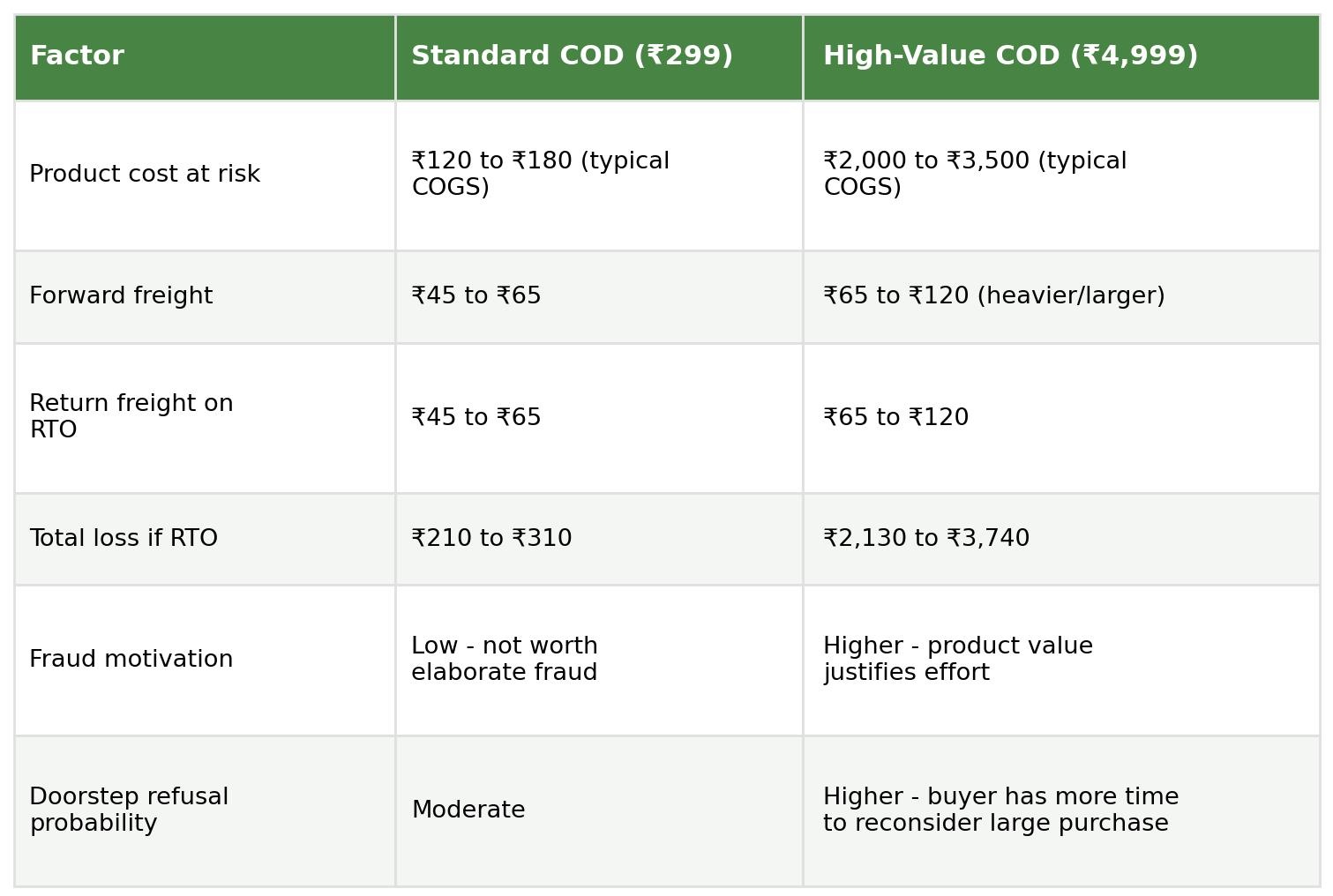
The loss on one high-value COD RTO can exceed the profit from five or ten successfully delivered standard orders. This asymmetry justifies a significantly higher investment in verification and delivery management for high-value COD orders than for standard ones.
Defining High-Value COD - Where to Draw Your Threshold
There is no universal definition of high-value COD. The threshold that triggers your enhanced verification protocol should be set based on your product economics:
- A sensible starting point for most categories: ₹1,500 and above. Orders at this level carry enough product cost at risk to justify the 5 to 10 minutes of verification effort
- For lower-margin categories (FMCG, mass fashion): ₹999 and above may be the right trigger
- For higher-margin categories (premium fashion, electronics, jewellery): ₹2,499 and above is a common threshold
- For very high-value single items (furniture, appliances): Every COD order regardless of value should go through the full verification process
Step 1: Order Confirmation Before Dispatch
The most effective and lowest-cost intervention for high-value COD. A WhatsApp message sent within 30 minutes of order placement asking the customer to confirm.
What to send: 'Hi [Name], your order for [Product] (₹[Amount]) has been received. Our team will prepare and ship it shortly. Please reply YES to confirm you want this order, or NO to cancel. Payment will be collected on delivery.'
Orders that do not receive a confirmation response within 2 to 4 hours should trigger a follow-up call. Orders where the customer explicitly cancels should be cancelled immediately - before packing and before shipping. This single step eliminates a large proportion of impulse COD orders that would have become doorstep refusals.
For very high-value orders above ₹4,999, a phone call confirmation in addition to WhatsApp is worth the 2 to 3 minutes - hear the customer's voice, confirm the delivery address verbally, and answer any product questions that might otherwise surface as a reason to refuse at the door.
Step 2: New Customer Risk Scoring
Apply additional scrutiny to COD orders from customers with no purchase history with your brand. First-time high-value COD buyers carry significantly higher fraud and refusal risk than returning customers.
For new customers placing high-value COD orders, check:
- Address completeness: Is the delivery address complete with door number, building name, and pincode? Incomplete addresses from new customers are a risk signal
- Pincode history: Is the delivery pincode one that has generated high RTO rates on your previous orders? Most courier aggregator dashboards allow pincode-level RTO analysis
- Phone number consistency: Does the phone number provided match the number on the order? Multiple orders from the same phone number with different names or addresses can indicate fraudulent ordering patterns
- Order pattern: Multiple high-value COD orders placed simultaneously or in rapid succession from the same region are a fraud signal worth investigating before dispatch
Step 3: Address Quality Validation
Before any high-value COD order ships, run the delivery address through address quality validation. An incomplete or incorrect address on a high-value COD order leads to a failed delivery, multiple reattempts, and ultimately an RTO with full product cost and double freight absorbed.
iCarry®'s Address Quality Scoring evaluates every delivery address before dispatch and flags incomplete or high-risk entries. For high-value COD orders specifically, this flag should trigger a manual review and a call to the customer to get the complete address before sealing and shipping.
Step 4: Verify Declared COD Amount
A mistake that happens frequently at scale: the declared COD amount at booking does not match the order value. The courier collects whatever amount is declared. If ₹2,499 is declared on a ₹4,999 order, the courier collects ₹2,499 and remits ₹2,499. The remaining ₹2,500 is unrecoverable.
For high-value COD orders, verify the declared COD amount at booking matches the exact order amount including any applicable shipping charges that the customer is paying. Make this a checklist item - not an assumption.
Step 5: Use Delivery Boost for Active Delivery Coordination
Standard courier delivery operates with limited pre-delivery customer contact. The delivery executive arrives at the address and either delivers or files an NDR. For high-value COD orders, this passive approach is insufficient.
iCarry®'s Delivery Boost assigns trained agents who:
- Call the customer before delivery to confirm they will be available and ready with the exact payment amount
- Confirm the delivery address, floor, and access details with the customer in their regional language
- Alert the seller if the customer expresses hesitation or requests cancellation - allowing the seller to intervene before the courier completes the delivery attempt
- Audit any subsequent NDR claims and open tickets for suspected fake non-deliveries
- Upload call recordings as evidence for courier escalations on high-value shipments
Step 6: Two-Way WhatsApp Communication at the Delivery Stage
Even with Delivery Boost active, some customers need direct communication flexibility - they need to reschedule, they realise they will not be home, they want to give the delivery executive specific access instructions.
iCarry®'s two-way WhatsApp engagement enables exactly this. When a high-value COD customer receives a delivery update, they can reply directly to:
- Reschedule delivery to a time when they will have the exact cash amount ready
- Update a specific address detail - flat number, floor, building entrance
- Ask the delivery executive to call before arriving so they can come down to collect
- Flag that they need a few hours' notice before the delivery
iCarry®'s coordination team manages all of these responses on the seller's behalf. Every conversation is logged and visible to the seller. For high-value orders, this visibility matters - the seller knows what has been communicated to the customer and what to expect.
Step 7: OTP Verified Delivery for High-Value Prepaid Conversions
For customers who place a high-value COD order and are then converted to prepaid through your WhatsApp confirmation step, OTP Verified Delivery provides an additional layer of delivery accountability.
Available for shipments through iCarry®, OTP Verified Delivery requires the consignee to enter a one-time password before the courier can mark the delivery as complete. This eliminates fake delivery claims - a common dispute on high-value orders where the customer claims non-receipt after the courier has marked it as delivered.
Managing High-Value COD RTO When It Happens
Despite all preventive measures, some high-value COD orders will RTO. The protocol when this happens:
- Inspect immediately on return: High-value products that return must be inspected the day they arrive. Assess condition and determine whether the product can be relisted, needs refurbishment, or is damaged - see How to Handle Damaged Shipments in India for the full claims process if the product is damaged in transit
- Identify the RTO cause: Was it customer unavailable (repeated)? Address issue? Refused? The cause determines whether a reattempt or a cancel-and-restock is the right response
- Restock quickly: Every day a high-value product sits as returned inventory is a day it is not generating revenue. Relist or restock within 24 hours of return arrival and inspection
- Flag the customer: If a customer refuses a high-value COD order without a legitimate reason, flag their account to require prepaid payment on future orders
When to Decline High-Value COD Orders
Some high-value COD orders should be declined outright rather than managed through a verification framework. Decline when:
- The customer has a previous RTO on a high-value order with your brand
- Multiple high-value orders have been placed from the same number or address pattern without any previous successful delivery
- The order value exceeds a threshold where COD collection risk is genuinely unacceptable for your product category (common for furniture, appliances above ₹15,000)
- The delivery pincode has a greater than 40% RTO rate on your historical COD data
Declining COD is a legitimate business decision. It is better to lose a sale than to absorb a ₹5,000+ loss on a fraudulent or high-risk order. Offer prepaid as the alternative with a visible incentive - a ₹100 to ₹200 prepaid discount often converts the genuine buyer while deterring the fraudulent one.
How iCarry® Supports High-Value COD Operations
iCarry® is a courier aggregator that provides Indian businesses with the specific tools needed to manage high-value COD orders profitably:
- Delivery Boost: Pre-delivery customer contact, NDR auditing, fake delivery investigation - specifically designed for high-risk COD orders
- Two-way WhatsApp engagement: Customer can reschedule, update address, or coordinate delivery timing directly. Full conversation visibility for the seller
- Address Quality Scoring: Pre-dispatch address validation to catch incomplete or high-risk addresses before a high-value product ships
- OTP Verified Delivery: For converted prepaid orders, eliminates fake delivery claims on high-value shipments
- COD remittance: Automatic daily T+7 settlement. For high-value order volumes, early remittance (T+0 to T+4) improves working capital position on COD collections
- My Shipments dashboard: Monitor all high-value COD orders in one view - identify those approaching delivery, those with NDRs, and those at risk of RTO
Watch Overview of My Account > My Shipments to see how active COD shipments and NDR statuses are tracked in iCarry®.
Final Thoughts
High-value COD orders are not the enemy. They are a commercial necessity for reaching buyers who need the confidence of paying on delivery. The businesses that manage them well capture this demand while protecting their margins. The ones that treat high-value COD the same as standard COD absorb avoidable losses at every scale.
The verification framework is not complex: confirm before dispatch, validate the address, verify the COD amount, activate Delivery Boost, use two-way whatsapp engagement at delivery. Each step takes minutes. Together they reduce high-value COD RTO to a manageable level while keeping the channel open for genuine buyers who need it.
Build the framework before the losses force you to.
Frequently Asked Questions (FAQs)
What is considered a high-value COD order in India?
The threshold varies by category and margin structure. A sensible starting point for most sellers is ₹1,500 and above for enhanced verification. For furniture, appliances, and premium products, every COD order regardless of value should go through a full verification protocol given the product cost at risk.
How do I confirm a COD order before dispatch?
Send a WhatsApp message within 30 minutes of order placement asking the customer to reply YES to confirm. For orders above ₹4,999, follow up with a phone call. Orders that do not confirm within 2 to 4 hours should be called. Orders where the customer cancels should be cancelled before packing. This eliminates most impulse COD orders that would have become doorstep refusals.
What is Delivery Boost and why use it for high-value COD?
Delivery Boost is an iCarry® service where trained agents call customers before delivery, confirm availability and payment readiness, and audit any subsequent NDR claims. For high-value COD orders, Delivery Boost is available at a nominal cost, helping businesses reduce the risk of costly RTOs and improve successful deliveries.
What should I do when a high-value COD order is refused at the door?
Call the customer immediately to understand why they refused. If it was a mistake, request reattempt with the courier. If the customer genuinely does not want the product, accept the RTO and process the return. Flag the customer's account to require prepaid payment on future orders. Inspect the returned product the day it arrives and relist within 24 hours.
Should I offer COD above a certain order value?
This depends on your category and margin. For furniture and appliances above ₹15,000, requiring prepaid is a legitimate policy that many established brands use. For fashion and lifestyle products, a COD minimum order value (e.g. no COD above ₹9,999) combined with a prepaid discount often works better. Let your historical RTO data by order value guide the decision.
How does OTP Verified Delivery protect against fraud on high-value orders?
OTP Verified Delivery (available on iCarry® requires the consignee to enter a one-time password before the courier can mark the shipment as delivered. This creates an irrefutable delivery record and eliminates claims of non-receipt on high-value prepaid orders - the most common dispute type on premium products.
High-value COD orders are not the enemy - they are a commercial necessity for reaching buyers who need the confidence of paying on delivery. The verification framework is not complex: confirm before dispatch, validate the address, verify the COD amount, activate Delivery Boost, use two-way WhatsApp engagement at delivery. Each step takes minutes. Together they reduce high-value COD RTO to a manageable level while keeping the channel open for genuine buyers who need it.