
A handmade brass necklace set takes three days to craft. It ships in the wrong box, gets scratched in transit, and the customer posts an unboxing video of a tarnished, tangled piece that looks nothing like the listing photo. One bad delivery. One negative review. One refund that costs more than the product margin.
Jewellery is one of the most rewarding categories to sell in India - high perceived value, strong domestic and international demand, and a customer who cares deeply about what the product looks like when it arrives. It is also one of the most unforgiving categories to ship poorly. The margin between a delightful unboxing and a disappointed refund request is entirely determined by how well the product was packaged, insured, and delivered.
India's jewellery market spans a vast range - from fashion and imitation jewellery sold at ₹299 to handcrafted silver and metal artisan pieces at ₹20,000 and above. This diverse market is worth an estimated USD 85 billion and is projected to reach USD 130 billion by 2030 (IBEF), growing across domestic retail, marketplace selling, D2C brands, and international exports. Each price point has different packaging, insurance, and logistics requirements - and getting the right setup for your specific product is what this guide covers.
What Is Jewellery Shipping? Key Requirements
Jewellery shipping means protecting pieces with a high value-to-weight ratio against scratching, tarnish, and stone loss across multiple handling points, while insuring against loss or damage that standard courier liability does not cover. It also means verifying delivery with tools like OTP Verified Delivery for high-value orders, and - for international shipments - declaring the correct HS code and accurate value on customs paperwork.
How to Check You're Ready to Ship Jewellery?
- Is the piece individually packaged in a protective pouch or box before outer packaging?
- Have you photographed the jewellery before sealing - clearly showing its condition?
- For pieces above ₹2,000, have you declared the correct value and enabled insurance?
- Have you enabled OTP Verified Delivery for high-value prepaid orders?
- For multi-piece orders, is each piece individually wrapped to prevent scratching or tangling?
- For international orders, do you have the correct HS code and commercial invoice prepared?
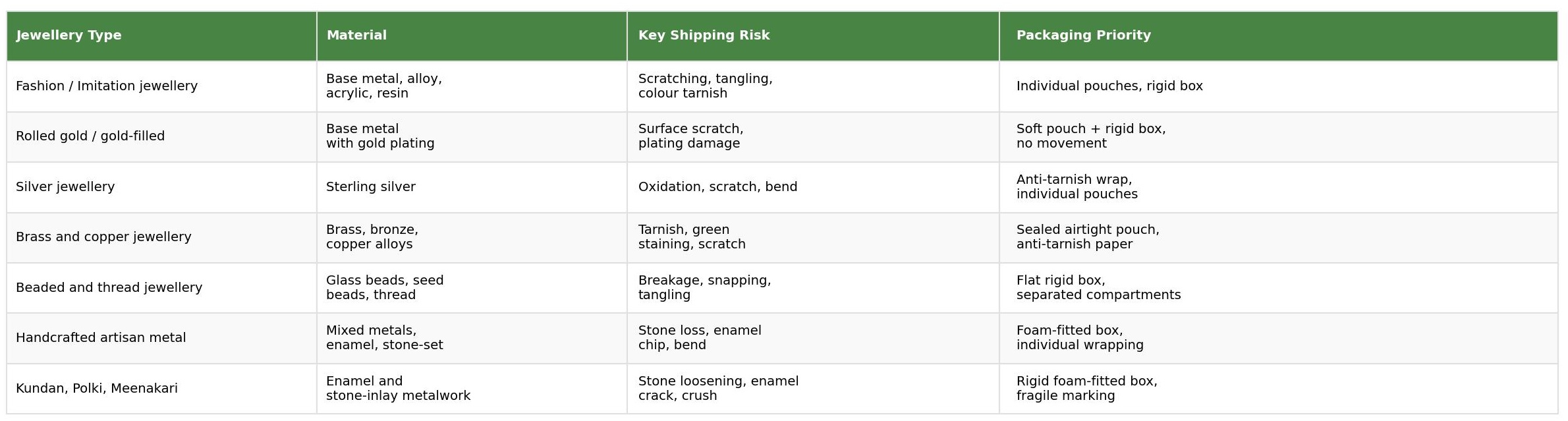
Jewellery Types and Their Specific Shipping Requirements
Packaging Jewellery for Safe Domestic Delivery in India
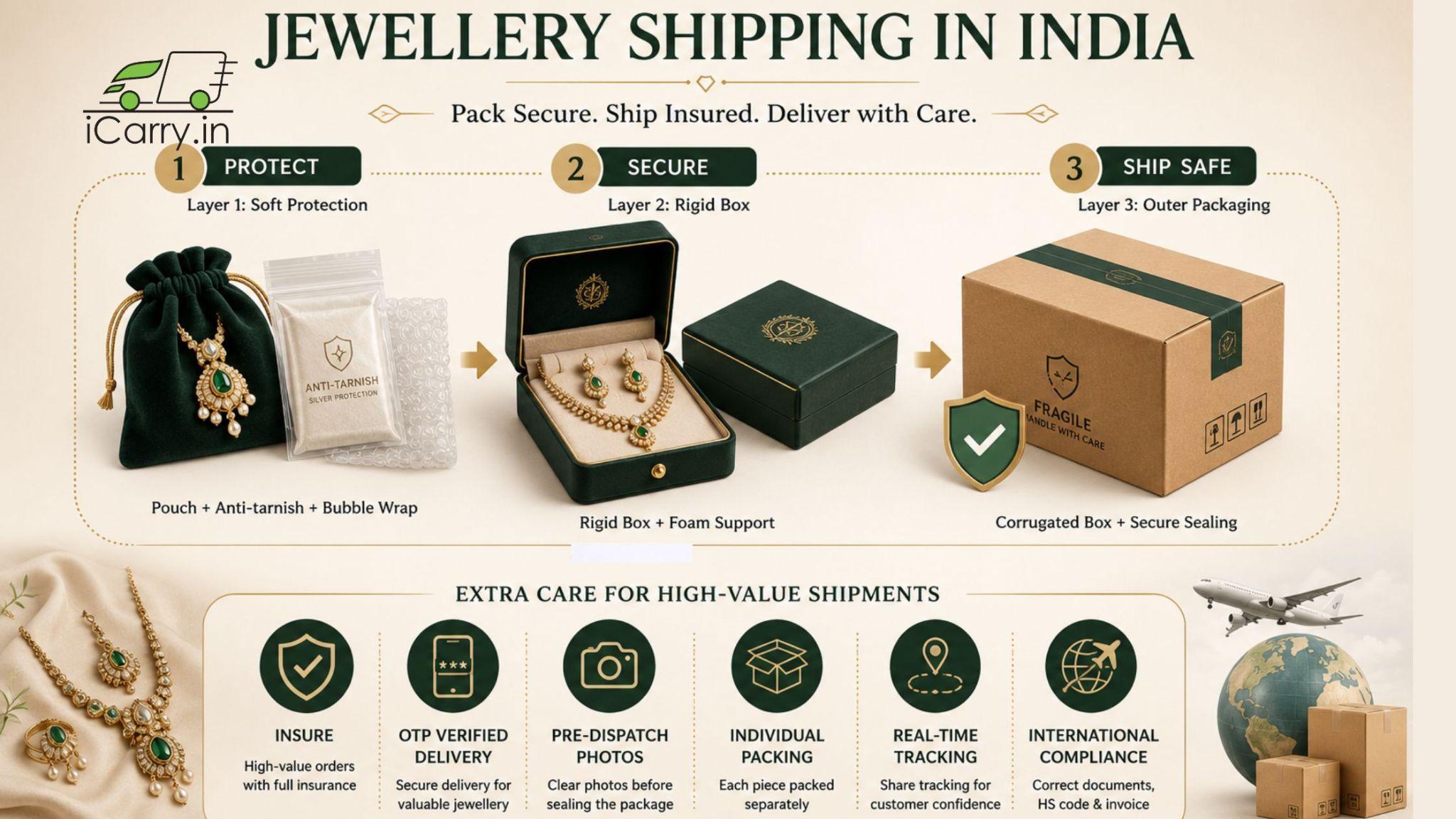
Jewellery shipments travel through 4 to 6 handling points between dispatch and delivery. Each handling point is an opportunity for a catch, a crush, or a scratch. The packaging must protect against all three - and look beautiful when the customer opens it.
Layer 1 - Primary Product Protection
Every piece individually wrapped or pouched before anything else:
Soft pouches: Velvet or microfibre drawstring pouches for fashion and imitation jewellery. Inexpensive, protective, and add perceived value at unboxing. Prevents scratch on other pieces in the same parcel
Anti-tarnish pouches: For silver, brass, and copper jewellery. These zip-seal bags contain anti-tarnish compounds that slow oxidation during transit and storage. Available from packaging suppliers across India
Bubble wrap for delicate pieces: Stone-set, enamel, or kundan pieces need individual bubble wrap before the pouch. Any piece where a stone could loosen or enamel could chip needs the extra impact cushion
Layer 2 - Rigid Inner Box
A soft pouch inside a poly mailer is not sufficient for jewellery. The rigid box is what protects against the compression and impact that crushes pieces during sorting and vehicle transport.
Small jewellery boxes (5x5x3 cm to 10x10x5 cm depending on piece) for individual items or sets
Foam insert inside the box - custom-cut or stock foam - prevents movement inside the box
For premium brands, branded tissue inside the box with logo sticker seal elevates unboxing experience significantly
Multiple pieces in one order: individual pouches inside a shared box with foam dividers separating each piece
Layer 3 - Outer Shipping Packaging
The outer packaging is what the courier handles, drops, stacks, and squeezes. It must be structurally independent of the inner box.
Rigid mailer or small corrugated box: For most jewellery shipments. Never use a standard poly mailer for any jewellery above ₹500 - poly mailers offer zero crush or impact protection
Size it right: The outer box should fit snugly around the inner jewellery box with 2 to 3 cm of void fill padding around all sides. Too tight risks crushing the inner box; too loose allows the inner box to shift
Seal completely: All seams taped. A jewellery parcel that opens in transit is a complete loss - the pieces scatter and are irretrievable
Packaging for High-Value Artisan and Handcrafted Pieces
For jewellery priced above ₹2,000 per piece - handcrafted sets, Kundan work, stone-set artisan pieces - standard pouches and boxes are insufficient:
Custom foam-fitted insert cut to the exact shape of the piece - prevents any movement even under significant external pressure
Rigid presentation box with magnetic closure - protects and presents simultaneously
Outer corrugated box one size larger than the presentation box with full void fill on all sides
FRAGILE and DO NOT CRUSH markings on all outer faces
Photograph the piece in its packaging at each layer before sealing - this documentation is essential for insurance claims
Insurance for Jewellery Shipments
Jewellery has a high value-to-weight ratio. A 50g piece of silver jewellery may be worth ₹8,000. Standard courier liability at ₹50 to ₹100 per kg means the courier's maximum liability for a lost or damaged 50g parcel is ₹2.50 to ₹5 - a fraction of the product value.
For any jewellery shipment above ₹1,000 in declared value, specific shipment insurance is strongly recommended:
Declared value coverage through the courier: Most couriers offer declared value coverage at booking for an additional fee - typically 0.5 to 1.5% of declared value. This caps the courier's liability at the declared value if the shipment is lost or damaged
Third-party cargo insurance: For very high-value pieces, a dedicated cargo insurance policy through an insurer provides broader coverage than courier-declared value programs
Pre-dispatch documentation: Photograph the piece, the packaging layers, and the sealed parcel on a weighing scale with the AWB visible before handover. Without this, no insurance claim stands
Key principle: Declare the actual value - not a lower number to avoid insurance premium. Under-declaration means the insurance payout is proportionally reduced if the declared value is discovered to be lower than the actual value during a claim.
OTP Verified Delivery - Essential for High-Value Jewellery
For prepaid jewellery orders above ₹2,000, OTP Verified Delivery is one of the most important features a jewellery business can enable.
When OTP Verified Delivery is active, the delivery executive cannot mark a shipment as delivered until the consignee enters a one-time password sent to their registered mobile number. This means:
No fake delivery claims - the courier cannot mark a high-value jewellery parcel as delivered without the customer being physically present to enter the OTP
Irrefutable delivery record - the OTP entry timestamp and registered number create a clear audit trail for any subsequent dispute
Reduced customer complaints about missing jewellery orders - a common problem at high value points
Available through iCarry® at a nominal cost for Prepaid orders. For jewellery businesses shipping pieces above ₹2,000 on a regular basis, this is a significant dispute prevention tool. Watch Overview of My Account > My Shipments to see how Delivery status appears in the iCarry® dashboard.
Delivery Boost and Two-Way WhatsApp Engagement for Jewellery COD Orders
COD remains common in the fashion and imitation jewellery category - particularly for orders in the ₹500 to ₹2,500 range from Tier 2 and Tier 3 customers. The challenges are doorstep refusals (impulse buyers changing their mind) and fake NDRs (delivery executives not attempting delivery on orders with no high-visibility accountability).
Delivery Boost: iCarry®'s Delivery Boost agents call COD jewellery customers before delivery, confirm their availability, and follow up on NDR claims. For a jewellery brand with high COD volume in smaller cities, this directly reduces the RTO rate that makes COD unprofitable in this category.
Two-way WhatsApp engagement: Customers receive a delivery update they can reply to - to confirm availability, update a building name or floor number, or request a specific delivery time. iCarry®'s support team manages these responses on the seller's behalf with full transparency to the seller. For jewellery customers who have been waiting for a special piece, this communication builds anticipation rather than anxiety.
Preventing and Managing Jewellery Returns
Jewellery returns are expensive and operationally complex. A returned piece arrives with unclear condition - possibly scratched, possibly missing stones, possibly in the original pouch or not. The returns inspection process for jewellery must be more rigorous than for apparel or electronics.
Prevention
Accurate listings: Size of the piece in centimetres (not just 'small/medium/large'), weight in grams, metal composition, plating type (rolled gold vs gold plated vs brass), and stone type. Customers who receive exactly what the listing described do not return
Unboxing video policy: For orders above ₹1,000, include a printed note in the parcel asking the customer to record an unboxing video before removing the piece from its packaging. This is your evidence if a customer later claims a piece arrived with a missing stone or damaged enamel
Real colour photography: Brass jewellery photographed under studio lighting often looks like gold-coloured metal. Customers who expect a gold look and receive warm brass may return. Accurate colour representation in multiple lighting conditions prevents this
Returns Inspection
Every returned jewellery piece inspected against the pre-dispatch photograph before any other action
Check: all stones present and intact, clasps functional, no additional scratches beyond pre-dispatch condition, all enamel sections intact
Grade A - matches pre-dispatch condition: restock as new after cleaning and re-pouching
Grade B - minor new marks: relist at clearance price with accurate condition description
Grade C - significant damage, missing stones, broken: write off or repair before any relisting
Shipping Jewellery Internationally From India
Indian jewellery - silver, brass, imitation, handcrafted artisan pieces - has strong international demand, particularly from the Indian diaspora in UK, USA, UAE, Australia, and Canada, and from global buyers of ethnic and artisan jewellery on platforms like Etsy.
HS Codes for International Jewellery Exports

Customs Documentation for Jewellery Exports
Every international jewellery shipment from India requires:
Commercial invoice with product description, HS code, declared value per piece, total value, and Incoterms
Packing list with weight and dimensions per package
IEC (Import Export Code) for commercial exports
Certificate of origin where applicable for preferential duty treatment
Declaring value accurately is critical for jewellery internationally. Many customs authorities cross-reference declared value against the selling platform price. Under-declared jewellery is one of the categories customs authorities most commonly investigate. Declare the actual Etsy, website, or invoice price - nothing less.
Compare international rates for your specific jewellery parcel weight and destination.
Cost Structure for Jewellery Shipping in India

For jewellery businesses shipping at volume, hidden shipping charges - particularly weight discrepancy charges on declared weight vs actual packaged weight - are worth monitoring. Always weigh the sealed jewellery parcel including box and void fill before booking.
How iCarry® Supports Jewellery Businesses
iCarry® is a courier aggregator that supports Indian jewellery businesses - from fashion jewellery brands to handcrafted artisan labels to B2B wholesale distributors - with multi-courier access and delivery accountability tools:
Multiple courier partners: Blue Dart for high-value express, Delhivery for standard surface and OTP Verified Delivery, Xpressbees, Amazon shipping and Ekart for COD-heavy orders to Tier 2 cities
OTP Verified Delivery: Available for Prepaid orders. Eliminates fake delivery claims on high-value jewellery shipments
Delivery Boost: For COD jewellery orders in high-RTO pincodes - agents call customers before delivery and audit fake NDRs
Two-way WhatsApp engagement: Customers can reschedule, update delivery address details, or confirm availability. Full conversation visibility for the seller
Weight discrepancy dispute management: Pre-upload product images per SKU to enable automatic dispute triggering when couriers raise discrepancy charges
Free plan: No monthly fee, no minimum volume. A jewellery brand shipping 20 orders a week accesses the same multi-courier rates and OTP Verified Delivery tools as a large distributor
Final Thoughts
Jewellery is a category where the product and the delivery experience are inseparable. A piece that took days to craft and sells for ₹3,000 should not arrive in a crushed poly mailer inside a damaged box. The packaging investment - an anti-tarnish pouch, a rigid jewellery box, a corrugated outer - costs ₹12 to ₹18 and protects the entire margin on that order.
For high-value pieces, OTP Verified Delivery and insurance together are non-negotiable. They protect against the two most common losses in high-value jewellery shipping - fake delivery claims and uninsured courier liability.
For COD jewellery orders, Delivery Boost and COD confirmation before dispatch address the two most common causes of avoidable RTO. A customer who confirmed their order before dispatch and received a WhatsApp update before delivery is significantly less likely to refuse at the door.
iCarry® gives jewellery businesses the courier access, OTP Verified Delivery, Delivery Boost, Whatsapp engagement and delivery coordination tools to ship every piece safely and profitably. Start shipping by registering free at iCarry.
Frequently Asked Questions (FAQs)
How should jewellery be packaged for courier delivery in India?
Three layers: individual pouch or anti-tarnish bag per piece, rigid jewellery box with foam insert as the second layer, and corrugated outer packaging with void fill. Never use poly mailers for jewellery. For stone-set or enamel pieces, add bubble wrap between the piece and the pouch.
How do I insure a high-value jewellery shipment?
At booking, declare the actual value of the jewellery and select the courier's declared value coverage option. This caps the courier's liability at the declared value rather than their standard per-kg limit. For pieces above ₹5,000, consider Photograph the piece and sealed parcel before handover as evidence.
What is OTP Verified Delivery and should jewellery sellers use it?
OTP Verified Delivery requires the consignee to enter a one-time password before the courier can mark the shipment as delivered. For prepaid jewellery orders above ₹2,000, it is strongly recommended - it eliminates fake delivery claims and creates an irrefutable delivery record. Available through iCarry® at a nominal cost.
What HS code should I use for shipping imitation jewellery internationally?
Imitation and fashion jewellery made from base metal uses HS code 7117. Silver jewellery is 7113.11. Rolled gold and gold-filled jewellery is 7113.19. Brass and copper jewellery generally falls under 7117.19. Always verify the specific HS code for your exact product material and construction before any international shipment.
How do I reduce RTO on COD jewellery orders?
Confirm every COD jewellery order via WhatsApp within 30 minutes of placement. Enable Delivery Boost for high-risk COD orders in Tier 2 and Tier 3 pincodes. Use two-way WhatsApp engagement for delivery coordination. Track RTO rate by courier and pincode monthly and reroute volume away from consistently high-RTO combinations.
What should I do if a customer claims their jewellery arrived damaged?
Request the customer's unboxing video immediately - this shows the packaging condition at the moment of opening. Cross-reference against your pre-dispatch photograph of the sealed parcel. If outer packaging damage is visible in the unboxing video, the damage occurred in transit and the courier's declared value insurance applies. Without pre-dispatch photographs, all damage claims are very difficult to substantiate.
Jewellery is a category where the product and the delivery experience are inseparable - the packaging investment of ₹12 to ₹18 for an anti-tarnish pouch, rigid box, and corrugated outer protects the entire margin on an order, while OTP Verified Delivery and insurance together are non-negotiable for high-value pieces, protecting against fake delivery claims and uninsured courier liability. For COD jewellery orders, Delivery Boost and COD confirmation before dispatch address the two most common causes of avoidable RTO, making a customer significantly less likely to refuse at the door.