You built a product your customers love. Your website converts well. Orders are coming in consistently. But at the end of the month, when you do the maths, the number staring back at you is uncomfortably small.
For most Indian D2C brands, the gap between gross revenue and net profit runs directly through logistics. Shipping is not just a line item - it is often the difference between a business that scales and one that slowly bleeds out on every order.
The problem is rarely obvious. Per-shipment rates look reasonable. The courier seems to be delivering most orders. But underneath the surface, RTO charges are compounding, weight discrepancies are being absorbed without dispute, COD float is locking up working capital, and the blended cost per delivered order is far higher than the headline rate suggests.
Research consistently shows for many Indian D2C brands, logistics is one of the largest controllable expenses after customer acquisition and inventory.
What Is Shipping Margin for D2C Brands?
Shipping margin for a D2C brand is the difference between what a customer pays for delivery and the true cost of fulfilling that order - including forward freight, RTO charges, weight discrepancy fees, and COD float. Most Indian D2C brands underestimate this cost because they track per-shipment rate rather than cost per delivered order. The gap between these two numbers is where most margin is silently lost.
This breakdown covers the 6 biggest shipping margin killers for Indian D2C brands, how to calculate your true shipping margin, and the specific steps you can take to improve it - without sacrificing delivery speed or customer experience.
Quick Checklist - Are These Margin Leaks Affecting Your Business?
Run through these 7 questions honestly before reading further:
- Do you know your exact RTO rate by courier and pincode - not just an overall percentage?
- Are you disputing weight discrepancy charges within the 5-day window every time they arise?
- Are you comparing courier rates before every booking or always using the same courier by default?
- Is your packaging right-sized for each product, or are you using oversized boxes that trigger volumetric weight billing?
- Do you know how much working capital is permanently locked in COD remittance float?
- Are you tracking cost per delivered order - not just cost per shipped order?
- Have you shifted any COD orders to prepaid through incentives at checkout or post-order WhatsApp nudges?
If you answered no to three or more, the margin improvement available to you is significant. The rest of this guide shows you exactly where to find it.
7 Signs Your Shipping Margins Are Too Low
Many D2C brands assume their shipping costs are under control because their courier rates look reasonable. In reality, the problem often shows up in the overall economics of the business rather than on the freight invoice itself.
You may have a shipping margin problem if:
- Your RTO rate is above 20%
- Shipping costs exceed 15% of revenue
- COD accounts for more than 70% of total orders
- Your cost per delivered order is more than 1.5x your headline freight rate
- Weight discrepancy charges appear regularly on your invoices
- You frequently experience failed deliveries and repeat delivery attempts
- Working capital is constantly tied up waiting for COD remittances
Quick Benchmark for Indian D2C Brands
As a general benchmark, well-optimised D2C brands typically operate with:
- RTO below 15%
- Shipping costs below 12% of order value
- First-attempt delivery success above 88%
- Weight discrepancy rates below 3% of shipments
- Cost per delivered order less than 1.2x the headline freight rate
If two or more of these apply to your business, there is a strong chance that logistics inefficiencies are reducing your profit margins more than you realise.
Why Shipping Margins Matter More for D2C Than Marketplace Sellers
On a marketplace like Amazon or Flipkart, logistics costs are partially absorbed into the platform's fee structure. Sellers pay a referral fee and a fulfillment fee - and the complexity of per-shipment logistics is largely handled by the platform.
For a D2C brand selling direct, every rupee of shipping cost is fully visible and fully your responsibility. You negotiate the courier rates, manage the disputes, handle the NDRs, and absorb the RTO charges. There is no platform buffer.
This makes shipping margin management more impactful for D2C brands than for any other eCommerce model. A 5-percentage point improvement in shipping efficiency on a D2C brand doing ₹50 lakh per month in revenue is worth ₹2.5 lakh per month in recovered margin - money that was being lost silently.
The full framework for understanding these numbers is covered in the guide on unit economics of shipping for D2C brands - including how to calculate cost per delivered order, blended RTO cost, and the true margin impact of different courier partner choices.
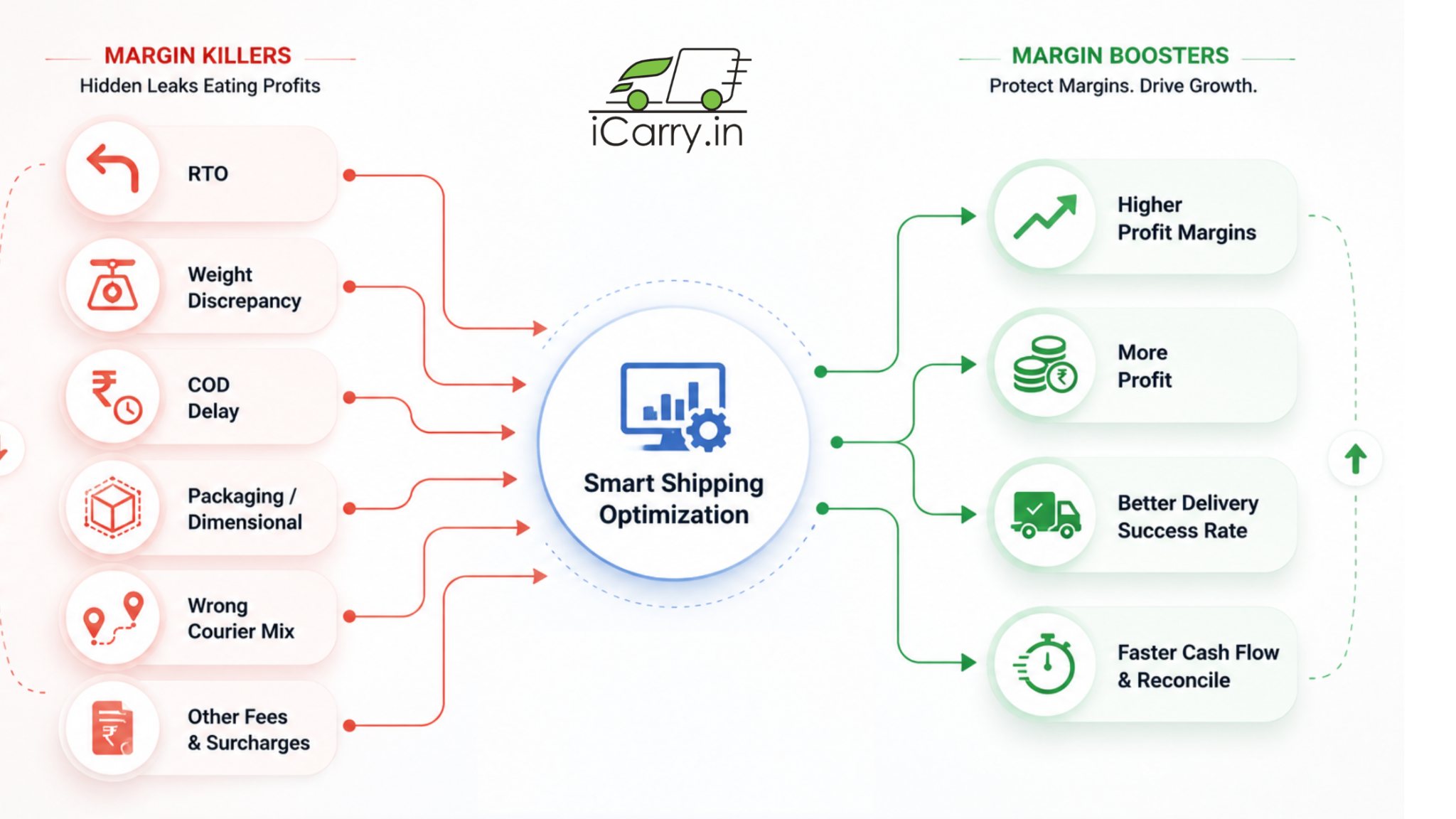
The 6 Biggest Shipping Margin Killers for Indian D2C Brands
| Margin Leak | Typical Impact |
|---|---|
| RTO | High |
| Wrong courier | High |
| COD float | Medium |
| Volumetric weight | Medium |
| Weight discrepancy | Medium |
| Platform fees | Low-Medium |
1. RTO and Double Freight Charges
Return to Origin is the most expensive recurring cost in Indian D2C logistics. When a delivery fails and the shipment comes back, you pay the forward freight charge and the return freight charge - while receiving zero revenue from that order.
For a brand with 500 COD orders per month, an average freight of ₹80 per order, and a 25% RTO rate:
- 125 orders return every month
- Double freight cost: 125 x ₹ 160 = ₹20,000 in pure RTO freight loss
- At 15% RTO instead of 25%, this loss drops to ₹12,000 - ₹8,000 monthly saving from a 10-point RTO reduction alone
Most of this RTO is preventable. Fake non-delivery reports from courier executives, customers who placed impulse COD orders with no real intent, and unvalidated delivery addresses account for the majority of failed deliveries in high-COD categories.
The systematic approach to reducing RTO for D2C brands combines address validation, COD order confirmation, NDR follow-up within 24 hours, and active courier accountability - each one reducing a specific category of avoidable return.
2. Weight Discrepancy Charges
Weight discrepancy charges occur when the courier measures your shipment at a different weight or dimension than you declared at booking. The difference is billed as an additional charge - sometimes weeks after the shipment was delivered.
At scale, these charges add up faster than most brands realise. A brand shipping 1,000 parcels per month with a 10% discrepancy rate and an average additional charge of ₹30 per discrepancy is losing ₹3,000 per month to charges many of which are disputable.
The most important thing to know: you have 5 business days from the discrepancy notification to raise a dispute with supporting evidence. Most brands miss this window entirely because they do not have a system to catch and dispute charges promptly.
Pre-uploading product images for each SKU on your shipping platform enables automatic dispute triggering. When a discrepancy arrives on a product with pre-uploaded images, the dispute is raised automatically without any manual action.
3. COD Float and Remittance Delay
Under the standard T+7 COD remittance cycle, the cash your customers paid on delivery does not reach your bank account for 7 business days after delivery. For a brand with 400 COD deliveries per day at an average order value of ₹ 700, this means ₹ 19.6 lakh is permanently locked in transit at any given time.
That is working capital your business has earned but cannot use. If you are borrowing to fund inventory purchases while waiting for COD to settle, the interest cost of that borrowing is a direct shipping margin killer that never shows up on your logistics invoice.
Two levers address this. First, shift more orders from COD to prepaid - each prepaid conversion eliminates the float problem for that order entirely. Second, use early COD remittance options to accelerate settlement on orders that remain on COD.
iCarry® offers free daily automatic remittance on the T+7 cycle for all plans including the free Bronze plan. Early remittance from T+4 to T+0 is also available with iCarry® advancing the payment from its own working capital before courier partners settle.
4. Wrong Courier for the Pincode
Using a single courier for all orders regardless of destination is one of the most common and costly mistakes in D2C logistics. Every courier has geographic strengths and weaknesses. A courier that delivers 95% on-time to Bengaluru may have a 70% first-attempt success rate in smaller Uttar Pradesh towns.
The impact of routing an order to the wrong courier goes beyond the direct RTO cost. Low first-attempt success rates generate NDRs. NDRs require follow-up. Failed follow-up generates RTO. Each step in this chain adds cost and removes margin.
Routing each order to the best available courier for that specific pincode - based on actual delivery performance data rather than rate alone - is one of the highest-leverage improvements a D2C brand can make to shipping margins. A 5% improvement in first-attempt delivery success across 1,000 monthly orders, at ₹ 80 average return freight avoided, is ₹ 4,000 per month recovered from courier selection alone.
5. Volumetric Weight and Oversized Packaging
Couriers bill based on the higher of actual weight or volumetric weight. Volumetric weight is calculated as Length x Breadth x Height in centimetres, divided by 5000.
A product that weighs 300 grams in a 25 x 20 x 15 cm box has a volumetric weight of 1,500 grams - five times the actual weight. The shipment is billed at 1,500 grams. If a right-sized 15 x 12 x 10 cm box would have worked, the volumetric weight drops to 360 grams - billed at actual weight.
The difference across 1,000 shipments per month is not a rounding error. Moving from a 500g weight slab to a 300g weight slab saves ₹ 15 to ₹ 25 per shipment depending on the courier and zone. On 1,000 orders per month, that is ₹ 15,000 to ₹ 25,000 per month from packaging optimisation alone.
The investment required is a packaging audit - measuring and testing right-sized box options for each SKU category. Most brands complete this in a single afternoon and see the savings on the next month's invoice.
6. Platform Overhead and Monthly Plan Costs
Fixed monthly platform fees are a shipping margin cost that many D2C brands do not count correctly. A ₹ 3,000 per month plan on an aggregator platform sounds small. But for a brand shipping 200 orders per month, that is ₹ 15 per order in fixed overhead before a single shipment is booked.
At higher volumes the per-order impact diminishes. But for brands still scaling, platform overhead on a mandatory paid plan compresses margins during the period when cash efficiency matters most.
Platforms such as iCarry® offer a free plan with no monthly fee and no minimum volume. Lowest rates are promised and start as low as ₹21* per 500g. Sellers get access to multiple courier partners, daily COD remittance, and full API integration from day one without any fixed overhead - meaning the platform cost per order is zero regardless of how few or how many orders you ship.
How to Calculate Your True Shipping Margin
Most D2C brands calculate shipping cost as: courier freight rate per shipment. This is incomplete. True shipping margin requires the full cost per delivered order:
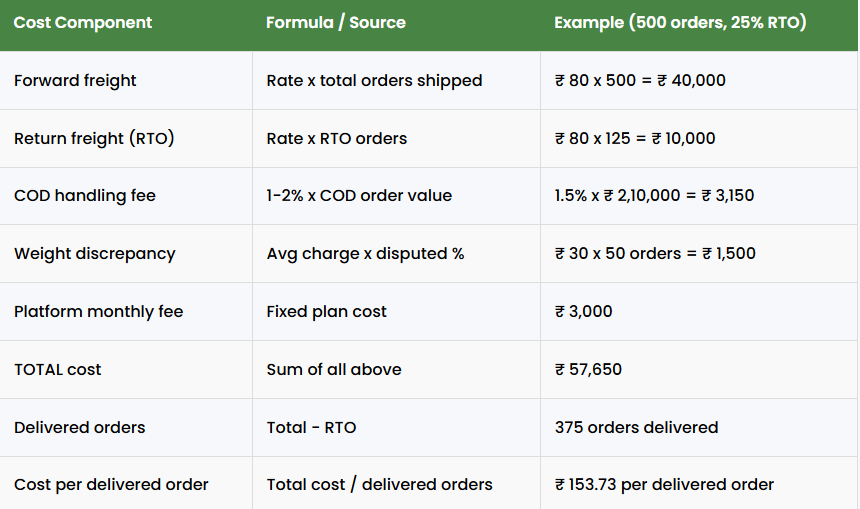
Compare this against your headline freight rate of ₹ 80 per shipment. The true cost is nearly double. This is the calculation that reveals where the margin is going.
Now model the impact of reducing RTO from 25% to 15%:
- Return freight drops from ₹ 10,000 to ₹ 6,000 - saving ₹ 4,000
- Delivered orders increase from 375 to 425
- Cost per delivered order drops from ₹ 153 to ₹ 125
- At ₹ 700 average order value, this 10-point RTO reduction adds approximately ₹ 28,000 in recovered revenue per month
Strategies to Improve Shipping Margins - Prioritised by Impact
Priority 1: Reduce RTO
The highest-impact lever for most Indian D2C brands. Active NDR management, COD order confirmation before dispatch, WhatsApp delivery notifications, and courier accountability tools like Delivery Boost all attack different failure modes.
iCarry®'s Delivery Boost deploys trained agents who call customers on your behalf, audit courier delivery claims, and open tickets for fake NDRs - at a nominal cost per shipment. iCarry's WhatsApp Engagement sends two-way delivery notifications from iCarry's official whatsapp number, giving customers a direct channel to flag delivery issues before they become RTOs. Together these two features address the two biggest sources of avoidable return: fake NDRs and missed delivery windows.
For pincode-level RTO diagnosis, use NDR data to identify delivery failure patterns and get the data framework to find which specific couriers and pincodes are generating disproportionate returns - and exactly where to reroute volume.
Priority 2: Right-Size Packaging
Audit your top 10 SKUs by volume. For each, measure the minimum box that adequately protects the product. Calculate the volumetric weight at current box size vs right-sized box. Multiply the weight slab difference by your monthly shipment volume. The number you get is your monthly packaging optimization opportunity.
This is a one-time audit with permanent monthly savings. Most brands that complete it find that 30 to 50% of their SKUs can be shipped in smaller packaging without compromising protection.
Priority 3: Use Multiple Courier Partners
Access multiple courier partners through an aggregator and compare rates before every booking. Route COD orders in Tier-2 and Tier-3 cities to the courier with the lowest RTO rate for those pincodes. Route high-value prepaid orders to the courier with the highest POD reliability. Route lightweight metro orders to the courier with the lowest rate for sub-500g shipments.
This is the single practice that most differentiates profitable D2C logistics operations from unprofitable ones. The blended cost improvement from courier selection outperforms any single rate negotiation.
Priority 4: Shift COD to Prepaid
Every order shifted from COD to prepaid eliminates the RTO risk, the COD handling fee, and the remittance float for that order simultaneously. Even shifting 20% of COD volume to prepaid meaningfully improves blended shipping margins.
Effective conversion tactics: a ₹30 to ₹50 prepaid discount shown prominently at checkout, a WhatsApp payment link sent within 30 minutes of COD order placement, and prepaid-only benefits like same-day dispatch or free express upgrade.
Priority 5: Dispute Weight Discrepancies Systematically
Set up a weekly review of weight discrepancy notifications. For any discrepancy where the revised weight is significantly different from your declared weight, raise a dispute immediately with photos of the sealed parcel, AWB visible, and weight measurement.
Pre-upload standard product images for your top SKUs on iCarry® - this enables automatic dispute triggering for those products, removing the manual review step entirely.
Priority 6: Optimise COD Remittance Timing
For brands where working capital is tight, early COD remittance reduces the cost of external financing used to bridge the remittance gap. Compare the early remittance fee (0.39% to 1.99% depending on tier) against your actual cost of bridging capital. For most brands at T+2 or T+3, the remittance fee is cheaper than any alternative financing.
How iCarry® Supports D2C Shipping Margin Improvement
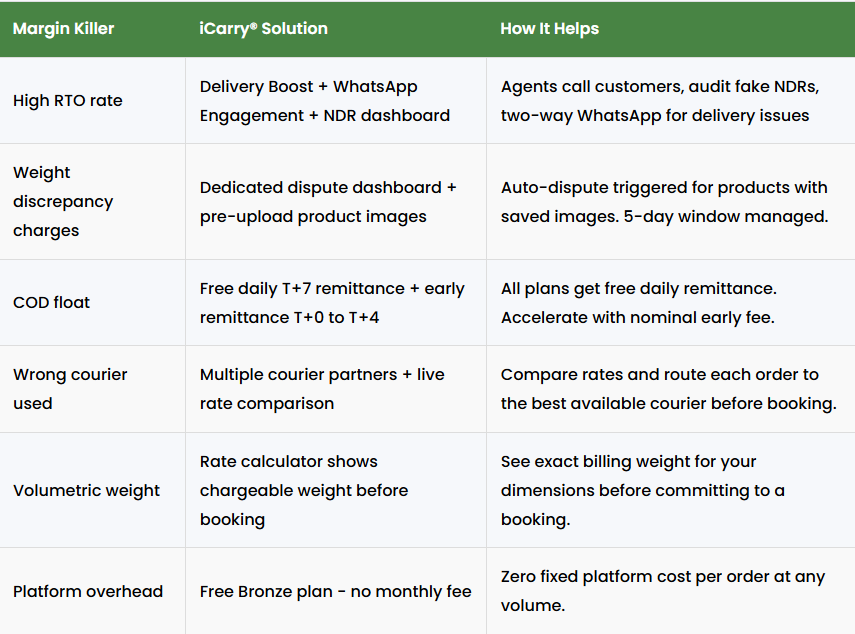
See how all of this compares to other platforms and courier options, compare live rates across multiple courier partners for your exact pincode and weight. No login required.
Shipping Margin Benchmarks for Indian D2C Brands
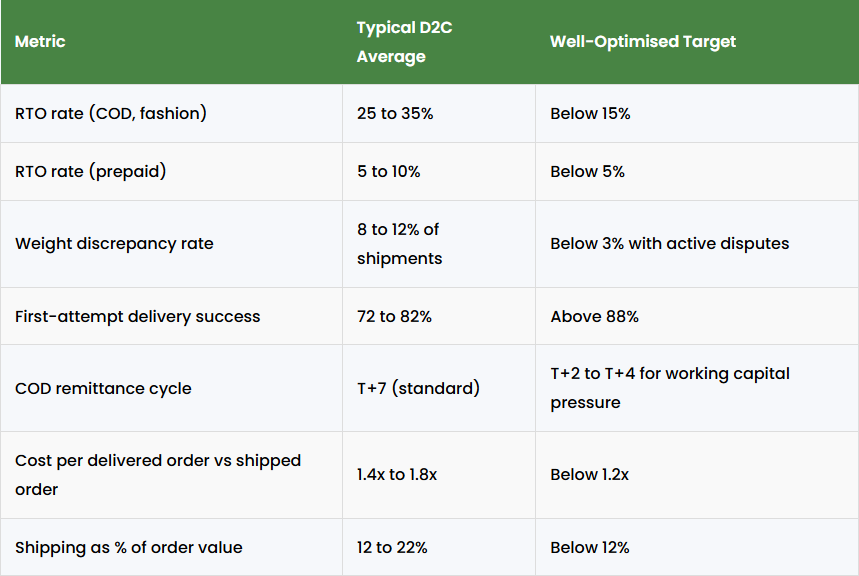
India's eCommerce logistics sector is expected to continue growing significantly through 2026 and beyond. D2C brands that build efficient shipping operations now create a compounding margin advantage - lower cost per delivered order means more budget for customer acquisition, product development, and brand building.
Final Thoughts
Shipping margin improvement for D2C brands is not a single action. It is a system of connected decisions - courier selection, packaging, RTO management, COD conversion, and dispute handling - each one compounding on the others.
The brands that achieve sub-15% RTO rates, right-sized packaging, and multi-courier routing are not doing anything technically complex. They are simply making data-driven decisions consistently, disputing what is disputable, and using platforms that give them the tools to act rather than just observe.
Start with the highest-impact lever for your current operation. If RTO is above 20%, reduce that first. If weight discrepancies are accumulating, build a dispute habit this week. If COD float is constraining inventory purchasing, configure early remittance today.
Every percentage point improvement in shipping efficiency goes directly to your bottom line. At D2C scale, these points add up fast.
iCarry® gives D2C brands access to multiple courier partners, daily COD remittance, weight discrepancy dispute management, Delivery Boost, WhatsApp Engagement and OTP Verified Delivery - all from a free Bronze plan with no minimum shipment volume required. Start for free at iCarry.in.
Frequently Asked Questions (FAQs)
What is the biggest shipping cost for D2C brands in India?
RTO (Return to Origin) is typically the largest avoidable shipping cost. At 25% RTO on COD orders with double freight on each return, RTO charges often exceed the base freight cost for the delivered orders. Reducing RTO is the highest-impact margin lever for most Indian D2C brands.
How do I calculate my true cost per delivered order?
Add: forward freight on all shipments + return freight on RTO shipments + COD handling fees + weight discrepancy charges + monthly platform fees. Divide the total by the number of orders actually delivered (total shipped minus RTO). This is your true cost per delivered order - typically 1.4x to 1.8x the headline per-shipment rate.
What is a good RTO rate for a D2C brand in India?
Below 15% overall is achievable with active NDR management and COD conversion tactics. For prepaid-heavy brands, below 5% is realistic. For COD-heavy fashion and lifestyle brands, 15 to 20% is a strong benchmark. Above 25% on COD indicates systemic issues in address validation, order confirmation, or courier selection.
How does volumetric weight affect D2C shipping margins?
Couriers charge based on the higher of actual weight or volumetric weight (L x B x H in cm divided by 5000). Oversized packaging inflates volumetric weight - sometimes billing 3 to 5 times the actual product weight. Right-sizing packaging for each SKU is one of the fastest ways to reduce per-shipment cost permanently.
How can iCarry® help improve D2C shipping margins?
iCarry® addresses all major shipping margin killers from one platform. Delivery Boost and WhatsApp Engagement reduce RTO. The weight discrepancy dashboard with pre-uploaded product images automates dispute filing. Free daily COD remittance eliminates the T+7 float problem. Multiple courier partner access and live rate comparison ensures each order is routed to the most cost-effective option. All available on the free Bronze plan with no monthly fee.
When does early COD remittance make financial sense?
When the cost of bridging capital (business loans, overdraft, informal financing) to cover the COD remittance gap exceeds the early remittance fee. At T+2 (0.89% fee), if your borrowing cost to bridge 5 days of COD float is higher than 0.89% of the payout, early remittance is cheaper than your alternative. Most brands with meaningful COD volume find T+2 or T+3 pays for itself within the first month.
Should D2C brands use a single courier or multiple?
Multiple courier partners consistently outperform single-courier operations on blended delivery success rate and cost per delivered order. Different couriers have different strengths by geography, weight class, and order type. Routing each order to the best available option for that specific pincode - rather than defaulting to one courier for everything - is the practice that most distinguishes profitable D2C logistics operations.
What percentage of revenue should D2C brands spend on shipping?
While the ideal number varies by category, well-optimised D2C brands typically keep shipping costs below 12% of order value. Brands above 15% should review RTO rates, packaging efficiency, courier selection, and COD dependence to identify margin leaks.
The biggest shipping margin killers for Indian D2C brands - RTO charges, weight discrepancies, COD float, wrong courier selection, oversized packaging, and platform fees - are all controllable. Every percentage point improvement in shipping efficiency goes directly to the bottom line. At D2C scale, these points add up fast.