The Last Mile Is Where Your Money Goes Missing
The package left your warehouse on time. The courier picked it up. Everything looked fine.
Then it came back.
In India, over 20% of COD shipments fail at the last mile - that final step from the local delivery hub to the customer's door. Every one of those failures costs you forward freight, return freight, and a lost sale.
Last mile problems are the biggest reason sellers see high RTO, delayed cash flow, and poor reviews - despite doing everything else right. Here's what's causing it and what you can do about it.
What Is Last Mile Delivery in eCommerce?
Last mile delivery is the final stage of a shipment - from the courier's local hub to the customer's doorstep. It is the most expensive, most complex, and most failure-prone stage of logistics. In India, last mile failures (RTOs) cost sellers double the forward shipping cost and directly reduce profit margins.
How to Fix Last Mile Delivery Problems in India
These 6 fixes address the most common causes of failed deliveries:
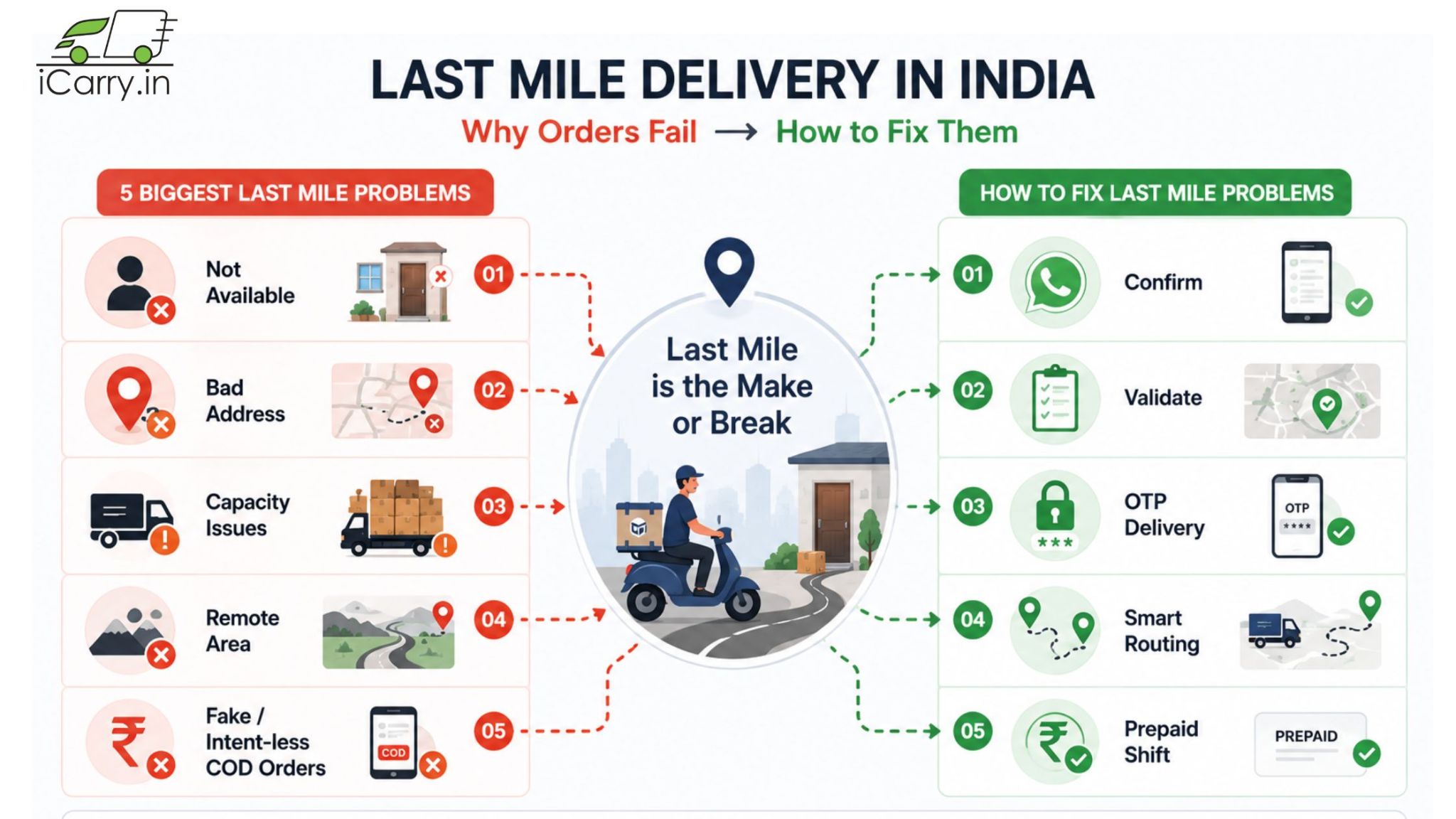
- Confirm before dispatch - A WhatsApp or call confirmation reduces intent-less COD orders before they ship.
- Validate addresses at checkout - Catch bad pincodes and incomplete addresses before the order is confirmed.
- Use OTP-based delivery - Reduces fake delivery attempts and ensures genuine handover.
- Send proactive delivery updates - WhatsApp/SMS notifications reduce missed attempts by keeping customers informed.
- Choose couriers by pincode track record - Route to the courier with the best success rate for each specific location.
- Reduce COD dependency - Prepaid orders have significantly lower RTO - often 5-10% vs 20-30% for COD.
The 5 Biggest Last Mile Problems in India
1. Customer Not Available
The most common cause of delivery failure. The customer placed an order - then wasn't home, didn't answer, or moved without updating their address.
Each re-attempt adds cost and delay. Most couriers make 2-3 attempts before marking RTO. That's 3x delivery cost for a shipment that never completes.
Fix: proactive WhatsApp/SMS scheduling before the delivery attempt. Let the customer choose their slot. Or try features such as WhatsApp Engagement where the customer can reply to the notifications to ensure they are definitely available before courier attempts.
2. Incorrect or Incomplete Address
Common in COD orders where customers type quickly at checkout. Missing apartment number, wrong pincode, or abbreviations the courier can't interpret.
Fix: real-time address validation at checkout. Flag incomplete pincodes before the order is confirmed. Or try features such as address quality scoring to audit and take appropriate action before dispatch.
3. Courier Capacity Issues
During peak seasons (Diwali, year-end sales), delivery networks get overloaded. Shipments pile up at hubs and miss SLAs.
Fix: diversify across courier partners so you're not dependent on one network at peak. This is exactly the scenario where multi-courier allocation saves sellers significant money and delivery failures - by routing each order to the courier with the best capacity and track record at that moment.
4. Remote Location Challenges
Tier 3 and rural pincodes often have poor last mile infrastructure. Some couriers mark these as unserviceable mid-delivery, triggering automatic RTO.
Fix: use a courier aggregator to route remote pincodes to the courier with actual coverage in that area. Not all couriers are equal on remote routes - our breakdown of the best courier services in India for eCommerce covers which partners perform best in Tier 2/3 and rural zones.
5. Fake / Intent-less COD Orders
India's COD culture means some customers order on impulse and refuse delivery. For fashion and lifestyle, fake order rates can run 10-15%.
Fix: pre-dispatch confirmation call or WhatsApp message filters out intent-less orders before they ship. Incorporate processes such as COD Confirmation or WhatsApp Engagement before dispatch.
According to World Bank research on logistics performance in South Asia, last mile costs account for 40-50% of total logistics spend in developing markets. India's fragmented geography and infrastructure gaps make this challenge significantly more acute than in most comparable economies.
Last Mile Delivery Cost by Shipping Zone in India
Last mile delivery costs are not uniform across India. Courier charges vary significantly by shipping zone - and this is one of the most under-checked variables when sellers calculate their per-order margins.
Metro-to-metro shipments are usually the cheapest because of high delivery density and short line-haul distances. Zone C, Zone D, and remote/ODA (Out of Delivery Area) routes cost more because of longer haul distances, fewer direct connections, and weaker last mile infrastructure.
| Route Type | Typical Cost Impact | Last Mile Complexity | RTO Risk |
|---|---|---|---|
| Metro to Metro (Zone A) | Lowest - base rate | Low - high delivery density | Low |
| Metro to Tier 2 (Zone B) | Medium - 10-20% premium | Medium | Medium |
| Inter-state Tier 2/3 (Zone C) | Higher - 20-35% premium | High - fewer direct routes | Higher |
| Remote / ODA areas (Zone D+) | Highest - 40-80% premium | Very high | Highest |
The pattern matters beyond just cost. Zones C and D don't just cost more - they also have higher last mile failure rates. Couriers with strong metro networks often have thin or patchy coverage in these areas, meaning your RTO risk rises at the same time your shipping cost does.
If a significant portion of your orders are going to Tier 2/3 or remote zones, this compounds your margin problem fast. Our guide on how to reduce shipping costs for eCommerce in India covers how zone-aware courier routing is one of the most effective cost levers available - routing each Zone C or D order to the courier that actually covers it well, rather than defaulting to your primary partner.
How to Calculate Your True Last Mile Delivery Cost
Most sellers look at their courier rate card and assume that's what they're paying. It's not.
Before finalising any courier partner, calculate your true cost per delivered order - not just the base shipping rate. Here's the full formula:
- Base shipping rate - The quoted per-kg or per-shipment rate.
- Fuel surcharge - 10-20% of base rate. Usually applied automatically.
- COD handling fee - ₹20-50 per shipment if it's a COD order.
- Zone surcharge - Add 10-80% depending on delivery zone (see table above).
- RTO cost - If your RTO rate is 20%, factor in full return freight on 1 in 5 shipments.
Example: Base rate ₹80 + fuel surcharge ₹12 + COD fee ₹30 + Zone C premium ₹24 = ₹146 forward cost. If this order RTOs, add ₹80-100 return charge. Total cost of one failed COD order in Zone C: ₹226-246 - with zero revenue.
At 500 orders a month with 25% RTO in Zone C, that's 125 failed deliveries costing roughly ₹29,000-31,000 in pure shipping losses. Every month.
One more variable worth factoring in: whether you're using surface or air for these routes. The cost difference is significant - see our comparison of surface vs air shipping for eCommerce in India for a full breakdown of when each makes sense.
How Last Mile Failures Hit Your Business
- Higher RTO costs - Each failed COD shipment costs ₹140-200 in double freight at typical rates.
- Delayed cash flow - RTO orders hold up COD remittance. At 25% RTO on 500 orders/month, that's 125 remittances stuck in the return cycle.
- Poor customer reviews - Failed deliveries generate 1-star reviews even when the product is fine.
- Lost repeat business - A customer who got a failed delivery is far less likely to reorder.
For further context on how delivery failures affect brand loyalty in India, YourStory's coverage of India's D2C logistics challenges documents how RTO and failed deliveries are consistently among the top reasons customers don't reorder from new brands.
Who Should Read This?
- Sellers with RTO above 15% on COD orders
- D2C brands seeing delivery failures in Tier 2/3 and remote zones
- Shopify/WooCommerce sellers who haven't set up pre-dispatch confirmation
- Anyone whose courier keeps marking orders RTO despite customers claiming they were home
Conclusion
Most last mile delivery failures in India are preventable. Not by switching courier. Not by spending more. But by building a smarter process upstream.
Confirm intent before you ship.
Validate the address before the order is created.
Send the customer a heads-up before the delivery attempt.
Route each order to the courier that actually delivers well in that pincode and zone.
None of this is complicated on its own - but most sellers don't have the tools to do it consistently. If you want to understand the full picture of what drives RTO and how to fix it systematically, our complete guide to reducing RTO for D2C sellers in India covers every lever available - from pre-dispatch confirmation to NDR workflows to courier selection by pincode.
And if delivery failures are costing you more than just the RTO charge - if they're also affecting your COD remittance cycle and per-order margins - it's worth understanding how multi-courier allocation improves both delivery success rates and cash flow for Indian eCommerce sellers. Routing the right order to the right courier for that zone is the single biggest structural fix most sellers haven't made yet.
iCarry® brings all of this together in one platform - pre-dispatch confirmation, address validation, NDR management, and zone-aware smart courier routing. No complex integrations. No extra headcount.
Start reducing last mile failures with iCarry®.
Frequently Asked Questions
What causes last mile delivery failures in India?
The most common causes are customer unavailability, incorrect address, courier capacity overload, remote area coverage gaps, and intent-less COD orders. Pre-dispatch confirmation and address validation fix the majority of these.
What is a good RTO rate for eCommerce in India?
For prepaid orders, under 5% is healthy. For COD, under 15% is a good target. Industry average for COD in fashion/lifestyle runs 20-30%.
How does OTP delivery reduce RTO?
OTP delivery requires the customer to provide a code to complete handover. This eliminates fake delivery attempts by agents and ensures genuine delivery confirmation - one of the most reliable ways to reduce agent-side fraud.
Why are last mile delivery charges higher than the quoted rate?
Quoted rates typically exclude fuel surcharge (10-20%), COD handling fees, zone/remote area surcharges, and RTO return charges. Once these are added, your actual per-shipment cost is often 30-40% above the base rate. Always ask for an all-inclusive rate card that shows total cost per zone before committing to a courier partner.
How are last mile delivery charges calculated for large but lightweight packages?
Couriers calculate the billable weight as whichever is higher between actual weight and volumetric weight. Volumetric weight = (Length x Width x Height in cm) / 5000. A package that weighs 500g but ships in a 30x25x20cm box has a volumetric weight of 3 kg - so you'll be billed for 3 kg, not 500g. Right-sizing packaging is one of the fastest ways to bring down your last mile delivery cost.
Most last mile delivery failures in India are preventable - through pre-dispatch confirmation, address validation, proactive delivery notifications, and pincode-aware courier routing. Sellers who build these into their process consistently see lower RTO, lower double-freight costs, and better customer retention.