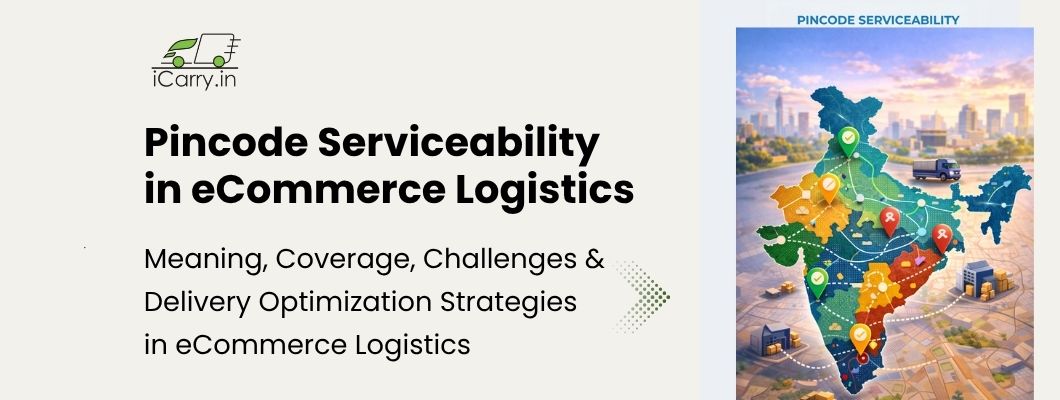
In India's vast and diverse geography, delivering orders efficiently depends heavily on pincode serviceability in eCommerce logistics, which determines delivery feasibility across regions. Whether an eCommerce brand can deliver to a customer depends on pincode serviceability, which defines delivery coverage and logistics network reach across regions.
Pincode serviceability in India directly impacts delivery success rates, logistics costs, and customer satisfaction, making it a critical factor in eCommerce supply chain optimization.
From metro cities to remote villages, India has 19,000+ pincodes, but not all are serviceable due to logistics coverage limitations and infrastructure challenges. India's postal system defines the structure and coverage of pincodes across the country, forming the backbone of location-based delivery networks. For eCommerce businesses, understanding pincode serviceability is critical to ensuring order fulfillment reliability, delivery speed, and customer satisfaction through optimized shipping operations.
Many operational challenges—such as delivery delays, high RTO rates, and failed shipments—are directly linked to poor serviceability planning and inefficient last-mile execution.
This guide explains what pincode serviceability means, how it works, coverage challenges in India, and strategies to optimize delivery performance across regions.
What is Pincode Serviceability?
Pincode serviceability in eCommerce logistics refers to the ability of courier and logistics networks to deliver shipments to specific postal codes based on coverage, infrastructure, and operational feasibility. Efficient logistics networks rely on strong geographic coverage and infrastructure to ensure seamless delivery operations according to the World Bank's transport sector research. In eCommerce logistics, it plays a crucial role in determining whether an order can be fulfilled for a customer's location.
It defines whether delivery is possible and determines shipping options such as prepaid orders, Cash on Delivery (COD), and express logistics services, while also influencing delivery timelines.
In simple terms, a serviceable pincode allows successful order fulfillment, while a non-serviceable pincode restricts or prevents delivery operations.
Why Pincode Serviceability is Important in eCommerce Logistics
Pincode serviceability plays a major role in overall logistics performance and directly impacts business growth.
Determines Market Reach
Businesses can only sell in locations where they can deliver, making efficient logistics and supply chain management essential for expansion. Expanding serviceable pincodes allows brands to reach new customers, especially in Tier-2 and Tier-3 markets.
Impacts Delivery Speed
Serviceability influences transit time. Locations with strong courier networks and infrastructure benefit from faster and more reliable deliveries. Transportation infrastructure quality plays a key role in determining logistics performance and delivery efficiency across regions according to the World Bank's Logistics Performance Index.
Influences RTO Rates
Non-serviceable or difficult-to-access locations often lead to higher delivery failures, increasing Return-to-Origin (RTO) rates and operational costs.
Affects Customer Experience
Customers expect accurate delivery timelines based on their location. Proper serviceability ensures realistic expectations and builds trust.
Types of Pincode Serviceability in Logistics
1. Fully Serviceable Pincodes
These areas offer reliable delivery coverage with multiple courier options and faster delivery timelines. Customers can typically access all services, including prepaid, COD, and express delivery. Such pincodes are commonly found in metro and major Tier-1 cities.
2. Partially Serviceable Pincodes
These locations have limited courier availability and may support only specific services, such as prepaid orders while restricting COD. Delivery timelines are usually longer. These are commonly seen in Tier-2 and Tier-3 cities.
3. Non-Serviceable Pincodes
These are areas where courier services are unavailable, making deliveries impossible or highly restricted. Such pincodes are typically located in remote or hard-to-access regions.
Core Components of Pincode Serviceability
1. Courier Network Coverage
Different courier companies have varying levels of serviceability across regions, making coverage a key deciding factor when selecting courier aggregation platforms.
2. Delivery Infrastructure
Road connectivity, transportation systems, and regional logistics infrastructure significantly impact delivery feasibility and speed.
3. Last-Mile Delivery Capability
Even if shipments reach a nearby hub, delivery depends on the availability of local delivery agents in that area.
4. Service Type Availability
Service availability varies by pincode. Some locations may support only prepaid orders, while others may have limited COD availability or no access to express delivery.
Step-by-Step Serviceability Workflow
Step 1: Customer Enters Pincode
The process begins when customers enter their pincode on an eCommerce website to check delivery availability.
Step 2: System Checks Serviceability
The system verifies whether the pincode is serviceable using courier databases or logistics APIs.
Step 3: Courier Selection
Based on coverage, cost, and delivery timelines, the system selects the most suitable courier partner.
Step 4: Delivery Timeline Display
Customers are shown estimated delivery timelines based on their location.
Step 5: Order Processing & Shipping
Once confirmed, the order is processed and shipped according to the serviceability of that pincode.
Real-World Business Examples
Example 1: Multi-Courier Optimization
An eCommerce brand uses multiple courier partners to expand pincode coverage across India, ensuring better delivery success rates through intelligent courier allocation strategies.
Example 2: Tier-2 Expansion
A D2C brand enters Tier-2 markets by partnering with logistics providers that have strong regional networks, enabling efficient deliveries.
Example 3: COD Restriction Strategy
Businesses often disable COD for high-risk pincodes to reduce RTO losses and improve operational efficiency.
Serviceability Comparison Across Regions
Serviceability varies significantly depending on the region and available infrastructure. The table below highlights how pincode serviceability levels vary across different regions in India based on infrastructure and logistics coverage:

Benefits of Optimized Pincode Serviceability
Increased Market Reach Through Expanded Pincode Serviceability
Expanding serviceable areas enables businesses to tap into new customer segments and increase sales opportunities.
Better Delivery Performance
Optimized courier selection improves delivery success rates and reduces delays.
Reduced RTO Rates
Improved serviceability minimizes failed deliveries and lowers return-related costs.
Enhanced Customer Experience
Providing accurate delivery timelines builds trust and improves overall customer satisfaction by creating a seamless delivery experience.
Challenges in Pincode Serviceability in India
Uneven Infrastructure
Rural and remote areas often lack logistics infrastructure, limiting pincode serviceability and increasing delivery timelines and reducing overall logistics efficiency across regions.
Courier Coverage Gaps
Not all courier partners serve every location, leading to serviceability limitations.
High Delivery Costs
Shipping to remote areas can be significantly more expensive, impacting profitability.
Address Accuracy Issues
Incorrect or incomplete addresses can lead to failed deliveries and operational inefficiencies.
Common Mistakes Businesses Make
Relying on a Single Courier Partner
This limits serviceability coverage and reduces flexibility in operations.
Ignoring Regional Performance Data
Different regions require different logistics strategies, and ignoring this can lead to inefficiencies.
Offering COD in High-Risk Areas
Providing COD in such areas increases the chances of RTO and financial losses.
Not Updating Serviceability Data
Outdated serviceability information can result in incorrect delivery promises and failed shipments.

Practical Best Practices
Use Multi-Courier Networks
Leverage multiple logistics partners to increase coverage and reduce dependency on a single provider.
Enable Smart Courier Allocation
Automatically assign the best courier based on location, cost, and delivery speed.
Restrict COD in Risky Areas
Limit COD availability in high-risk pincodes to reduce RTO rates.
Improve Address Validation
Use tools to verify and standardize addresses for better delivery accuracy.
Monitor Serviceability Metrics
Track key performance indicators such as delivery success rate, transit time, and RTO rate to continuously optimize logistics operations.
Data-Driven Insights
Expanding serviceability can significantly increase order volume and revenue. Global eCommerce research from UNCTAD's eCommerce and digital economy division highlights how expanding delivery coverage is critical for scaling online businesses and reaching new customer segments.
Conclusion
Pincode serviceability is a foundational element of eCommerce logistics in India. It determines where businesses can deliver, how fast orders reach customers, and how efficiently logistics operations perform.
By optimizing courier networks, improving address accuracy, and using data-driven logistics strategies, businesses can expand their serviceable areas while maintaining delivery reliability.
In a country as diverse as India, mastering pincode serviceability is essential for scaling eCommerce operations and improving customer satisfaction.
Improve Pincode Serviceability and Delivery Coverage with Smarter Logistics Solutions
Achieving efficient pincode serviceability requires strong courier partnerships, real-time data visibility, and optimized shipping workflows. Businesses that leverage technology to manage serviceability can improve delivery performance and expand their reach using advanced logistics technologies.
Turn your pincode serviceability into a competitive advantage with data-driven logistics optimization using iCarry.
Frequently Asked Questions (FAQs)
What is pincode serviceability in eCommerce logistics?
Pincode serviceability refers to whether a courier or logistics network can deliver orders to a specific postal code.
Why is pincode serviceability important?
It determines delivery feasibility, shipping timelines, customer experience, and overall logistics performance.
How can businesses improve pincode serviceability?
Businesses can improve serviceability by using multiple courier partners, optimizing logistics networks, and expanding regional coverage.
What is a non-serviceable pincode?
A non-serviceable pincode is a location where delivery is not possible due to lack of courier coverage or infrastructure.
How does pincode serviceability affect delivery time?
Serviceable areas with strong logistics networks have faster delivery times, while remote areas may experience delays.
Can COD be restricted based on pincode?
Yes. Many businesses restrict COD in high-risk or low-serviceability areas to reduce RTO losses.
Pincode serviceability in eCommerce logistics refers to the ability of courier networks to deliver shipments to specific postal codes based on coverage and infrastructure—determining delivery feasibility, shipping options (prepaid, COD, express), and timelines—with India's 19,000+ pincodes varying from fully serviceable metros to non-serviceable remote areas, requiring businesses to optimize multi-courier networks, enable smart allocation, restrict COD in risky zones, and continuously monitor performance metrics to expand market reach and improve delivery success.