
An electronics accessories brand ships 800 orders a month. In any given month, 4 to 6 parcels go missing somewhere between pickup and delivery. The business declares ₹500 on every shipment to save the coverage fee. Each missing parcel recovers ₹500. Each missing parcel actually contained ₹2,500 to ₹4,000 in product.
Over 12 months: 60 lost parcels. ₹30,000 recovered. ₹1.2 lakh to ₹2.1 lakh in actual product value never recovered. The declared value decision alone cost the business more than the annual cost of a part-time employee.
Shipment loss in Indian courier networks is not random. With India's express parcel market on track to reach 24-29 billion shipments by FY30 (IBEF), the loss rate across the industry is a small but consistent percentage. What separates businesses that absorb these losses from those that recover them is almost entirely a documentation and accountability system - not luck, not courier choice alone.
This guide covers how to prevent shipment loss where possible, document correctly to recover when it does happen, and build a courier accountability framework that makes losses financially manageable.
What Does Courier Accountability for Lost Shipments Mean?
Courier accountability for lost shipments means having the documentation and process in place to hold a courier to its declared-value liability when a parcel genuinely goes missing - rather than accepting whatever the courier offers, or nothing at all. In practice, this means a signed pickup manifest, a pre-dispatch photograph, accurate declared value with coverage enabled where it matters, and a tracked claims process with defined filing windows. If these steps are not followed before a shipment is lost, businesses may find it difficult to prove their claim and recover the right compensation from the courier.
How to Check If Your Business Is Loss-Ready
- Do you photograph every parcel before handover with AWB visible?
- Do you always get a signed manifest from the courier agent at pickup?
- Is declared value coverage enabled for shipments above ₹2,000?
- Do you monitor tracking for the first 48 hours after pickup for scan anomalies?
- Do you have a defined process to raise a trace request within 72 hours of a static tracking?
- Do you track loss rate by courier and by route to identify patterns?
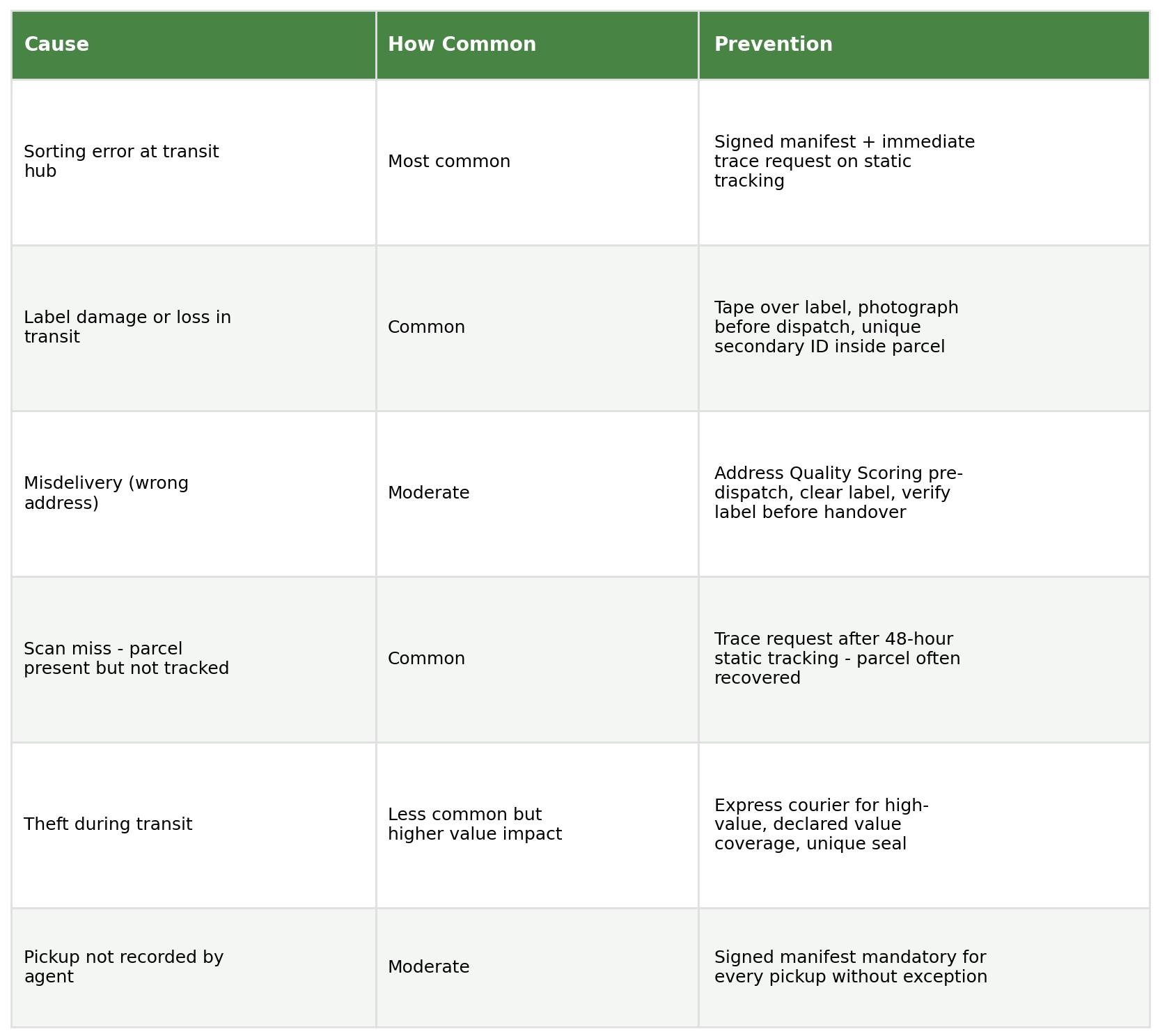
What Causes Shipment Loss in Indian Courier Networks
Understanding the causes of loss helps prioritise the right prevention measures:
Prevention: The 5 Habits That Reduce Shipment Loss
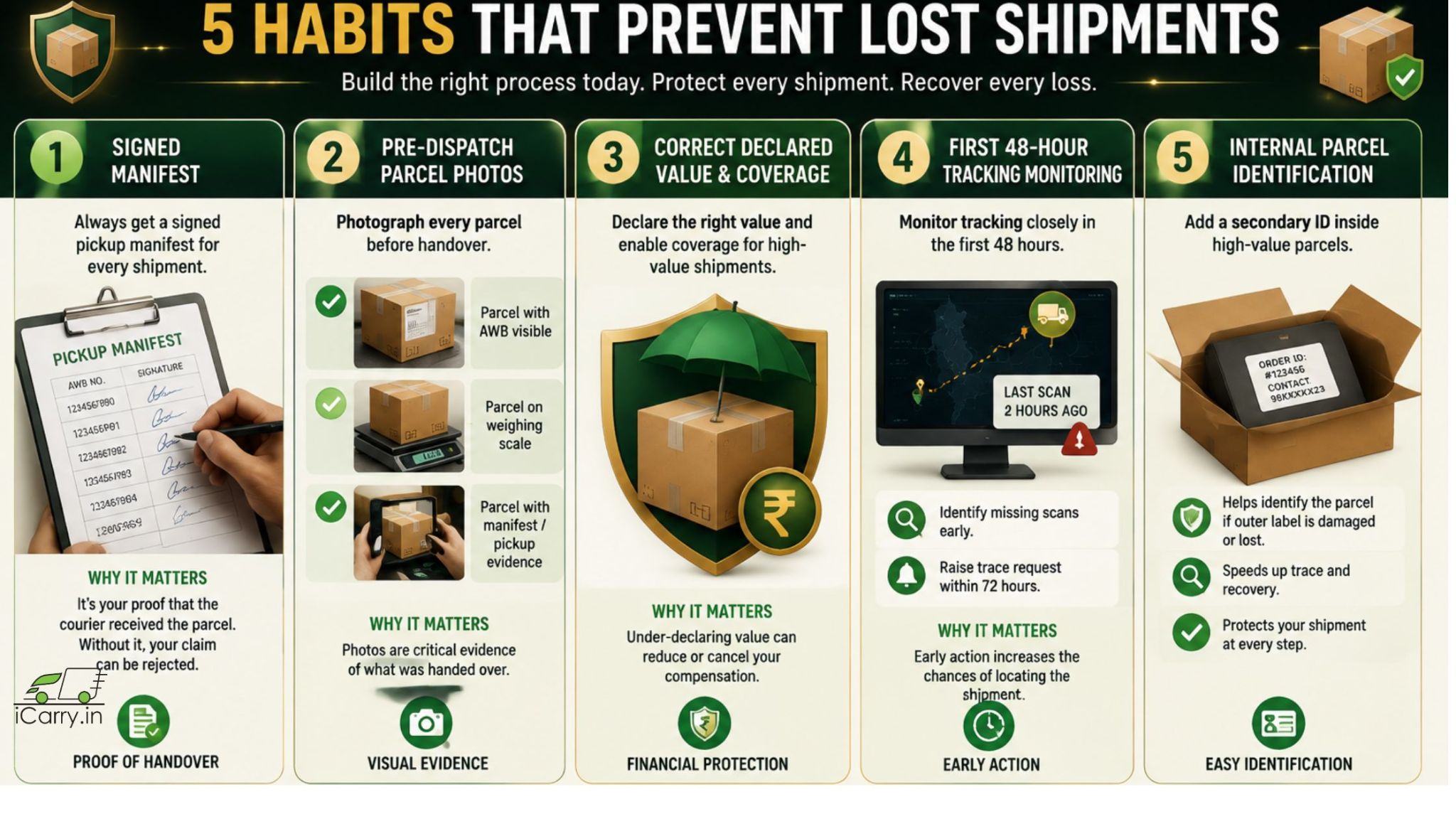
Habit 1: Always Get a Signed Manifest
The signed manifest is your proof that the courier received the parcel from you. Without it, the courier can claim they never collected the shipment - and you have no evidence to the contrary.
The pickup manifest lists every AWB collected. The courier agent signs it. You keep a copy - physical or photographed. This document is the starting point of every loss claim. A claim without a signed manifest is a claim you will lose.
Make it non-negotiable: No signature from the courier agent = no handover of parcels. Train every member of your dispatch team on this rule. It takes 30 seconds. It creates the foundational evidence for every claim.
Habit 2: Photograph Every Parcel Before Handover
Three photographs before every dispatch of a shipment (mainly for shipments above ₹2,000 in value):
- The sealed parcel with the AWB label clearly visible
- The parcel on the weighing scale with the weight readable
- The parcel alongside the manifest or alongside the courier agent collecting it
These photographs are timestamped evidence that the parcel existed, was sealed, was labelled correctly, and was handed to the courier on a specific date. They convert an unverifiable claim into a documented one.
Habit 3: Declare Accurate Value and Enable Coverage
This does not prevent loss - but it is the most important financial protection against it. Under-declared shipment value is the single most common reason Indian businesses absorb the full loss on a missing parcel instead of recovering it.
The declared value coverage fee is typically 0.5 to 1.5% of declared value. On a ₹4,000 shipment, this is ₹20 to ₹60. The cost of not enabling coverage on a lost ₹4,000 shipment is ₹3,950 to ₹4,000. No business that runs the numbers chooses to skip coverage.
Build it into your SOP: Declared value coverage enabled for all shipments above ₹2,000 is a default setting, not an optional add-on.
Habit 4: Monitor Tracking for the First 48 Hours
The first 48 hours after pickup are the most critical window. A shipment that scans at the origin facility and progresses normally is very unlikely to be lost. A shipment that does not scan within 24 hours of pickup is significantly more likely to have been misrouted, mislabelled, or not scanned into the system at all.
Check tracking for every high-value shipment within 24 hours of dispatch. If there is no first scan within 24 hours - raise a trace request immediately. Do not wait. Early trace requests have a significantly higher recovery rate than requests filed 7 days after the shipment went quiet.
Habit 5: Place a Secondary ID Inside Every High-Value Parcel
A simple practice that significantly aids recovery of mislabelled or label-damaged parcels: place a card inside the parcel with the AWB number, sender's name, sender's phone number, and consignee's name and phone number.
If the outer label is damaged or detached in transit, the courier's recovery team can open the parcel to identify it. Without an internal ID, an unidentifiable parcel cannot be returned to sender or delivered. With one, it can be reunited with its AWB and delivered or returned correctly.
Accountability: Holding Couriers Responsible
Prevention reduces loss frequency. Accountability determines what you recover when loss does occur. Both are necessary.
Track Loss Rate by Courier and Route
The first step in courier accountability is measurement. You cannot hold a courier accountable for a loss rate you have not measured. This matters more every year - the domestic express courier sector alone is projected to grow from ₹78,525 crore to ₹1,57,050-1,91,950 crore by FY30 (IBEF), meaning an unmeasured loss rate scales into a much bigger problem as volume grows.
- Track every confirmed lost shipment by: courier, origin pincode, destination pincode, month, and declared value
- Calculate monthly loss rate per courier: (lost shipments / total shipments) x 100
- Compare loss rates across your courier partners on similar routes. A courier with a 0.8% loss rate on Zone D routes is significantly more costly than one with 0.2% when the difference is applied to 500 monthly shipments
- Flag couriers with persistently higher loss rates on specific routes and route away from them on those pincodes
Raise Trace Requests Immediately - Not Eventually
A trace request asks the courier to physically locate the shipment in their network. The success rate of trace requests drops significantly with time - a trace raised within 72 hours of a static tracking has a much higher recovery rate than one raised after 10 days.
- Set a clear internal rule: any shipment with no tracking update for 72 hours gets a trace request raised that day
- Assign a specific person to monitor tracking and raise trace requests - not a shared responsibility that everyone assumes someone else is handling
- Include the signed manifest and pre-dispatch photograph in every trace request submission
- Follow up daily. A trace request submitted and not followed up is often deprioritised
File Loss Claims Within the Window
Every courier has a claim window - the period within which a loss claim must be filed. Filing after this window closes the claim regardless of evidence quality.
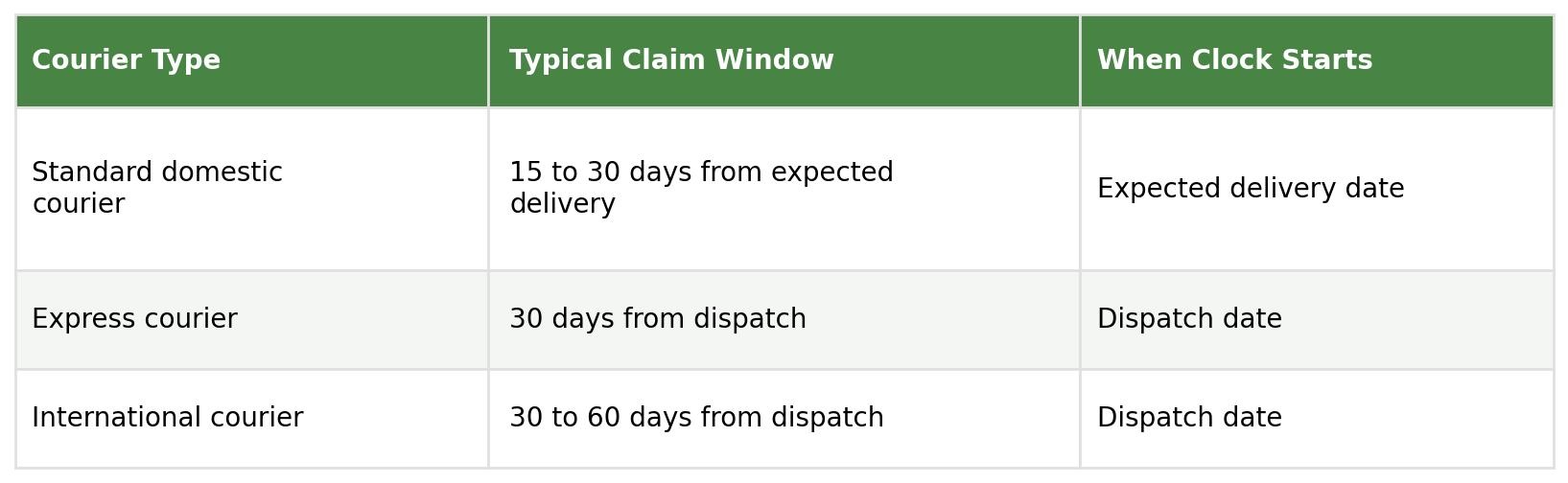
Calendar the claim window for every high-value shipment that goes into a trace request. Do not assume the trace will resolve in time - file the loss claim before the window closes even if the trace is still active.
Escalate Systematically When First-Level Support Fails
First-level courier support is designed to handle routine queries - it is not designed to resolve complex loss investigations. When first-level support fails to provide a trace outcome within the committed timeline:
- Escalate in writing (email or ticket) to the courier's nodal officer or grievance team
- Reference all previous support ticket numbers and submission dates
- Attach all evidence: signed manifest, pre-dispatch photograph, tracking screenshot, commercial invoice
- State the claim amount, the claim window deadline, and request written confirmation of receipt of the escalation
- If the courier aggregator raised the ticket, involve them in the escalation - aggregators have direct escalation paths that individual sellers often do not
Use Loss Data to Make Courier Selection Decisions
Courier accountability is not just about recovering from individual losses - it is about using loss data to improve your courier mix. A courier with persistently high loss rates on specific routes should receive less volume on those routes, not the same volume with better claim management.
Multi-courier access through a courier aggregator gives you the flexibility to route away from high-loss couriers on specific pincodes without changing your overall logistics setup. Multi-courier allocation based on performance data - delivery success rate, loss rate, damage rate - is the most sophisticated form of courier accountability available.
How iCarry® Supports Shipment Loss Prevention and Recovery
iCarry® is a courier aggregator that gives Indian businesses the tools to reduce loss and recover effectively when it occurs:
- Declared value coverage: Enable at booking for all shipments above your risk threshold. The option is shown transparently before confirmation - no extra navigation required
- Pre-uploaded product images: Upload standard product images per SKU. When a loss or damage claim is filed, pre-uploaded images serve as evidence without manual submission per claim
- Centralised tracking: All shipments across all courier partners in one dashboard. Tracking anomalies - 48-hour static scans, unexpected locations - are visible without logging into multiple portals
- Support ticket system: Raise trace requests and loss claims directly against specific AWBs in iCarry®. All communication is logged and timestamped, creating a defensible record. Monitor all active shipments from My Shipments
- Address Quality Scoring: Pre-dispatch address validation reduces the label-cannot-be-delivered scenario that contributes to misdelivery and eventual loss
- Multi-courier routing: Route high-value shipments to couriers with lower loss rates on your specific routes, based on your own performance data across couriers
- Free Bronze plan, no minimum volume.
Final Thoughts
Shipment loss is not a cost of doing business that must be silently absorbed. It is a controllable, measurable operational risk that responds to documentation habits, tracking discipline, and courier accountability systems.
The five prevention habits - signed manifest, pre-dispatch photograph, accurate declared value with coverage, 48-hour tracking review, and internal secondary ID - take under 5 minutes per high-value dispatch and collectively convert most potential full losses into recoverable claims.
The accountability framework - loss rate tracking by courier, immediate trace requests, claim window management, systematic escalation, and courier routing decisions based on loss data - converts loss management from a reactive firefighting exercise into a proactive margin protection system.
Build both before the next loss forces you to.
Frequently Asked Questions (FAQs)
What is the most effective way to prevent shipment loss in India?
Always get a signed manifest at pickup - this is the single most impactful prevention habit because it proves the courier received the parcel. Photograph every high-value parcel before handover. Enable declared value coverage for shipments above ₹2,000. Monitor tracking within 48 hours of dispatch and raise a trace request immediately if the parcel has not scanned into the courier system.
What is a signed pickup manifest and why is it essential?
A pickup manifest is a document listing all parcels collected by the courier agent at your premises. The courier agent signs it to confirm receipt of each AWB. Without a signed manifest, you have no proof the courier ever took the parcel - which means any loss claim can be denied on the basis that the shipment was never received. Always require a signature before handing over parcels.
How do I calculate my loss rate by courier?
Divide the number of confirmed lost shipments by the total shipments booked with that courier in the same period, then multiply by 100. For example: 5 lost shipments out of 500 total = 1% loss rate. Calculate monthly and by route (same origin pincode to same destination zone) to identify patterns that inform courier routing decisions.
What should I do if a courier refuses to settle my loss claim?
Escalate in writing to the courier's nodal officer with all evidence attached - signed manifest, pre-dispatch photographs, tracking history, and commercial invoice. State the claim amount and the claim window deadline explicitly. If using a courier aggregator, involve them in the escalation - aggregators have direct escalation paths with couriers that individual sellers often cannot access.
Does declared value coverage guarantee full recovery on a lost shipment?
Declared value coverage means the courier's liability extends to the declared amount. Recovery depends on successfully proving the loss and navigating the claim process within the filing window. A well-documented claim - signed manifest, photographs, tracking history - has a significantly higher settlement rate than an undocumented one. Coverage is necessary but documentation is what makes it pay out.
How does iCarry® help with lost shipment claims?
iCarry® provides a centralised ticket system to raise and track trace requests and loss claims against specific AWBs. Pre-uploaded product images serve as claim evidence without manual submission per claim. Declared value coverage is enabled at booking. All courier interactions are logged for escalation purposes. Multi-courier access allows routing away from high-loss couriers on specific routes based on your own performance data.
Shipment loss is not a cost of doing business that must be silently absorbed - it is a controllable, measurable operational risk. The five prevention habits take under 5 minutes per high-value dispatch and convert most potential full losses into recoverable claims. The accountability framework - loss tracking by courier, immediate trace requests, claim window management, and systematic escalation - turns loss management from reactive firefighting into proactive margin protection. Build both before the next loss forces you to.