
Why Education Supplies Are a Seasonal Logistics Challenge
Schools reopen on Monday, and 200 textbook sets are still sitting in a courier hub. Every late set is a parent who may not order from you again.
Education supplies run on a fixed calendar. Orders for textbooks, notebooks, uniforms and school kits spike between March and July, then fall sharply. Colleges and coaching institutes have their own peaks around semester starts and entrance exam cycles. A late delivery in this category is not just a delay - a student without books in the first week of term is a lost customer.
India's education market is one of the largest in the world, and online retail keeps growing. For publishers, stationers and kit suppliers, planning logistics before the season starts is the difference between a profitable quarter and a backlog.
What Is School Supplies Shipping in India?
School supplies shipping is the delivery of textbooks, notebooks, uniforms, kits and lab equipment to schools, colleges and parents, timed around reopening and admission peaks. Orders spike between March and July, so dispatch must be planned by zone before the season starts. School orders also need receiving-hour checks and a signed challan.
How to Plan the Season Before Orders Arrive
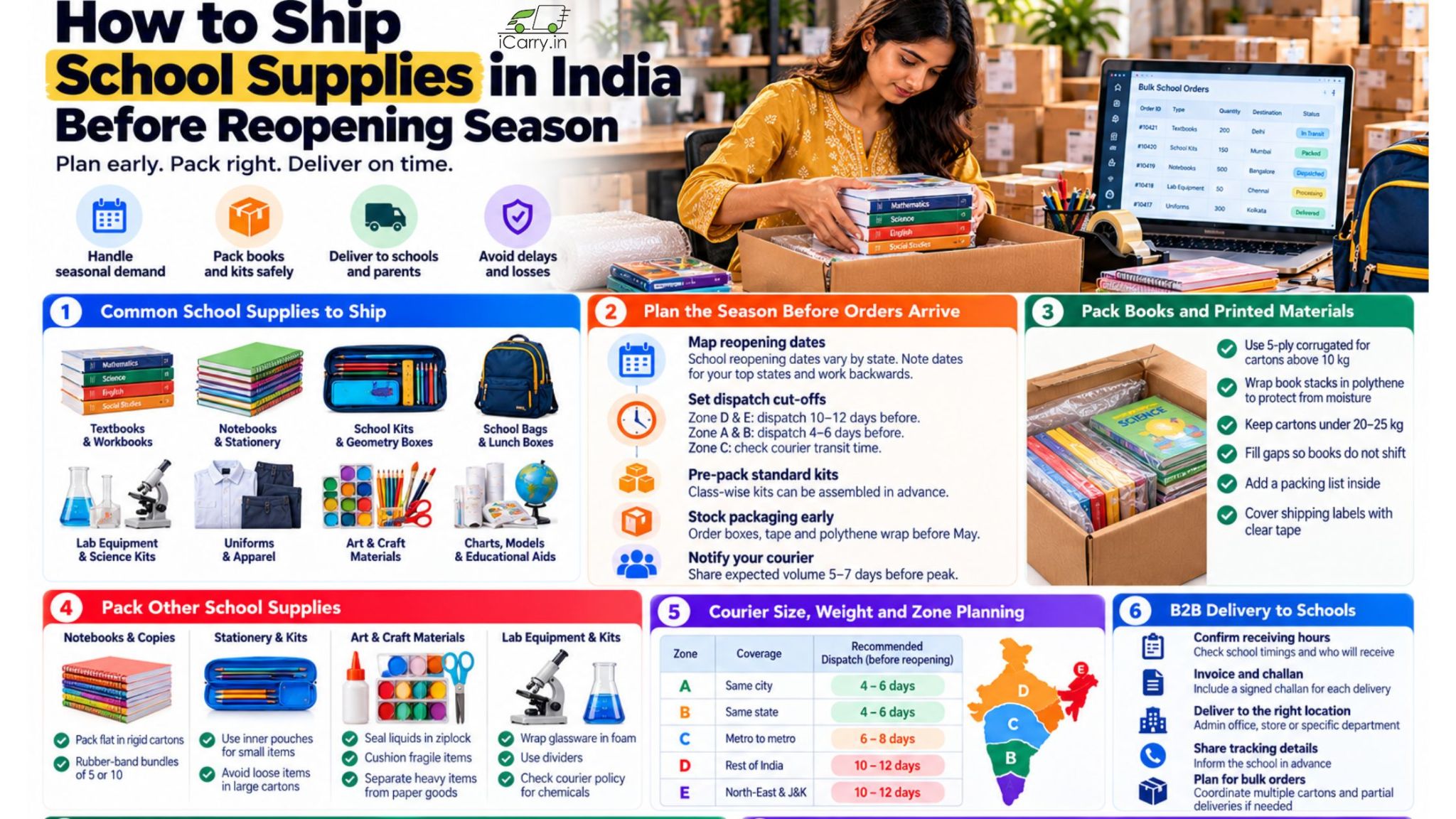
- Map the demand calendar: School reopening dates vary by state. Note the dates for your top 10 states and work backwards from each
- Set dispatch cut-offs: For Zone D and Zone E deliveries, dispatch 10 to 12 days before the reopening date. Zone A and B can dispatch 4 to 6 days before. Couriers typically use Zone A for same-city, B for same-state, C for metro-to-metro, D for the rest of India and E for the North-East and J&K. Zone C falls between the two ranges, so check your courier's transit time for each lane.
- Pre-pack standard kits: Class-wise kits (for example, Class 6 textbook and notebook set) can be assembled in advance, which shortens pick and pack time when orders surge
- Stock packaging early: Order boxes, tape and polythene wrap for peak volumes before May. Supply tightens as the season approaches
- Notify your courier: Tell your courier agent and aggregator support your expected volume 5 to 7 days before the peak, so they can allocate vehicle capacity
Check rates and transit for each zone with the iCarry® domestic rate calculator before you set your cut-off dates.
Packing Books and Printed Materials
Books are dense and heavy. A box of 20 textbooks can exceed 15 kg, and paper is vulnerable to moisture and corner damage.
- Use 5-ply corrugated for cartons above 10 kg. Standard 3-ply boxes split at the base under book weight
- Wrap book stacks in polythene to protect from moisture, especially during monsoon reopening in June and July
- Keep cartons under 20 to 25 kg so they stay within standard courier limits and can be handled by receiving staff
- Fill gaps so books cannot shift. Loose books damage each other's corners
- Add a packing list inside each carton with titles and quantities
- Cover shipping labels with clear tape. Paper labels peel in humid conditions
Packing Notebooks, Stationery and School Kits
- Notebooks and copies: Pack flat in rigid cartons. Rubber-band bundles of 5 or 10 to keep them aligned
- Geometry boxes, pens and stationery: Combine small items in inner pouches so they are not lost in a large carton
- Art and craft materials: Seal liquids in ziplock bags, keep glass items cushioned, and separate heavy items from paper goods
- School bags and lunch boxes: Flatten and compress where possible to reduce volumetric weight. Poly mailers are fine for soft bags under 1 kg
Lab Equipment and Educational Kits
- Glassware (beakers, test tubes, flasks): Individual wrap in foam sheet, dividers between items, FRAGILE and THIS SIDE UP marking
- Chemicals: Many lab chemicals are restricted or classified as dangerous goods. Check courier acceptance policy and provide required documentation before booking
- Electronic kits and robotics: Anti-static bags, foam inserts, and a rigid outer. Declare lithium batteries correctly
- Models and charts: Use rigid corrugated tubes for rolled charts and boxed foam inserts for 3D models
B2B Delivery to Schools, Colleges and Coaching Centres
Institutional deliveries are different from consumer deliveries:
- Confirm receiving hours: Schools often receive deliveries only during office hours and not during exams or events. Confirm a delivery window with the school office
- Identify the receiving person: Get the name and mobile number of the person who will accept the delivery, such as the store in-charge or accounts officer
- Check access: Gates, security procedures and floor level matter for heavy cartons. Plan for a trolley or ground floor drop
- Use linked multi-box bookings: For large orders, book all cartons as one linked consignment so they are tracked and delivered together
- Take a signed delivery challan: Count cartons at delivery, note any shortage or damage, and get the school stamp and signature
Booking a school order with many cartons? See how to book a multi-box B2B shipment on iCarry®.
GST, E-way Bill and Documents
- Printed books: Nil-rated for GST. Since 22 September 2025, exercise books, graph books, laboratory notebooks, pencils, sharpeners, maps and globes are tax-free too, and geometry and colour boxes are at 5%.
- E-way bill: Printed books are on the e-way bill exemption list, so a books-only consignment needs none. For stationery, kits, bags and lab equipment, one is required when the consignment value exceeds ₹50,000, and the value of exempt books is left out of that total. Carry the invoice or challan either way
- Tax invoice and challan: Include the buyer's GSTIN where applicable, carton count, and item quantities. Keep a signed copy as proof of delivery
- Institutional payment terms: Schools and colleges often pay by cheque or bank transfer after delivery. Agree payment terms upfront and avoid COD for large institutional orders
Managing COD and Returns for Individual Parents
- Send a WhatsApp confirmation before dispatching COD orders above ₹499. Parents often order multiple sets and later cancel
- Offer a size and set exchange window for uniforms and kits, and communicate it clearly
- Plan for late-season returns of unused or wrongly ordered books, and decide upfront whether returns are accepted for opened items
How iCarry® Supports Education Supply Sellers
iCarry® is a courier aggregator that helps education suppliers, publishers, and stationery businesses manage shipping through multiple courier partners from one account, especially during busy school reopening and admission seasons.
- Bulk booking: Process multiple orders efficiently using Excel or CSV bulk shipment uploads, helping streamline dispatch when order volumes increase.
- Multi-box B2B booking: Link multiple cartons under one booking for institutional orders and manage B2B multi-box shipments with coordinated tracking.
- Rate comparison before booking: Compare courier rates using actual carton weights and dimensions to help manage delivery costs across different destinations.
- Two-way WhatsApp Engagement: Parents and school contacts can confirm availability, update address details, or coordinate delivery through WhatsApp engagement. Sellers can also view conversation history, helping manage delivery coordination during peak periods.
- Address Quality Scoring: Identify incomplete or potentially problematic delivery addresses before dispatch, helping reduce avoidable delivery failures for shipments going to parents, schools, colleges, and coaching centres.
- Delivery Boost: For time-sensitive school supply orders, Delivery Boost supports additional pre-delivery coordination to help reduce failed delivery attempts.
- Shipment management: Manage bookings and track shipments across available courier partners through one account, making it easier to monitor dispatches during seasonal demand peaks.
Whether you're shipping individual stationery orders to parents or multiple cartons to educational institutions, iCarry® helps simplify shipping operations and compare available courier options.
Free Bronze plan with no minimum shipment volume.
Frequently Asked Questions (FAQs)
How early should I dispatch school supplies before reopening?
Dispatch Zone D and Zone E orders at least 10 to 12 days before the school reopening date, and Zone A and B orders 4 to 6 days before. Courier networks are congested during peak admission and reopening periods, so build a 3 to 5 day buffer on top of normal transit times.
What packaging should I use for heavy textbook orders?
Use 5-ply corrugated boxes for cartons above 10 kg, wrap book stacks in polythene to protect from moisture, and fill gaps so books cannot shift. Keep each carton under 20 to 25 kg and include a packing list. Cover shipping labels with clear tape, especially during monsoon.
Is an e-way bill needed for shipping books and stationery to a school?
Not for printed books, which are on the exemption list. For stationery, kits, bags and lab equipment, yes, when the consignment value exceeds ₹50,000, with the value of exempt books left out of the total. Generate the e-way bill before pickup, use the correct HSN code and GST rate for each item, and keep a signed delivery challan as proof of delivery. Carry the invoice or challan even when no e-way bill is needed.
How do I deliver bulk orders to multiple schools or branches?
Create a separate shipment per location with its own packing list and receiving contact. Book multi-carton orders as a linked multi-box shipment so all cartons travel and arrive together. Confirm delivery windows with each school office, and get a signed challan with the carton count at delivery.
Education supplies ship on a fixed calendar, so the season is won before orders arrive: work dispatch cut-offs back from each state's reopening date (10 to 12 days for Zone D and E, 4 to 6 for Zone A and B), pack books in 5-ply cartons under 25 kg with a packing list inside, and book institutional orders as linked multi-box consignments with a signed challan at delivery. Printed books need no e-way bill, but check the rest of the consignment against the ₹50,000 threshold before pickup.