
A skincare subscription box brand ships 600 boxes on the 5th of every month. Every box has five products, a curated card, and branded tissue. Every customer expects their box on time, in perfect condition, with the unboxing experience they subscribed for. If 40 boxes arrive late, 40 customers question whether the subscription is worth renewing.
Subscription boxes are one of the fastest-growing segments of Indian eCommerce - but they have a logistics profile unlike any other product category. The shipments are predictable and recurring. The delivery window is emotionally significant - subscribers have been waiting since the last box. The packaging is a core part of the product experience. And the economics only work if churn is low, which means logistics cannot afford to disappoint.
India's subscription commerce market is growing rapidly across categories - beauty, food, books, fitness, stationery, kids, and more. Recurring commerce models are gaining traction, part of a D2C market projected to cross USD 100 billion in 2025 (IBEF) across Indian consumer categories as buyers become comfortable with pre-commitment purchases. Getting the logistics right is what turns a good product idea into a sustainable subscription business.
This guide covers everything a subscription box business in India needs to know about recurring fulfilment, packaging, COD, and keeping delivery quality consistent every single month.
What Is Subscription Box Shipping?
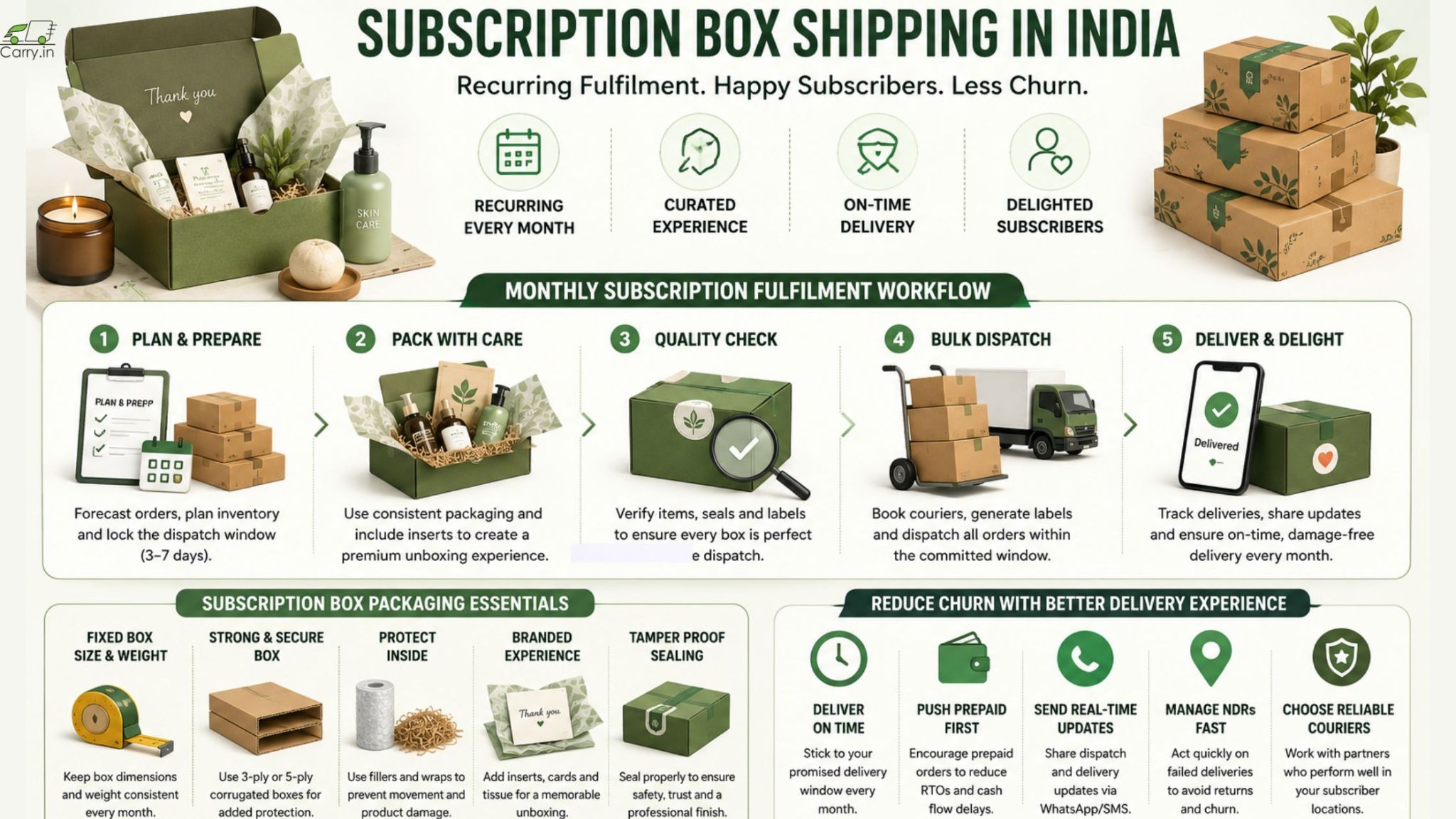
Subscription box shipping means fulfilling and dispatching recurring, curated boxes to the same subscriber base on a fixed monthly schedule, rather than shipping unpredictable one-off orders. It requires locking in consistent box dimensions and weight, planning courier capacity for a compressed 3 to 7 day dispatch window, and treating on-time, undamaged delivery as a retention metric rather than just a logistics outcome - since a late or damaged box directly drives subscriber churn.
How to Check Your Subscription Box Logistics Readiness
- Have you mapped your monthly dispatch timeline from packing start to last delivery date?
- Is your packaging sized and weighted for a specific weight slab - or does it vary month to month?
- Do you have a dedicated dispatch window (2 to 5 days) that allows for bulk booking and consolidated courier pickup?
- Have you decided your COD policy for subscriptions - and tested whether prepaid-only affects subscriber conversion?
- Is your courier aggregator account configured with multiple courier partners for the geographic spread of your subscribers?
- Do you track delivery success rate and late delivery rate as churn indicators, not just logistics metrics?
Why Subscription Box Logistics Is Different From Regular Shipping
Predictable Volume, Compressed Timeline
Standard businesses ship orders as they arrive - spread across the month. Subscription boxes ship almost all orders within a 3 to 7 day window every month. This creates a volume spike that requires pre-planned courier capacity, a packing station capable of processing hundreds of identical boxes in rapid sequence, and a dispatch cutoff that ensures all subscribers receive their box within the same week.
The logistics infrastructure for a subscription business must be sized for the peak dispatch window - not the average daily volume.
Consistent Packaging as Part of the Product
For a standard eCommerce order, the box is packaging. For a subscription box, the box is part of what the customer paid for. The weight, the feel, the printing, the tissue inside, the branded sticker sealing it - all of this is the product experience before a single item is unboxed.
This means packaging decisions for subscription boxes are brand decisions, not just logistics decisions. And the logistics implication is that the box size and weight must be fixed and consistent month to month - otherwise every month is a new volumetric weight calculation and a new rate comparison exercise.
Delivery Timing Expectations
Subscription customers have a conditioned expectation of delivery timing. If your box ships on the 5th and arrives between the 7th and 10th for the first six months, a subscriber who receives it on the 14th in month seven will notice. They might not cancel immediately - but the expectation has been disrupted, and disruption creates churn risk.
Consistent delivery timing is a retention tool as much as a logistics outcome. Businesses that ship on the same date every month, use the same couriers, and communicate proactively when exceptions occur have meaningfully lower churn from logistics causes than those that treat each month's dispatch as a fresh event.
Designing Your Subscription Box Packaging for Logistics
Fix Your Box Dimensions Before Launch
The single most important packaging decision for a subscription business is locking in box dimensions before the first shipment. Once fixed, dimensions should not change without a deliberate review of the logistics implications.
Why it matters: your rate comparison, your courier selection, and your packing line all depend on a known, consistent box size. A box that changes size monthly creates a new volumetric weight each cycle, new rate comparisons, and potential courier restrictions if dimensions exceed thresholds.
Volumetric weight formula: L x B x H (in cm) / 5,000. Your box must be sized so its volumetric weight is as close as possible to its actual filled weight. A 300g box in a 25 x 20 x 15 cm box has a 1,500g volumetric weight - billing at 5x the actual weight. Right-size the box to your product volume, not a standard off-the-shelf size.
Structural Requirements for Monthly Transit
Subscription boxes travel through the full courier handling chain - 4 to 6 handling points for most pan-India deliveries. The box must survive this repeatedly, month after month. Structural requirements:
Minimum 3-ply corrugated for any box above 500g filled weight
5-ply corrugated if the box contains glass, fragile items, or liquids
All internal items secured so they cannot shift in transit - foam inserts, tissue packing, dividers
Box must retain structural integrity if stacked - which it will be, in courier sorting centres
Outer tape on all seams - not just the top flap
Branded Packaging That Survives Transit
Many subscription brands invest in beautiful custom printed boxes - and receive photos of crushed, scuffed, or water-damaged boxes from customers. The printing and branding investment is wasted if the box does not arrive in displayable condition.
Recommendations:
Matte lamination on outer printing protects against minor surface scuffs
Avoid glossy finishes as the primary outer surface - scuff marks show clearly
If the branded box is the experience, consider a plain outer shipping box with the branded box inside. More cost, but protects the brand presentation reliably
For high-end subscription boxes, tissue paper inside a plain outer corrugated with a pull-tab opener maintains surprise while protecting the branded inner box
COD for Subscription Boxes - A Special Challenge
COD and subscription businesses have a structural tension that most subscription founders discover only after launch. COD works on a per-delivery collection model. Subscription works on a recurring commitment model. The two do not sit comfortably together.
The Core Problem
For a monthly subscription, the customer's billing happens before dispatch. For COD, the customer pays when the box arrives. A customer who decides not to renew in month 3 can simply refuse the box at the door - creating an RTO on a box that was curated specifically for them, with products sourced and purchased based on their subscription.
The RTO cost on a subscription box is particularly painful: the box contents cannot typically be separated and resold as individual items (they were curated as a set), the packaging costs are absorbed, and the forward plus return freight is lost.
Should Subscription Boxes Offer COD?
For most subscription models, the right answer is prepaid-only or prepaid-first. The subscription model itself is a commitment - the customer has agreed to receive and pay for a box every month. COD is fundamentally incompatible with this commitment because it allows non-payment at the moment of delivery without any pre-obligation.
However, not offering COD reduces conversion in India's market, particularly for new subscribers who do not know the brand. A practical approach:
First box COD, subsequent boxes prepaid: Allow COD for the first subscription box to reduce the barrier to trial. Collect payment digitally from month 2 onwards once the customer has experienced the product
Prepaid with cancellation flexibility: Offer prepaid with clear monthly cancellation - the customer can cancel before next month's billing. This addresses the commitment aversion that drives COD demand while keeping the business on a manageable remittance model
UPI collect before dispatch: Send a UPI payment request to COD subscribers 3 days before dispatch with a clear message that this month's box ships in 3 days. Those who pay get the box; those who don't are marked as cancelled
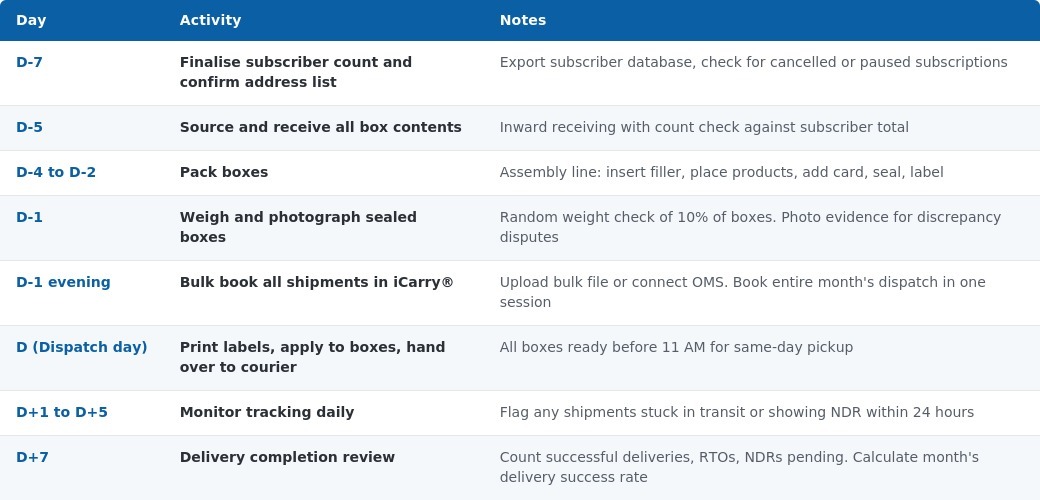
Monthly Fulfilment Workflow for Subscription Boxes
Courier Selection for Subscription Box Businesses
Subscription boxes have a different courier requirement profile from standard businesses. The priorities are:
Consistent performance on the same routes month after month: You are shipping to the same subscriber addresses repeatedly. A courier that performs reliably in Bengaluru and Pune for 6 consecutive months is more valuable than one with a better rate but variable performance
Bulk pickup capability: On dispatch day, you are handing over hundreds of identical boxes at once. Ensure your courier partner has confirmed bulk pickup capacity for your dispatch volume and timeline
Pincode coverage matching your subscriber geography: Map your subscriber addresses against courier serviceability before every month's dispatch. A subscription box that cannot be delivered because the courier does not serve the destination pincode is a guaranteed non-renewal
Consistent tracking quality: Subscription customers track their box obsessively. Couriers with poor tracking update frequency generate significant 'where is my box?' support volume
iCarry® gives subscription businesses access to multiple courier partners - Delhivery, Blue Dart, Xpressbees, Ekart, Amazon Shipping, shree maruti and others - from one account. Compare rates before each month's dispatch and route each box to the best available courier for each subscriber's pincode.
Managing Delivery Exceptions in Subscription Fulfilment
With hundreds of boxes dispatched in a compressed window, even a 3% exception rate means 15 to 30 boxes with problems every month. Managing these proactively is what keeps subscribers retained.
NDR Management for Subscription Boxes
Every failed delivery attempt on a subscription box must be acted on within 24 hours. A subscriber who expects their box and receives an NDR notification without any follow-up from the brand is a churn risk. Act on every NDR before it converts to RTO. The NDR follow-up process is critical for subscription businesses specifically because each RTO represents a subscriber who did not receive the experience they paid for.
Proactive Subscriber Communication
Send subscribers a dispatch confirmation with a tracking link the moment their box ships. Send an out-for-delivery notification when the courier updates status. For boxes that experience NDR, proactively reach out to reschedule before the subscriber contacts you.
iCarry®'s two-way WhatsApp engagement enables proactive delivery coordination on the seller's behalf. When a subscriber's delivery fails, the coordination team contacts them via WhatsApp to reschedule - and the subscriber can reply to confirm a new delivery window, update their address, or flag an access issue. The subscription brand has full visibility of every conversation.
Delivery Boost for Subscription COD Boxes
For subscription businesses that do offer COD on first-box trials, iCarry®'s Delivery Boost reduces first-box RTO by calling the new subscriber before delivery, confirming their availability, and auditing fake non-delivery reports. A good first-box delivery experience is the primary driver of renewal to a prepaid subscription.
Subscription Box Shipping Cost Management
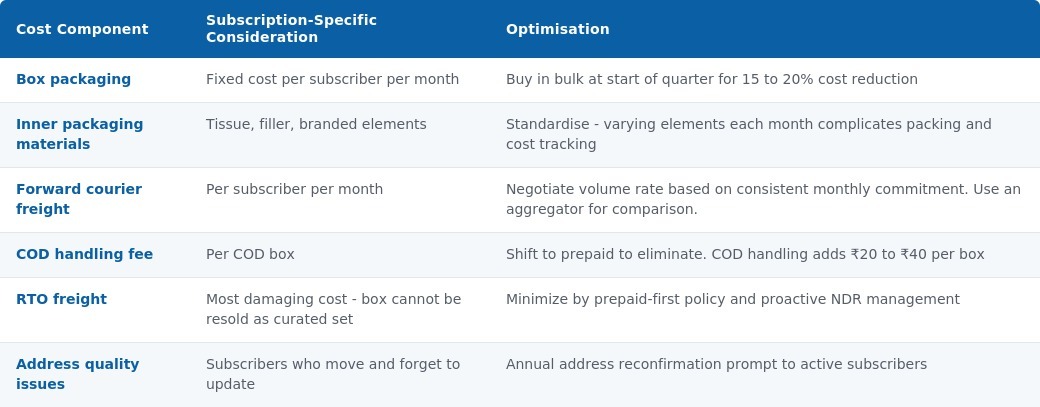
The hidden costs in subscription box shipping - weight discrepancy charges on boxes where the fill varies month to month, ODA surcharges on subscribers in remote pincodes - should be tracked against the subscriber and factored into whether that subscriber's zone is profitable at your current price point.
How iCarry® Supports Subscription Box Businesses
iCarry® is a courier aggregator built for all types of Indian businesses - including subscription box brands with recurring monthly dispatch needs:
Bulk booking: Book the entire month's subscriber dispatch in one session. Select all orders, choose courier, confirm - all boxes processed simultaneously
Multiple courier partners: Route each subscriber's box to the best available courier for their pincode
Two-way WhatsApp engagement: Proactive delivery coordination for subscribers experiencing delivery issues. Full conversation visibility for the subscription brand
Delivery Boost: For COD trial boxes, reduces first-box RTO and improves conversion to renewal
Address Quality Scoring: Pre-dispatch validation flags subscriber addresses that have become incomplete or high-risk since their last delivery
Free daily COD remittance: Automatic T+7 settlement for subscription COD boxes. Early remittance available for businesses managing tight monthly cash cycles
Weight discrepancy management: Pre-upload standard box images for auto-dispute triggering when couriers raise discrepancy charges on your monthly subscription dispatch
Free Bronze plan - no monthly fee, no minimum volume. Register at iCarry today.
Final Thoughts
Subscription box businesses have a logistics advantage most other Indian businesses do not - predictable monthly volume that enables planning, negotiation, and optimisation in ways that unpredictable daily orders cannot. The dispatch window is known. The box size is fixed. The subscriber list is defined.
The businesses that use this predictability well - standardising packaging, negotiating volume rates, dispatching in bulk, managing NDRs proactively, and converting COD subscribers to prepaid after month one - build shipping operations that compound their margin improvement every month.
The ones that treat each month's dispatch as an independent logistics event, without the planning and consistency that the subscription model makes possible, leave significant margin on the table while also creating churn through inconsistent delivery experience.
iCarry® supports subscription businesses with bulk booking, multi-courier access, delivery management tools, and daily COD remittance - all from a free plan. Start shipping smarter with iCarry.
Watch How to Estimate Shipment Cost on iCarry.in to see how rate comparison works before your next month's bulk dispatch.
Frequently Asked Questions (FAQs)
How do subscription box businesses manage monthly shipping in India?
Subscription businesses plan a 2 to 5 day dispatch window each month. Boxes are packed in bulk, weighed, labelled, and bulk-booked with a courier aggregator in one session. All boxes for the month ship within the same window to ensure consistent delivery timing. Tracking is monitored daily and NDRs are acted on within 24 hours.
Should subscription boxes offer COD in India?
Most subscription businesses are better served by prepaid-first or prepaid-only. COD is structurally incompatible with subscription because customers can refuse the box without prior cancellation - creating an RTO on a curated, non-resalable box. A practical compromise: allow COD for the first box to reduce trial friction, then shift subscribers to prepaid from month two.
What packaging should Indian subscription box businesses use?
Lock in box dimensions before launch and keep them consistent. Use minimum 3-ply corrugated - 5-ply if boxes contain glass or liquids. Secure all internal items to prevent movement. For branded boxes, either laminate the outer print or use a plain outer shipping box with the branded box inside. All seams taped, not just the top flap.
How do I reduce RTO on subscription box deliveries?
Shift as many subscribers as possible to prepaid - prepaid RTO rates are 3 to 8% versus 20%+ for COD. For remaining COD boxes, use Delivery Boost to reduce fake NDRs. Send two-way WhatsApp communication updates so subscribers know when their box is out for delivery. Act on every NDR within 24 hours.
How do I handle subscribers who move address?
Send an address reconfirmation request to all active subscribers 7 to 10 days before each month's dispatch. A simple form or WhatsApp message asking them to confirm or update their delivery address. Subscribers who have moved and forgotten to update their address are a guaranteed delivery failure and RTO.
Does iCarry® support bulk booking for subscription dispatch?
Yes. iCarry® supports bulk shipment booking - select all subscriber orders for the month, choose courier parameters, and process the entire dispatch in one action. Multiple courier partners available with rate comparison. Tracking, NDR management, and COD remittance all managed from the same dashboard for the entire subscriber base.
Subscription box businesses have a logistics advantage most other Indian businesses do not - predictable monthly volume that enables planning, negotiation, and optimisation in ways that unpredictable daily orders cannot. The businesses that use this predictability well - standardising packaging, negotiating volume rates, dispatching in bulk, managing NDRs proactively, and converting COD subscribers to prepaid after month one - build shipping operations that compound their margin improvement every month, while treating on-time, undamaged delivery as the retention metric it truly is.