Introduction
India's eCommerce growth is no longer limited to metros like Delhi, Mumbai, or Bengaluru. Over the last few years, Tier-2 and Tier-3 cities have emerged as the fastest-growing markets, driven by increasing internet penetration, digital payments adoption, and rising consumer demand.
Exporting this growth further, regional logistics in Tier-2 cities plays a critical role in ensuring fast, cost-efficient deliveries, making it a key factor for eCommerce scalability in India.
Cities like Jaipur, Indore, Lucknow, Coimbatore, and Surat are contributing significantly to online order volumes. Industry data from the Internet and Mobile Association of India (IAMAI) shows that a growing share of online orders now originates from Tier-2 and Tier-3 cities across India. However, serving these markets efficiently requires a different logistics strategy compared to metro cities, especially when businesses aim to optimize delivery speed and cost across regions.
Regional logistics in Tier-2 cities involves managing transportation, warehousing, and last-mile delivery across semi-urban and developing infrastructure environments, making last-mile execution a critical success factor.
Businesses must balance cost, speed, and delivery reliability while navigating challenges such as limited infrastructure and fragmented courier networks. Logistics performance and infrastructure quality play a critical role in determining delivery efficiency across regions as documented in the World Bank's Logistics Performance Index.
For eCommerce brands, logistics operators, and supply chain professionals, understanding regional logistics dynamics is critical for unlocking growth in India's next wave of digital commerce and managing end-to-end supply chain operations effectively.
What is Regional Logistics in Tier-2 Cities?
Regional logistics in Tier-2 cities refers to the management of transportation, warehousing, and delivery operations across non-metro urban areas.
It typically includes:
- Intercity transportation
- Regional warehousing
- Local distribution networks
- Last-mile delivery
In simple terms:
Regional logistics ensures that products move efficiently from warehouses to customers in Tier-2 cities and surrounding regions.
Why Tier-2 Logistics is Crucial for eCommerce Growth
Tier-2 cities are rapidly becoming the backbone of India's eCommerce expansion.
Key growth drivers include:
- Rising demand: More first-time online buyers
- Untapped markets: Lower competition
- Higher order volumes: Increasing repeat purchases
- Expansion potential: Scaling beyond Tier-1 saturation
For eCommerce businesses, expanding into Tier-2 markets is no longer optional. It is a strategic growth move.
Core Components of Regional Logistics
Regional Warehousing
Warehouses closer to Tier-2 cities reduce delivery timelines and transportation costs.
Line-Haul Transportation
Connects metro hubs with regional centers using road and rail networks.
Last-Mile Delivery
Depends on local courier partners, franchise models, and hyperlocal delivery networks.
Courier Partner Network
Courier companies ensure connectivity across regions through efficient courier network selection.
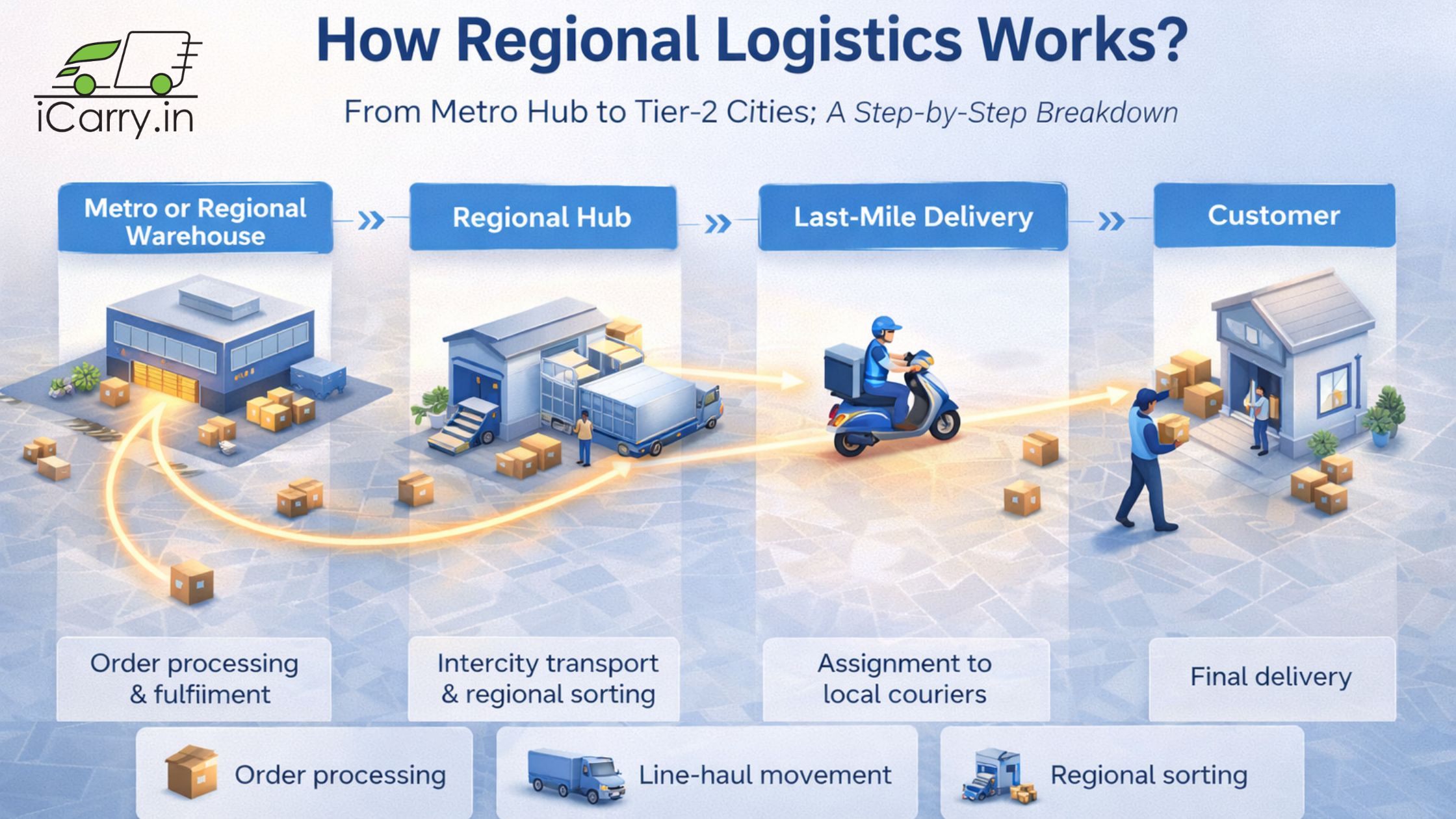
How Regional Logistics Works (Step-by-Step Flow)
- Order processing: At metro or regional warehouses
- Line-haul movement: Transport to regional hubs
- Regional sorting: Allocation to delivery centers
- Last-mile delivery: Final customer delivery
This structured flow improves delivery speed and reduces operational inefficiencies.
Tier-1 vs Tier-2 Logistics: Key Differences
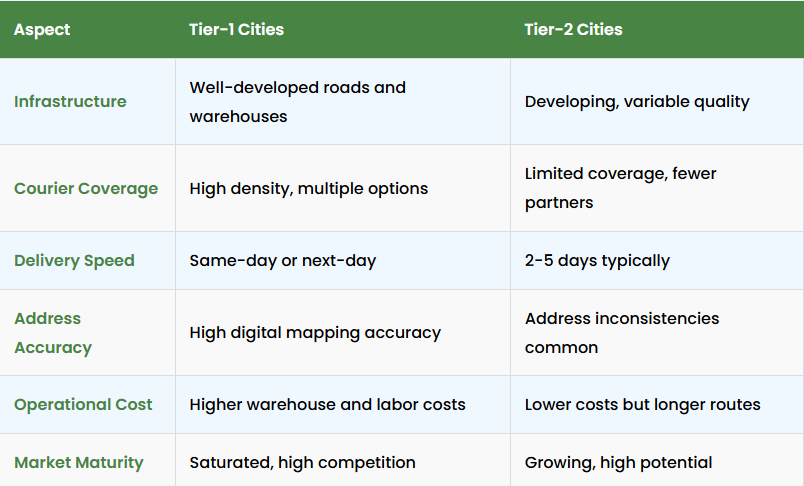
Insight: Tier-2 logistics requires localized strategies, not metro replication.
Challenges in Tier-2 Logistics
- Infrastructure limitations - Developing road networks and warehouse facilities
- Courier coverage gaps - Fewer delivery partners with consistent service
- Longer transit routes - Distance from metro hubs increases delivery time
- Address inconsistencies - Poor digital mapping and incomplete addresses
- Demand variability - Seasonal fluctuations and unpredictable order volumes
👉 These challenges directly impact delivery success rates and cost efficiency.
Benefits of Investing in Tier-2 Logistics
- Market expansion into underserved regions - Access to millions of new customers
- Lower operational costs - Reduced warehouse rent and labor expenses
- High growth potential - Faster year-over-year growth than metros
- Early mover advantage - Less competition compared to saturated Tier-1 markets
Common Mistakes to Avoid
- Over-reliance on metro warehouses - Increases transit time and costs
- Ignoring courier performance variations - Not all partners perform equally in regional markets
- Poor inventory distribution - Stocking wrong products in regional warehouses
- Applying Tier-1 strategies blindly - What works in metros may fail in Tier-2 cities
Best Practices for Optimizing Regional Logistics
Set up regional fulfillment centers
Establish warehouses closer to Tier-2 clusters to reduce delivery timelines and transportation costs.
Use multi-courier networks
Partner with multiple courier providers to ensure coverage across different regions. Implementing multi-courier allocation strategies improves delivery success rates.
Optimize transport routes
Plan efficient line-haul routes between metro hubs and regional centers to minimize transit time.
Improve address intelligence
Invest in address verification systems and local knowledge to reduce failed deliveries.
Track logistics KPIs
Monitor delivery success rates, transit times, RTO rates, and courier performance by region.
Key Data & Insights
- Over 50% of orders now come from Tier-2/Tier-3 cities - Non-metro markets dominate growth
- Delivery timelines: 2–5 days - Typical range for Tier-2 deliveries
- Faster growth vs metro markets - Year-over-year expansion outpaces Tier-1 cities
Localized supply chain strategies significantly improve efficiency and reach according to research from BCG's supply chain management practice.
Strengthening Tier-2 Logistics with Better Visibility
As operations expand across Tier-2 cities, managing multiple courier partners and tracking delivery performance becomes increasingly complex. Businesses often struggle with fragmented systems, limited tracking visibility, and inconsistent delivery performance across regions.
In such scenarios, centralized logistics workflows help improve operational clarity. iCarry enables businesses to manage courier allocation, monitor shipment performance, and maintain visibility across regional logistics operations. This allows companies to improve delivery success rates, reduce delays, and scale efficiently in Tier-2 markets.
Conclusion
Regional logistics in Tier-2 cities is becoming a critical growth driver for India's eCommerce ecosystem. As demand continues to rise, businesses must adapt logistics strategies to match regional realities.
By investing in regional warehousing, optimizing courier networks, and improving last-mile delivery operations, companies can unlock significant growth opportunities.
In Tier-2 markets, success is not just about reaching customers. It is about delivering consistently, efficiently, and at scale.
Frequently Asked Questions (FAQs)
What is regional logistics in Tier-2 cities?
It refers to managing transportation, warehousing, and delivery operations in non-metro regions.
Why are Tier-2 cities important?
They are the fastest-growing eCommerce markets in India with high growth potential and lower competition.
What are key challenges?
Infrastructure gaps, courier coverage issues, address inconsistencies, longer transit routes, and demand variability.
How to improve logistics?
Use regional warehouses, multiple courier partners, and optimize delivery routes while tracking performance KPIs.
What is typical delivery time?
Typically 2–5 days, depending on network efficiency and distance from regional hubs.
Regional logistics in Tier-2 cities involves managing transportation, warehousing, and last-mile delivery across non-metro urban areas—enabling eCommerce businesses to unlock India's fastest-growing markets by establishing regional fulfillment centers, optimizing multi-courier networks, and adapting strategies to match local infrastructure and delivery realities.