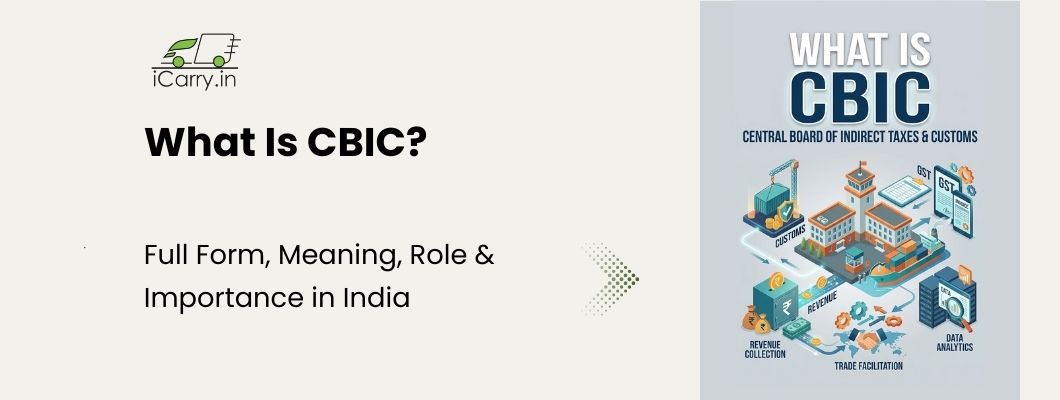
CBIC (Central Board of Indirect Taxes and Customs) is the apex government authority responsible for administering GST, customs duties, and central excise in India. It functions under the Ministry of Finance, within the Department of Revenue, and works alongside the Goods and Services Tax Council to implement GST policy and customs regulation across India.
CBIC doesn't collect income tax - but it controls how goods move, how GST works, and how India trades with the world through customs and export compliance frameworks.
This guide explains what CBIC is, what it does, and why it matters for businesses and taxpayers.
What Is CBIC?
CBIC is the apex policy-making body for indirect taxes and customs in India.
In simple words:
CBIC manages GST, customs duties, and indirect tax administration across the country.
It functions under the Ministry of Finance, Government of India.
CBIC Comes Under Which Ministry?
CBIC functions under the Ministry of Finance, Government of India. It operates within the Department of Revenue and is responsible for indirect tax administration at the national level.
What Taxes Fall Under CBIC?
CBIC oversees:
Goods and Services Tax (GST)
Customs duty (imports & exports), including documentation requirements and certification processes for cross-border trade such as free sale certificates and health certificates for exports.
Central Excise (limited goods like petroleum & tobacco)
Direct taxes like income tax fall under a different authority.
Key Functions of CBIC
1. GST Administration & Policy
CBIC:
- Drafts GST rules and notifications
- Issues circulars and clarifications
- Oversees GST implementation nationwide
It ensures GST laws are uniformly applied across states through the GST portal and related systems.
2. Customs Administration
As India's central customs authority, CBIC manages:
- Import and export clearance
- Customs duty collection
- Anti-smuggling operations
- Trade facilitation
Every international shipment passes through CBIC-controlled systems such as ICEGATE.
3. Revenue Collection
CBIC is responsible for:
- Collecting indirect tax revenue
- Preventing tax evasion
- Ensuring compliance
Indirect taxes administered by CBIC contribute a significant portion of India's annual central revenue collections.
4. Enforcement & Compliance
CBIC enforces laws through:
- Audits and inspections
- Anti-evasion drives
- Intelligence units
- Adjudication mechanisms
Its role is both regulatory and enforcement-oriented.
5. Trade Facilitation
Beyond enforcement, CBIC also:
- Simplifies procedures
- Digitises processes
- Reduces clearance time
Modern CBIC focuses on ease of doing business.
CBIC Structure (High Level)
The CBIC structure in India operates through:
- Central GST (CGST) formations
- Customs field offices
- Directorates (audit, intelligence, vigilance)
- Regional and local commissionerates
These formations ensure that CBIC policies are implemented uniformly across states and ports.
It has a nationwide operational footprint.
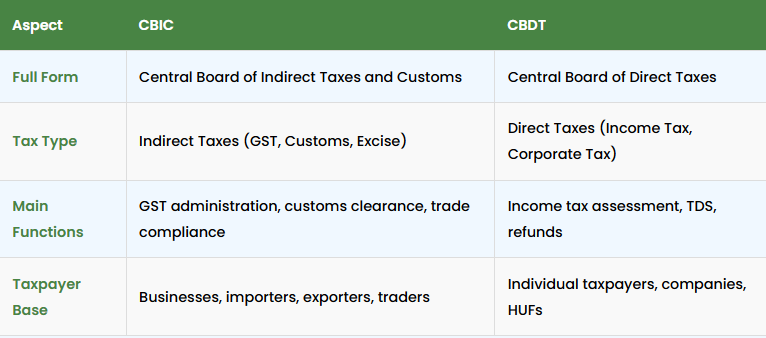
CBIC vs CBDT - What's the Difference Between Indirect and Direct Tax Authorities?
Both CBIC and CBDT function under the Ministry of Finance. However, CBIC focuses on taxation linked to goods, services, and trade, while CBDT focuses on income-based taxation.
Why CBIC Matters for Businesses
CBIC decisions affect GST compliance and refunds, import/export timelines, customs duties and exemptions - all of which directly influence shipping cost structures and operational efficiency.
For businesses, CBIC rules directly impact cost, cash flow, and speed.
Major CBIC Reforms in Recent Years
1. GST Implementation
CBIC played a central role in rolling out GST, replacing multiple indirect taxes with a single system.
2. Faceless & Digital Systems
Introduced:
- Online GST registrations
- E-invoicing
- ICEGATE for customs
- Faceless assessments
Reduced human interface = fewer delays.
3. Faster Customs Clearance
Reforms led to:
- Risk-based inspections
- Reduced documentation
- Faster port clearance
India's logistics efficiency improved significantly, particularly in reducing port delays and improving end-to-end supply chain coordination.
4. Trade Facilitation Measures
CBIC aligned with global standards to:
- Promote exports
- Reduce compliance burden
- Improve ranking in ease-of-doing-business metrics
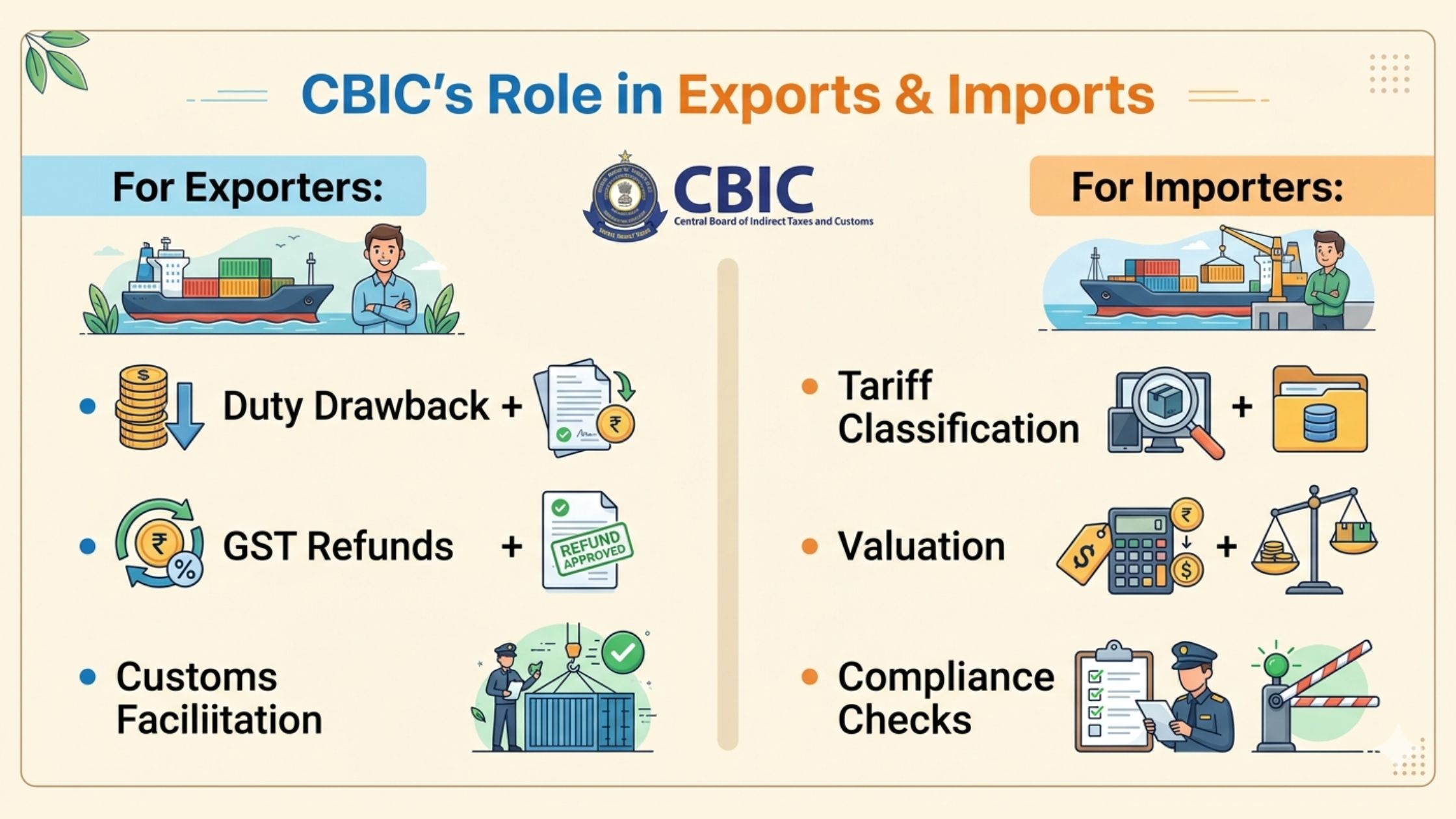
CBIC's Role in Exports & Imports
For exporters:
- Duty drawback
- GST refunds
- Customs facilitation
For importers:
- Tariff classification
- Valuation
- Compliance checks
CBIC influences cross-border competitiveness, especially for businesses operating in free trade zones and special export categories.
Challenges Faced by CBIC
Despite significant reforms, CBIC continues to face structural and operational challenges. These include complex GST compliance requirements for MSMEs, ongoing litigation and interpretation disputes, technology transition issues during digital transformation, and the constant need to balance enforcement with trade facilitation. As India's indirect tax framework evolves, continuous reform remains necessary to improve clarity, efficiency, and compliance.
CBIC in the Future
Going forward, CBIC is expected to strengthen AI-based compliance checks, adopt predictive risk management systems, expand digitisation across customs and GST processes, and further simplify taxpayer interfaces. The long-term vision is to build a trust-based, technology-driven indirect tax administration that improves transparency while reducing compliance burden.
Final Thoughts
CBIC is not just a tax authority - it's a gatekeeper of India's trade and consumption economy.
For businesses and professionals:
- Understanding CBIC means fewer surprises
- Better compliance
- Faster operations
In indirect taxes and customs:
If you understand CBIC, you understand how the broader trade and logistics ecosystem functions.
Regulatory clarity is only one part of operational success - consistent execution and efficient logistics processes matter just as much.
CBIC regulations directly influence customs clearance timelines, GST refund cycles, documentation compliance, and overall import-export cost structures. For businesses involved in cross-border shipments, even small regulatory delays can lead to higher operational costs and additional cash flow pressure.
To manage these complexities, many businesses rely on logistics platforms such as iCarry.in that help streamline shipping workflows, reduce customs related bottlenecks, and support compliance-driven logistics operations.
Frequently Asked Questions (FAQs)
Q1. What is the full form of CBIC?
CBIC stands for Central Board of Indirect Taxes and Customs.
Q2. Is CBIC under GST?
CBIC administers GST implementation and policy at the national level under the Ministry of Finance.
Q3. What is the difference between CBIC and CBDT?
CBIC handles indirect taxes like GST and customs, while CBDT manages direct taxes like income tax.
Q4. Under which ministry does CBIC work?
CBIC works under the Ministry of Finance, Government of India.
Q5. Is CBIC the Same as GST?
No, CBIC is not the same as GST. GST is a tax system, while CBIC is the government authority responsible for administering and enforcing GST laws along with customs and excise regulations.
CBIC (Central Board of Indirect Taxes and Customs) is India's apex authority for GST administration, customs duties, and trade compliance—it functions under the Ministry of Finance and directly impacts business costs, cash flow, and import-export operations through policy, enforcement, and digital facilitation systems.