Introduction
You book an order on Monday. By Thursday, your customer has it at their doorstep. No trips to a courier office. No standing in queues. No chasing someone to collect the parcel. That is what a door-to-door courier service actually means - and for most eCommerce sellers in India, it is the only way shipping should work.
Instead of requiring customers or businesses to drop off or collect shipments at courier hubs, D2DC services ensure that:
- Shipments are picked up from the sender's location
- Transported through logistics networks
- Delivered directly to the recipient's doorstep
India's eCommerce market hit $125 billion in 2024 and is projected to reach $345 billion by 2030. For eCommerce brands, SMEs, and exporters, D2DC services are what make that scale possible - simplifying logistics, improving customer experience, and reducing operational friction.
This guide explains what door-to-door courier services are, how they work, pricing models, benefits, and best practices for efficient logistics operations.
What is Door-to-Door Courier Service?
Door-to-door courier service is a logistics model where a shipment is picked up directly from the sender's location and delivered to the recipient's address - without requiring either party to visit a courier office. The courier manages the entire journey: first-mile pickup, transit through sorting hubs, and last-mile delivery to the doorstep.
Quick Checklist: Is Your D2DC Shipping Set Up Right?
Most sellers use D2DC shipping without ever optimising it. Check these 6 things first:
- Are pickups being scheduled before 11 AM for same-day dispatch?
- Is your packaging right-sized to avoid volumetric weight overbilling?
- Are you using more than one courier partner, or locked into one?
- Are you validating customer addresses before booking?
- Are you following up on NDRs within 24 hours?
- Are you tracking RTO rate by courier and pin-code?
What is Door-to-Door Courier Service (D2DC)?
Door-to-Door courier service (D2DC) is a logistics model where the courier company manages the entire shipment journey - from pickup at the sender's location to delivery at the recipient's doorstep.
In simple terms, the process is seamless: the package is picked up from your location and delivered directly to your customer, eliminating the need for manual drop-offs or additional handling.
Why Door-to-Door Courier Services Matter?
By managing the entire shipment journey - from pickup to final delivery - D2D services simplify logistics and improve overall efficiency.
Convenience
D2DC courier services eliminate the need for manual drop-offs. Shipments are picked up directly from your home, office, or warehouse, saving effort and streamlining the shipping process.
Time Efficiency
With end-to-end handling managed by courier partners, businesses can reduce operational delays and ensure faster order processing and delivery.
Improved Customer Experience
Direct doorstep delivery enhances reliability and ensures a smooth post-purchase experience, leading to higher customer satisfaction and repeat orders. Research consistently shows that delivery quality directly shapes how shipping experience impacts customer retention and repeat purchase rates.
Operational Simplicity
By outsourcing logistics to D2DC providers, businesses can focus on core activities such as sales, marketing, and growth, without worrying about shipping complexities.
Core Components of Door-to-Door (D2DC) Logistics
A typical door-to-door (D2DC) delivery process is made up of multiple interconnected stages that work together to ensure smooth and timely shipment movement from sender to recipient.
First-Mile Pickup
The process begins with the courier partner collecting the shipment directly from the sender's location, such as a warehouse, retail store, or office. Efficient first-mile pickup ensures faster dispatch and reduces initial delays. On iCarry®, shipments booked before 11 AM are usually picked up the same day.
Line-Haul Transportation
This long-distance movement, known as line-haul, is critical for connecting different cities and regions efficiently. The underlying structure is explained in detail in the guide on how hub-and-spoke logistics networks work in India. India's National Logistics Policy (NLP) targets a top-25 position in the World Bank Logistics Performance Index by 2030 - which means the line-haul backbone is getting faster and more reliable every year.
Sorting & Distribution
At sorting centres, packages are organised based on their destination. Advanced sorting systems help optimise routing, reduce transit time, and improve overall delivery accuracy.
Last-Mile Delivery
This is also the most challenging part of the process. The full picture of last-mile delivery challenges in India and how to solve them covers why Tier-2 and Tier-3 cities present unique difficulties and what sellers can do about it.
Step-by-Step D2DC Process
Understanding the complete D2DC shipping workflow helps businesses streamline logistics operations, reduce delays, and improve delivery efficiency.
Step 1: Order Booking
The process begins with booking the shipment through a courier platform or a logistics aggregator. This step captures essential details such as pickup location, delivery address, package weight, and service type.
Video: How to Book a Shipment and Select Your Preferred Courier on iCarry®
Step 2: Pickup Scheduling
Once the order is booked, the courier partner schedules a pickup based on location, availability, and service timelines, ensuring timely dispatch. On iCarry®, a pickup request is automatically generated when you book - you do not need to call anyone.
Step 3: Shipment Pickup
The package is collected directly from the sender's location - whether it is a warehouse, office, or retail store - marking the start of the shipping journey. The pickup executive will call before arriving. Always get their name and signature on the manifest copy for your records.
Video: How to Print Shipment Label and Manifest on iCarry®
Step 4: Transit Movement
After pickup, the shipment moves through a hub-and-spoke logistics network, passing through multiple sorting hubs and transit points to reach the destination city.
Step 5: Last-Mile Delivery
The shipment is assigned to a delivery agent and transported to the final destination, ensuring doorstep delivery to the customer.
Step 6: Delivery Confirmation
Once delivered, the customer receives confirmation along with real-time tracking updates, completing the shipment lifecycle. You can monitor all your shipments - from pending pickup through to delivered or returned - from a single view.
Video: Overview of My Shipments Dashboard on iCarry®
Real-World Use Cases of D2DC Courier Services
Door-to-door courier services are widely used across different business models to simplify logistics and improve delivery efficiency.
eCommerce Fulfilment
Online sellers use D2DC services to ship products directly from warehouses to customers - for faster deliveries and better order management. Whether you are selling on Shopify, WooCommerce, Meesho, or your own website, D2DC courier networks are the backbone of order fulfilment.
SME Logistics
Small and medium businesses use D2DC solutions to send parcels without the need to visit courier offices, saving time and effort. For a business shipping even 10 to 20 orders a day, the time saved by having pickup come to you - rather than going to the courier - compounds quickly across a month.
Cross-City Shipping
Businesses rely on D2DC networks to deliver products across cities efficiently, ensuring wide reach and consistent serviceability. iCarry® currently covers 29,000+ pincodes across India.
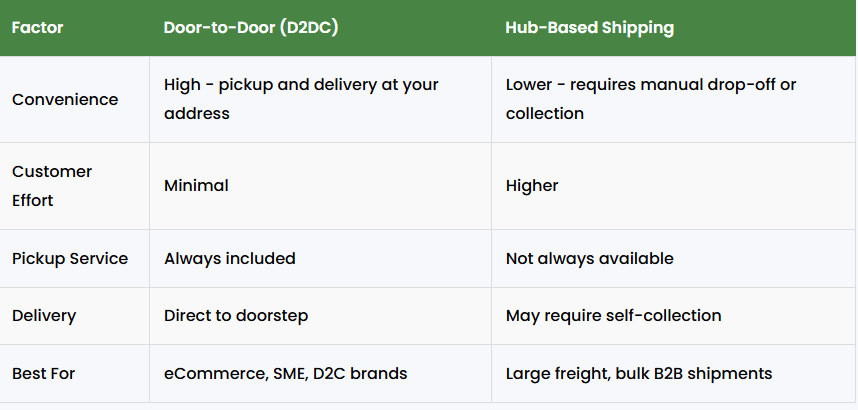
Door-to-Door vs Hub-Based Shipping
Best Door-to-Door Courier Services in India for eCommerce
There is no single best courier for every seller in India. The right choice depends on your product type, average order weight, delivery zones, and return rate. What matters more than picking one courier is how you manage multiple couriers together.
Here is what to look for when evaluating a D2DC service for eCommerce:
- Pin-code coverage - Does it deliver to your top customer locations, including Tier-2 and Tier-3 areas?
- Delivery success rate - How often does it deliver on the first attempt? Lower RTO means lower losses.
- Weight handling - Is it strong on lightweight parcels (fashion, accessories) or heavier products (electronics, home goods)?
- COD remittance speed - How quickly does cash-on-delivery money get credited back to you?
- NDR management - Can you reattempt failed deliveries quickly and with clear reason codes?
The smarter approach for most eCommerce sellers is to use a multi-courier platform like iCarry® - which gives you access to 10+ courier partners in one place. You compare rates, select the best courier per order, and manage everything from one dashboard. No volume minimums. No lock-in.
Pricing Structure of D2DC Courier Services
Understanding how pricing works helps you avoid overpaying and catch charges you were not expecting. For context: India's logistics costs sit at around 8-9% of GDP - among the highest in Asia - which is exactly why every rupee saved on shipping directly impacts your margins.
Key Cost Factors
- Weight: Actual weight or volumetric weight - whichever is higher is billed
- Distance: Local, regional, or national shipping zone
- Service Type: Standard surface or express air delivery
- Pickup Charges: May be included or charged separately depending on courier
- COD Charges: Extra fees for cash-on-delivery orders - a fixed charge plus a percentage of order value
One cost that catches many sellers off guard is volumetric weight billing. If your box is larger than it needs to be, you get charged for the space it occupies - not just its actual weight. Understanding how hidden shipping charges accumulate while sending shipments within India is essential before you lock in your packaging and courier choices.
Typical Pricing in India (Indicative, Subject to Change)
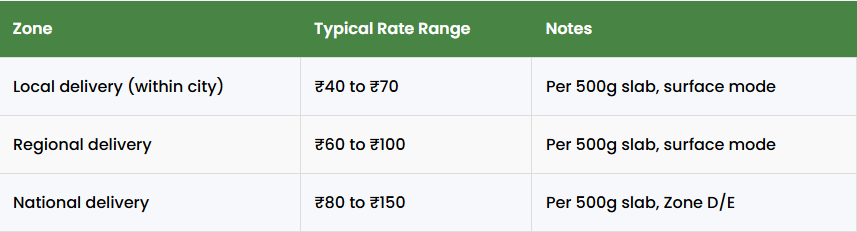
Rates vary by courier partner, weight slab, and plan. You can compare live rates across multiple courier partners for your specific pin-code and weight on iCarry®'s free rate calculator - no login needed.
Video: How to Estimate Shipment Cost on iCarry®
Benefits of Door-to-Door Courier (D2DC) Services
Door-to-door (D2DC) logistics offers significant advantages for businesses of all sizes by simplifying shipping operations and improving delivery efficiency.
End-to-End Convenience
D2DC services handle the entire shipment lifecycle - from pickup to final delivery - eliminating the need for manual intervention and reducing operational effort.
Faster Operations
With streamlined pickup, transit, and delivery processes, D2DC logistics enables quicker order fulfilment and faster shipping timelines.
Better Tracking and Visibility
Real-time tracking systems provide complete visibility into shipment status, allowing businesses and customers to stay informed at every stage. If you want to know which tracking and delivery KPIs to monitor, this guide to logistics KPIs for eCommerce covers the benchmarks that matter most.
Scalability for Growth
D2DC services make it easy for businesses to scale operations during peak demand without adding logistical complexity or infrastructure. Whether you are shipping 50 orders a day or 5,000, the same pickup-to-delivery model scales with you.
Challenges in Door-to-Door (D2DC) Logistics
Despite its benefits, D2D shipping also presents certain operational challenges that businesses must manage effectively.
Pickup Delays
Missed or delayed pickups can disrupt the entire delivery schedule, leading to slower dispatch and potential customer dissatisfaction. On iCarry®, shipments not picked within 5 days are automatically cancelled, so staying on top of pickup status is important.
Address Accuracy Issues
Incorrect or incomplete delivery addresses can result in failed deliveries, increased returns, and additional operational costs. This is one of the most common triggers for NDRs. Understanding how to use NDR data to improve delivery success helps you identify and fix address accuracy problems at scale.
Last-Mile Delivery Complexity
Deliveries in remote locations or densely populated areas can be challenging, often causing delays and inefficiencies in the final stage. Tier-2 and Tier-3 cities see structurally higher failed delivery rates than metros.
Cost Variability
Shipping costs may fluctuate depending on factors such as demand, distance, fuel prices, and service type, impacting overall logistics expenses. Weight discrepancies - where the courier bills you for a higher weight than declared - are a frequent source of unexpected charges. How to dispute and reduce weight discrepancy charges explains exactly how to protect yourself.
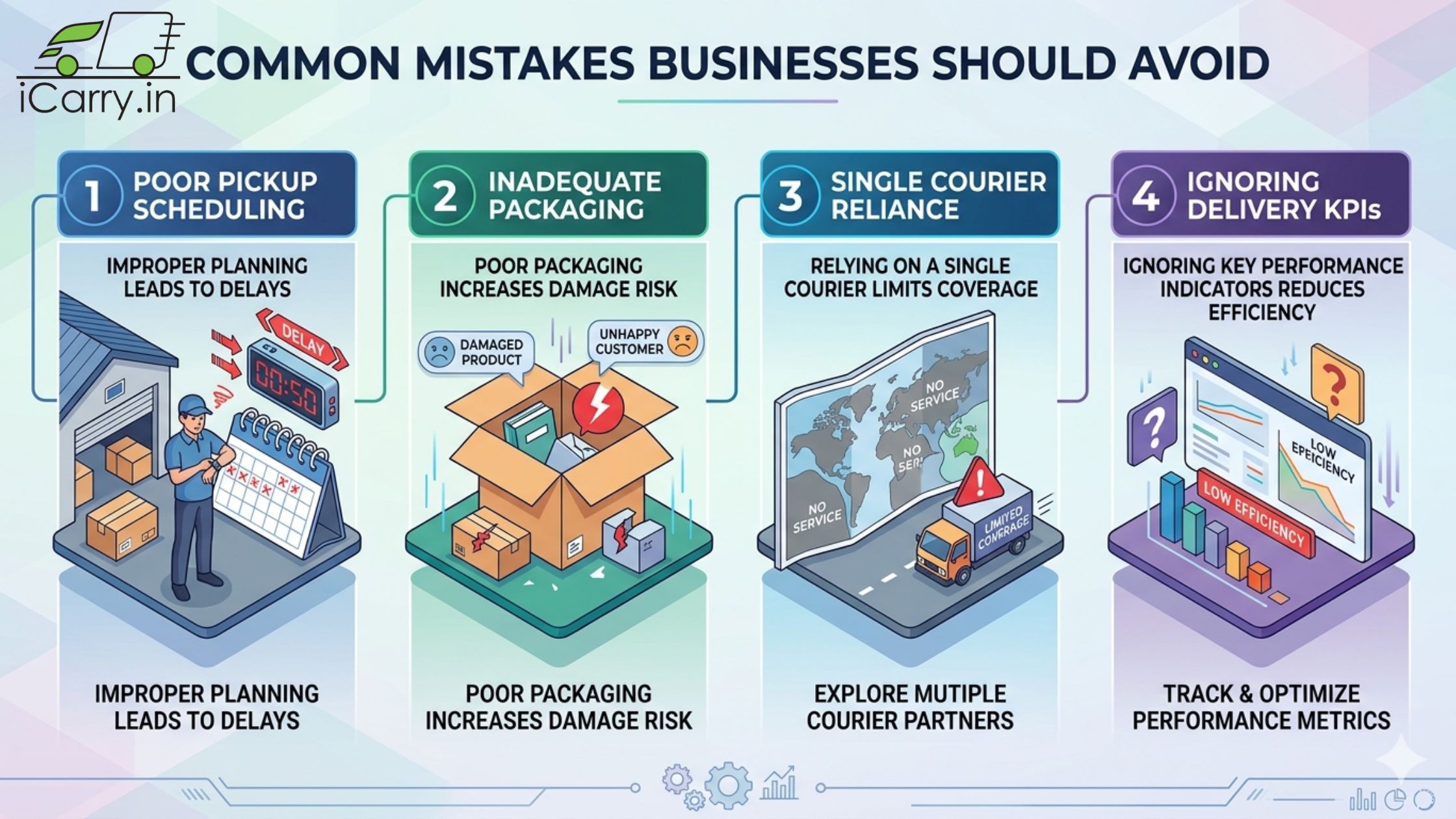
Common Mistakes Businesses Should Avoid
Avoiding these common errors can significantly improve logistics performance:
- Not scheduling pickups properly - book before 11 AM for same-day pickup; missed pickups delay the entire chain
- Poor packaging that increases damage risk and triggers volumetric weight charges
- Relying on a single courier partner - no one courier is strongest across all regions. Multi-courier allocation helps you route each order to the best available option automatically
- Ignoring delivery KPIs - if you are not tracking RTO rate, delivery success rate, and cost per shipment, you cannot improve them. Start with these 7 logistics KPIs
- Declaring incorrect weight at booking - always weigh and measure after sealing to avoid weight discrepancy charges
Best Practices to Optimise Door-to-Door (D2DC) Shipping
To maximise efficiency and minimise logistics challenges, businesses should adopt proven best practices that improve delivery performance and streamline operations.
Use Multi-Courier Platforms
Leverage multiple courier partners instead of relying on a single provider. This improves serviceability, increases delivery success rates, and ensures better capacity during peak demand. Multi-courier allocation explained in detail covers how smart routing rules work and why they outperform single-courier dependency.
Optimise Pickup Scheduling
Plan and schedule pickups strategically to ensure timely dispatch. On iCarry®, booking a shipment automatically generates the pickup request. Consistent pickup management helps avoid delays and keeps the shipping process on track.
Improve Address Accuracy
Use address validation tools and standardised formats to reduce errors. Accurate address details significantly improve delivery success rates and minimise returns. Always confirm the mobile number of the consignee before dispatch - it is the most common reason delivery fails.
Monitor Delivery Performance
Track key logistics KPIs such as delivery time, success rate, and Return-to-Origin (RTO) rate. Regular monitoring helps identify issues early and optimise operations. The most important logistics KPIs for eCommerce businesses gives you the benchmarks to compare against.
Optimise Packaging
Use efficient and secure packaging to reduce shipping costs and minimise the risk of product damage during transit. Right-sizing your packaging is one of the fastest ways to reduce shipping costs with no trade-off on delivery quality.
Data-Driven Insights
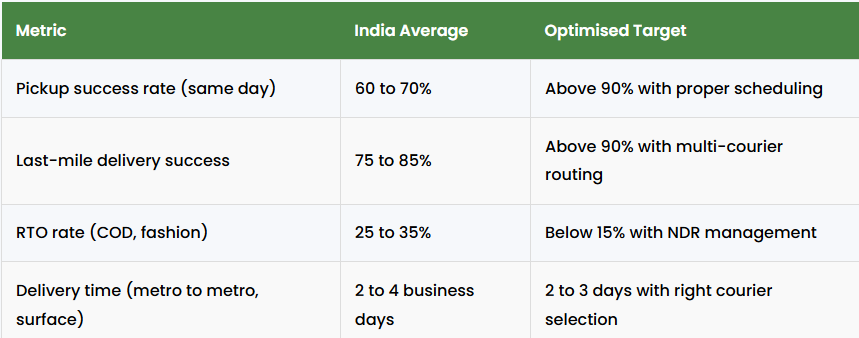
D2D services are the backbone of modern eCommerce logistics in India. Here is how the numbers look for sellers who get it right:
Who Should Use D2DC Services?
D2D shipping is ideal for:
- Businesses or eCommerce sellers shipping 1 to 5,000+ orders/month
- D2C brands wanting faster delivery and fewer complaints
- SMEs who cannot spare staff to visit courier offices
- Sellers shipping to Tier-2 and Tier-3 pincodes across India
Conclusion
For Indian sellers, D2DC shipping is not optional - it is the baseline. Fast pickups, accurate addresses, and the right courier mix are what separate smooth operations from avoidable losses.
Get this right and your customers see fewer delays, fewer returns, and better reviews.
Improve Logistics Efficiency with Smarter Shipping
Efficient door-to-door delivery requires strong coordination between pickup, transportation, and last-mile networks. Businesses that optimise these processes can significantly improve delivery performance.
Access 10+ courier partners, compare rates, book in bulk, manage NDRs, and track every shipment from one platform - with no minimum volume of shipments required.
New to iCarry®? Sign up for free and activate your account in minutes.
Video: How to Sign Up and Activate Your iCarry® Account
Frequently Asked Questions (FAQs)
What is door-to-door courier service?
Door-to-door courier service involves picking up a shipment from the sender's location and delivering it directly to the recipient's address - without requiring either party to visit a courier office.
How does D2DC shipping work?
The courier picks up the package from your location, transports it through sorting hubs and transit centres, and delivers it to the customer's doorstep. You can track every stage in real time.
Is door-to-door delivery available across India?
Yes, most courier companies offer D2D services across major cities and many Tier-2 and Tier-3 regions. iCarry® covers 29,000+ pincodes across India through its network of 10 courier partners.
What factors affect D2D shipping costs?
Costs depend on weight (dead weight or volumetric weight, whichever is higher), shipping distance and zone, service type (surface or air), COD charges if applicable, and any additional services like insurance or WhatsApp engagement.
What are the benefits of D2DC services?
Benefits include doorstep pickup and delivery, faster order fulfilment, real-time tracking, improved customer experience, and the ability to scale without building your own logistics infrastructure.
Can small businesses use D2DC services?
Yes. D2D services are widely used by SMEs and eCommerce businesses of all sizes. iCarry® has no minimum volume requirement - even a single shipment qualifies for pickup.
How do I handle failed deliveries in D2D shipping?
Failed deliveries generate an NDR (Non-Delivery Report). You should follow up within 24 hours by updating address details or requesting a reattempt through your shipping dashboard. Using NDR data effectively explains how to reduce failed deliveries systematically over time.
Door-to-door courier service (D2DC) handles the complete shipment journey from sender pickup to recipient doorstep - and for Indian eCommerce sellers, optimising it means scheduling pickups before 11 AM, right-sizing packaging to avoid volumetric weight charges, using multi-courier routing to improve delivery success, and following up on NDRs within 24 hours to keep RTO below 15%.