Why Parcel Limits Matter
A 32 kg carton booked on a standard courier service gets rejected at the hub. A 140 cm packed mirror is returned for being too long. A heavy appliance gets an overweight surcharge nobody told the seller about. In each case, the seller finds out after pickup, when time and money are already lost.
Every courier service has limits on weight and size for a single parcel. Knowing them before you pack prevents rejected shipments, surprise charges and delays, and tells you early when a product needs a different shipping mode.
What Is the Maximum Parcel Size and Weight for Couriers in India?
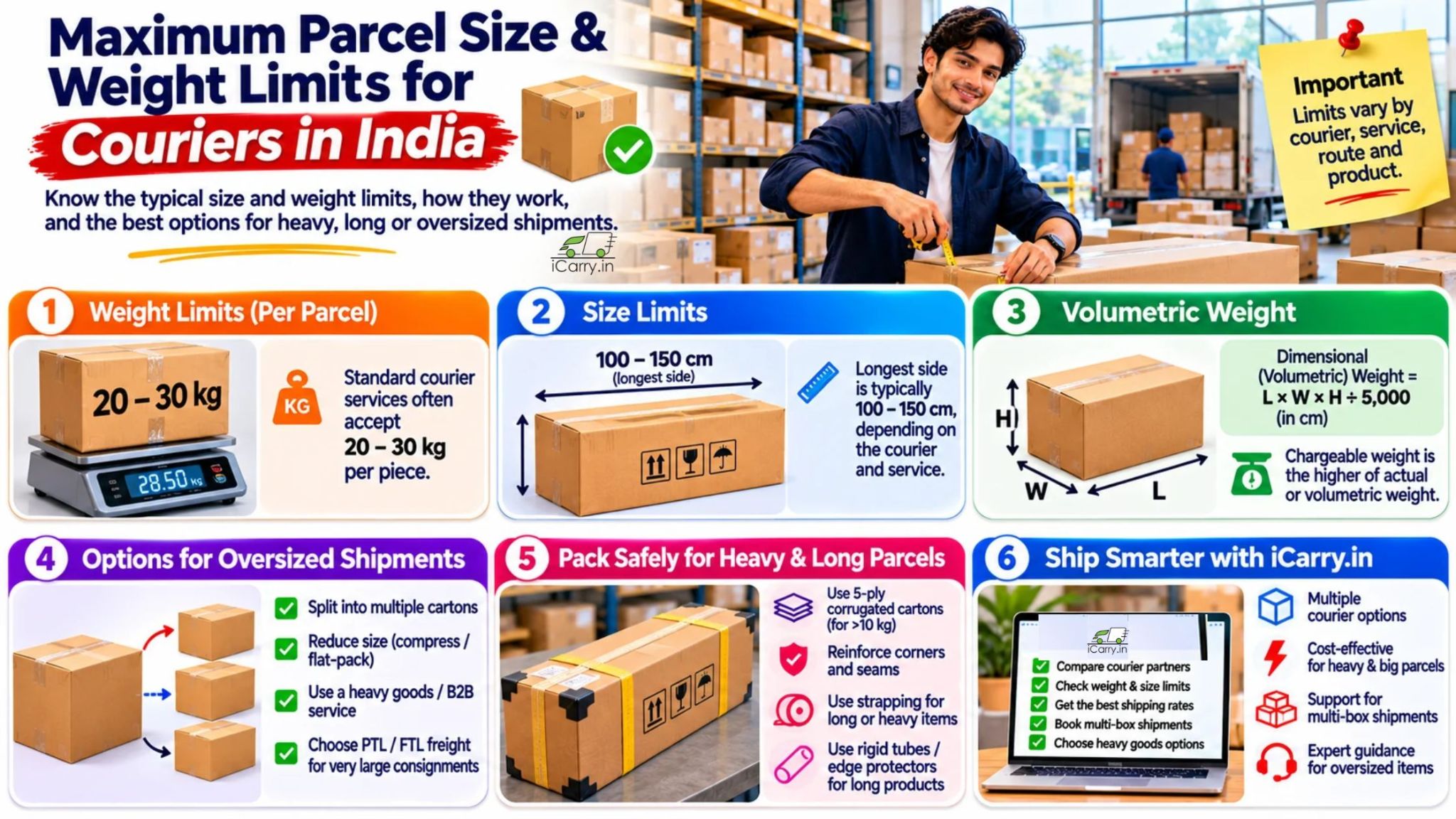
There is no single national limit. Many standard parcel services in India accept single pieces up to roughly 20 to 30 kg and 100 to 150 cm on the longest side, but each courier, service and route sets its own limit, so confirm it before you pack.
Important: Limits Differ by Courier, Service and Route
There is no single national limit. The maximum weight and size depends on:
- The courier: Each courier sets its own limits for single pieces
- The service: Surface, air, express and B2B or heavy services have different limits
- The route: Some origins, destinations and ODA pincodes have extra restrictions
- The product: Fragile, liquid, hazardous and valuable goods may have lower limits or special conditions
Check the exact limits for each courier partner and service before you pack. The figures below are typical patterns, not guaranteed limits.
Typical Ranges for Standard Parcel Services
- Weight per piece: Many standard parcel services accept single pieces up to roughly 20 to 30 kg. Heavier pieces often need a B2B or heavy goods service
- Longest side: Limits often fall in a range of roughly 100 to 150 cm for the longest side
- Combined size: Some services also limit length plus girth or the sum of all three sides
- Minimum size: Very small or flat items may have minimum dimensions or must travel as envelopes or documents
See which couriers show a rate for your packed parcel with the iCarry® domestic rate calculator.
How Limits Are Measured
- Measure the packed parcel: Use outer dimensions after packing, including tape, bulges and protruding items, not the product size
- Weigh the sealed parcel: Use actual packed weight on a scale, not the product label weight
- Check each piece: Limits usually apply per piece, not per shipment. A shipment of 4 cartons is judged carton by carton
- Check volumetric weight too: Chargeable weight is the higher of actual and volumetric weight. A parcel within the weight limit can still become a high billed weight
- Cylinders and irregular shapes: Tubes, rolls and odd shapes are measured at their widest points, and may be treated as non-standard
What Happens If You Exceed the Limits
- The booking may be blocked or the rate may not show for that parcel
- The courier may reject the parcel at pickup or at the hub
- An overweight or oversize surcharge may apply
- Delivery may be slower, because such parcels need special handling
- Damage and loss risk can increase, and claims can be refused if the parcel broke the rules
- You may pay for the trip, the return and the re-booking
Options for Heavy, Long or Oversized Items
For heavy, bulky or oversized products that exceed standard courier limits, iCarry® offers a B2B shipping option to help sellers manage larger consignments.
- Book B2B Multi-Box Shipments: Use iCarry® B2B Multi-Box Shipping to book eligible orders containing multiple cartons under one shipment.
- Ship Heavy and Bulky Orders: Choose the B2B shipping option for eligible heavy or oversized consignments, subject to applicable weight, dimension and serviceability limits.
- Get Help from Customer Support: Not sure how to book your heavy or multi-carton shipment? Contact iCarry® customer support, and the team will guide you through the booking process and help you understand the available shipping options.
For heavy, long or oversized shipments, contact iCarry® support before booking so the team can guide you towards the right B2B shipping solution.
Packing Heavy and Long Parcels Safely
- Use 5-ply corrugated for parcels above about 10 kg, and reinforce corners and seams
- Mark gross weight on the carton and use LIFT WITH CARE or HEAVY labels
- Use strapping for long or heavy cartons
- For long items, such as mirrors, rods and posters, use rigid tubes or corner and edge protectors
- Do not exceed the weight a carton can safely bear. A carton that splits in the sorting centre is an uncovered loss
How to Check a Large Parcel Before You Book: Checklist
- Measured the packed carton in cm and weighed it on a scale
- Calculated volumetric weight and compared it with actual weight
- Confirmed the weight and size limits with the courier partner for that service
- Checked whether the destination pincode has extra restrictions or ODA surcharges
- Decided whether to split, compress or switch to a heavy goods service
- Photographed the packed parcel with label and weight visible
How iCarry® Helps With Parcel Limits
iCarry® is a courier aggregator that gives sellers access to multiple courier partners and shipping tools through one account. Since parcel weight and dimension limits vary by courier and service, contact iCarry® support before booking large, heavy or oversized shipments.
- Rate Comparison at Packed Dimensions: Enter the packed weight and dimensions to compare available courier options and understand how chargeable weight is calculated.
- Multi-Box B2B Booking: For heavy orders that need multiple cartons, use iCarry® B2B Multi-Box Shipping to book eligible boxes as one linked shipment.
- Weight Discrepancy Management: Review differences between declared and courier-billed weight and raise disputes with supporting evidence. Pre-uploaded product images can help support weight discrepancy disputes.
- Multiple Courier Partners: Compare available courier services and check which partners can handle your parcel based on its weight, dimensions and destination.
- Address Quality Scoring: Identify incomplete or potentially problematic addresses before dispatch to help prevent avoidable delivery issues.
- Delivery Boost: Get additional pre-delivery coordination to help reduce failed delivery attempts and improve delivery communication.
- Two-way WhatsApp Engagement: Let customers confirm availability, update address details or reschedule deliveries, while keeping conversation history accessible.
- Shipment Tracking and Management: Track, filter and manage shipments from your iCarry® dashboard.
For heavy, long or oversized parcels, contact iCarry® customer support. The team can guide you through the available B2B booking options, parcel requirements and shipment process.
Frequently Asked Questions (FAQs)
What is the maximum weight of a courier parcel in India?
There is no single limit. Many standard parcel services accept single pieces up to roughly 20 to 30 kg, while heavier pieces need a B2B or heavy goods service. The exact limit depends on the courier, the service and the route, so check it before you pack.
What is the maximum size of a courier parcel?
Limits on the longest side commonly fall in a range of roughly 100 to 150 cm for standard parcel services, and some services also limit the combined dimensions. Measure the packed parcel, including bulges, and confirm the limits with your courier partner.
Do the limits apply to each carton or the whole shipment?
Limits usually apply per piece, so each carton in a multi-carton shipment is checked separately. Splitting a heavy order into several cartons that each fit within the limit, and booking them as a linked multi-box shipment, is a common solution.
What should I do if my product is too big or heavy for courier?
Split it into cartons, reduce its size by compressing or disassembling it, use a B2B or heavy goods service, or move it by PTL, FTL, pallet or local transport. Compare options for the route and weight before deciding, and confirm limits before pickup.
Parcel limits differ by courier, service and route, so measure and weigh the packed parcel, check limits for each piece, and compare chargeable weight before booking. For heavy, long or oversized shipments, use a B2B option and contact support first.