A customer opens an app at 9 PM. She needs chips, a phone charger, and a face wash. Ten minutes later, there is a knock at the door. No checkout queue, no minimum order, no waiting.
This is quick commerce. And in India's metro cities, it has moved from a novelty to a baseline expectation in under three years.
BlinkIt (owned by Zomato), Zepto, and Swiggy Instamart have collectively scaled to millions of daily orders across more than 50 cities. Zomato has made quick commerce a central pillar of its growth strategy through Blinkit. Amazon is expanding its own ultrafast delivery capabilities in select metros. And the pressure this creates on every other eCommerce seller - including D2C brands, marketplace sellers, and local retailers - is real and growing.
Invest India's sector analysis shows that quick commerce is the frontier of that growth - and understanding it is no longer optional for any seller who wants to remain competitive.
This breakdown explains what quick commerce is, how the major players operate in India, who the emerging challengers are, and critically - what sellers who do not want to build a dark store network can realistically do to offer faster delivery in 2026.
What Is Quick Commerce?
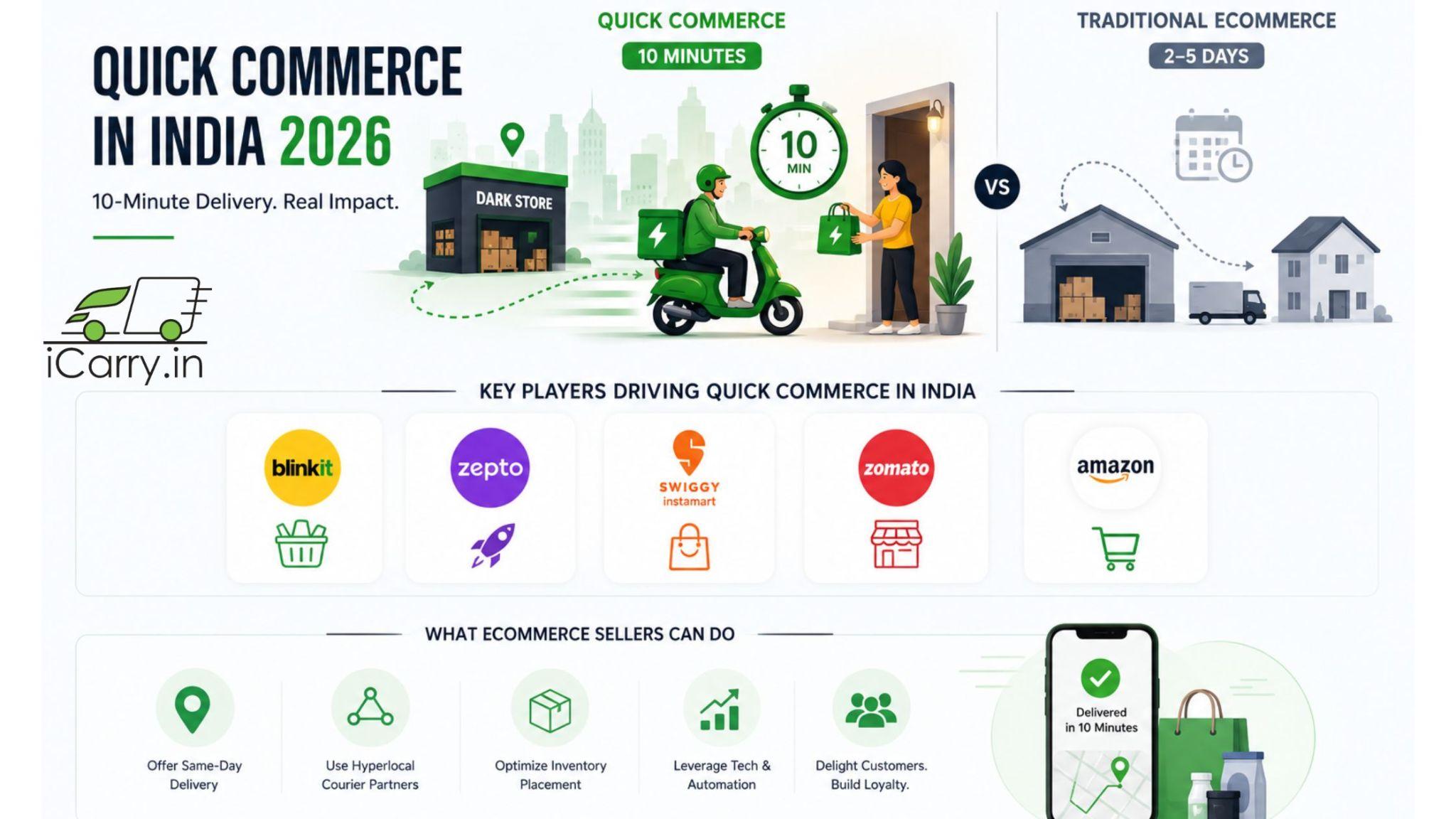
Quick commerce (also called q-commerce or instant delivery) is a retail fulfillment model built around delivering goods in under 30 minutes - often under 10 - using a network of micro-warehouses positioned within 2 to 3 kilometres of customers in dense urban areas.
The key structural difference between quick commerce and standard eCommerce is inventory placement. In standard eCommerce, inventory is centralised in one or a few large warehouses. In quick commerce, inventory is distributed across dozens of small dark stores - fulfillment hubs that stock only the most fast-moving SKUs and exist purely to enable ultrafast delivery.
The model trades storage efficiency for speed. Dark stores are expensive to run. But for the categories where customers want instant gratification - groceries, personal care, snacks, electronics accessories, medicines - the conversion and retention benefit outweighs the cost.
Quick Commerce Market Size in India
India's quick commerce market is expected to grow rapidly over the next few years, driven by urbanisation, smartphone adoption, UPI payments, and changing consumer expectations. Industry estimates project the sector to become one of the fastest-growing segments within Indian eCommerce, with Blinkit, Zepto and Swiggy Instamart continuing to expand into new cities and categories.
Advantages and Disadvantages of Quick Commerce
Advantages
- Faster customer satisfaction
- Higher repeat purchase frequency
- Convenience for urgent purchases
- Increased basket size for impulse purchases
Disadvantages
- High dark store costs
- Inventory duplication
- Limited SKU selection
- Difficult economics outside dense cities
- Sustainability concerns
The Major Quick Commerce Players in India in 2026
Blinkit
Blinkit - formerly Grofers - is now India's largest quick commerce platform, operating under the Zomato umbrella. Blinkit pioneered the dark store model in India at scale and currently operates across 70+ cities with thousands of dark stores nationally. Their 10-minute delivery promise in dense urban areas is backed by a dark store density that no other platform has matched.
Blinkit has expanded significantly beyond groceries - electronics, stationery, beauty, clothing, and even fresh flowers are part of their catalog in many cities. Their category expansion is directly increasing competitive pressure on D2C brands and specialty retailers.
Zepto
Zepto is one of the most remarkable growth stories in Indian consumer tech. Founded in 2021, Zepto rapidly scaled into one of India's largest quick commerce companies and has reported significant progress toward profitability.
Zepto has built a tightly executed dark store network in Tier-1 cities with a consistent sub-12-minute delivery performance. Their operational discipline - particularly in store density and inventory forecasting - is considered best-in-class in the Indian q-commerce segment.
Zepto's expansion into Tier-1 cities outside the top 6 metros and their Cafe format (fresh food and coffee delivered in minutes) indicate their intent to become a full-stack convenience platform rather than just a grocery delivery app.
Swiggy Instamart
Swiggy Instamart is Swiggy's quick commerce arm, leveraging Swiggy's existing delivery network and brand recognition across India. Operating in 50+ cities, Instamart benefits from Swiggy's established relationship with delivery partners and its dominant brand position in food delivery - a natural cross-sell into instant grocery and essentials.
Instamart's advantage is Swiggy's last-mile infrastructure and consumer trust built over years of food delivery. The challenge is competing with Blinkit's pure-play focus and Zepto's operational precision.
Amazon Fresh and Amazon Shipping
Amazon has been expanding its ultrafast delivery capabilities in India through Amazon Fresh (same-day grocery) and Amazon Shipping (fast courier for marketplace sellers). While not a quick commerce platform in the Blinkit / Zepto sense, Amazon's 2-hour and same-day delivery windows in metro cities create consumer expectations that spill over to all categories - including non-grocery products sold by third-party sellers on Amazon.
For Amazon marketplace sellers in India, this means their customers now expect delivery timelines that standard eCommerce cannot match - creating pressure to either fulfil through FBA or offer competitive self-ship alternatives.
Why is Quick Commerce Growing so Fast in India?
Urban Density
India's metros and Tier-1 cities have the population density that makes dark store economics work. With millions of potential customers within 3 kilometres of a single dark store, order volumes per store location are high enough to justify the infrastructure cost.
Smartphone Penetration and UPI Adoption
The combination of affordable smartphones and frictionless UPI payments has created a consumer base that is comfortable placing impulse digital orders. Quick commerce is the natural endpoint of this behaviour - the purchasing decision to the product in hand in under 15 minutes.
Shifting Consumer Expectations
Once a consumer experiences 10-minute grocery delivery, 3-day standard eCommerce delivery feels slow for anything that could have been quick. This expectation creep is the most significant long-term pressure quick commerce creates for all eCommerce sellers - not just grocers.
Post-Pandemic Behaviour
The pandemic normalised home delivery for categories that previously required in-store visits. Quick commerce captured this behavioural shift and institutionalised it - consumers who started ordering groceries online in 2020 are now ordering everything online in 2026.
How Quick Commerce Dark Stores Work
The dark store is the engine of quick commerce. Understanding how it works explains both the power of the model and its geographic limitations.
- Location: Dark stores are positioned in high-density residential areas - typically within 2 to 3 km of their target customer cluster. They are not accessible to the public and are optimised purely for order picking and dispatch
- Inventory: A typical dark store stocks 2,000 to 5,000 SKUs - a fraction of what a grocery store carries. Every SKU is chosen based on hyperlocal demand data. Items that do not sell fast enough are removed quickly
- Picking: Orders are picked within 2 to 3 minutes by dedicated pickers following optimised routes through the store. The entire picking and packing workflow is designed around speed, not cost
- Delivery: Riders stationed at or near the dark store are dispatched instantly. With a 2 to 3 km catchment radius, a rider on a bike can complete delivery in 7 to 10 minutes in most conditions
The key constraint is geography. Dark stores only work where population density justifies the inventory holding cost and rider deployment. This is why quick commerce in India remains concentrated in metro and Tier-1 cities. The last-mile delivery challenges in India that make quick commerce operationally difficult in smaller cities are the same challenges that have constrained standard eCommerce in those markets for years.
Challenges Facing Quick Commerce in India
- Dark store profitability
- Rider availability
- Sustainability concerns
- Inventory forecasting
- Expansion into Tier-2 cities
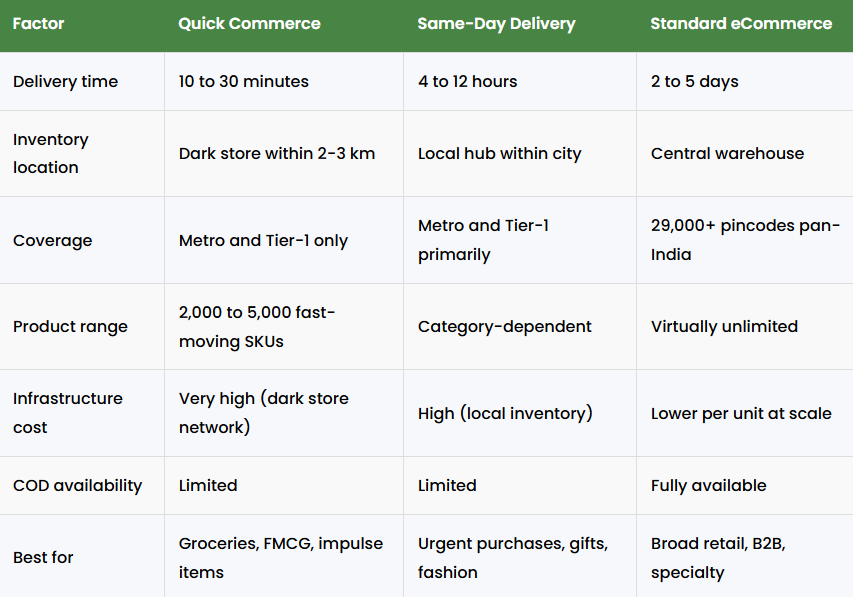
Quick Commerce vs Standard eCommerce vs Same-Day Delivery
What Quick Commerce Means for D2C and eCommerce Sellers
Most D2C brands, marketplace sellers, and independent eCommerce businesses will never build a dark store network. The capital requirement, operational complexity, and geographic concentration make the pure quick commerce model inaccessible outside a narrow set of well-funded consumer businesses.
But quick commerce is still relevant for every eCommerce seller in India - because it is reshaping what customers consider acceptable delivery performance.
The Expectation Spillover Effect
A customer who receives groceries in 10 minutes from Blinkit and clothes in 2 hours from an Ajio sale increasingly views 3-day standard delivery as a patience test, not a normal service. This expectation does not stay neatly in the grocery category - it bleeds into fashion, electronics, home products, and every other category over time.
For D2C sellers, this creates a real competitive pressure to offer faster delivery options even if same-day or next-day delivery is not their current capability.
Where D2C Sellers Can Compete
You do not need a dark store to offer faster delivery. Same-day delivery through on-demand logistics partners is increasingly accessible for sellers in metro cities - without the capital cost of dark store infrastructure.
How iCarry® Enables Same-Day Delivery for eCommerce Sellers
iCarry® is an online courier aggregator platform that gives eCommerce sellers access to multiple courier partners from one place for standard, express pan-India and even same-day shipping.
For sellers in metro cities who want to offer same-day delivery, iCarry® supports this through its partnership with Borzo - India's leading on-demand hyperlocal delivery platform. So iCarry® does not operate as a quick commerce platform but more like a one-stop-shop for all your courier needs.
Borzo specialises in fast, on-demand city delivery - connecting sellers with riders for same-day and even hour-level delivery windows within metros and select Tier-1 cities. Through iCarry®, sellers can access Borzo's hyperlocal network alongside multiple standard courier partners - handling both same-day city orders and standard pan-India shipments from a single logistics account.
This means a D2C seller operating in Bengaluru, Mumbai, or Delhi can offer:
- Same-day delivery: Fulfilled via Borzo for customers within the city
- Pan-India standard shipping: Fulfilled via Delhivery, Xpressbees, Blue Dart, and others for orders outside the city
- All managed from one iCarry® dashboard - same account, same tracking view, same early COD remittance system
This is not quick commerce - it is not 10-minute delivery, and it does not require a dark store. But it is a realistic, immediately accessible path to same-day or within-hours delivery for Indian eCommerce sellers who want to close the gap with fast-delivery consumer expectations, without building the infrastructure that Blinkit and Zepto have invested hundreds of crores to create.
Video: How to Book a Shipment and Select the Right Courier on iCarry®
Practical Steps for eCommerce Sellers to Move Toward Faster Delivery
Step 1: Identify Your High-Demand Geographies
Where are most of your orders coming from? If 40% of your orders ship to Bengaluru and Mumbai, those are the cities where offering faster delivery has the highest impact on conversion and retention.
Step 2: Position Inventory Closer to Demand
Standard eCommerce sellers can achieve significantly faster delivery by storing inventory in 2 to 3 city-level locations rather than a single central warehouse. A seller with inventory in Bengaluru and Delhi can offer next-day delivery to customers in those cities without any dark store infrastructure.
Step 3: Integrate Same-Day Delivery as an Option at Checkout
Offer same-day delivery as a premium shipping option for customers in eligible cities - with a clear surcharge if needed. Many customers will pay ₹ 50 to ₹ 100 more for delivery today vs delivery Thursday.
Step 4: Use Multi-Courier Allocation for Regional Optimisation
For orders outside same-day coverage areas, multi-courier allocation ensures each standard order is routed to the fastest available courier for that specific pincode - minimising transit time even for 2 to 3 day deliveries.
Step 5: Manage NDRs Proactively
Faster delivery promises are only valuable if delivery actually succeeds. Active NDR management - following up on failed delivery attempts within 24 hours - is as important for fast delivery operations as it is for standard eCommerce. Using NDR data to improve delivery success gives the systematic approach to minimise failed deliveries.
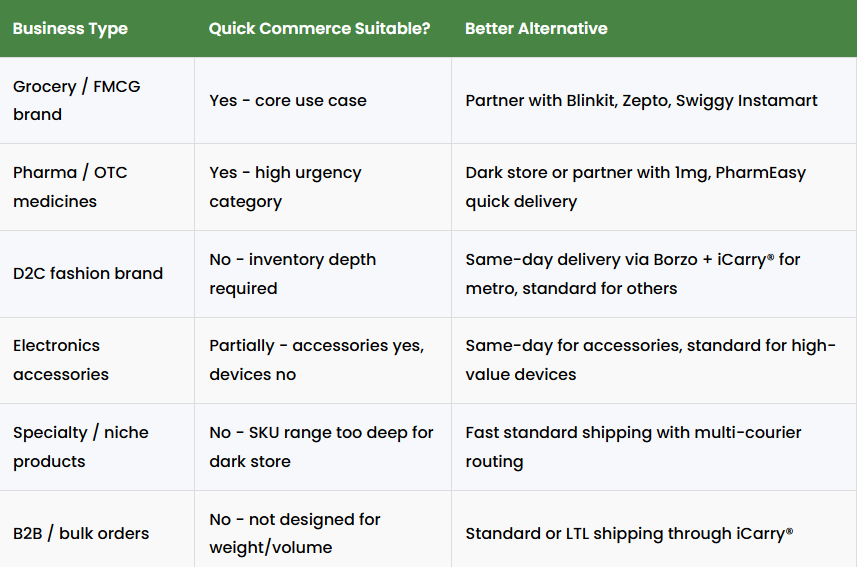
Who Is Quick Commerce Actually Right For?
Being honest about what quick commerce is and is not suitable for helps sellers make the right strategic choice rather than chasing a model that does not fit their business.
The Future of Quick Commerce in India
Expansion Beyond Top 6 Metros
The next battleground for quick commerce is Tier-2 cities - Pune, Jaipur, Lucknow, Surat, Kochi. Platform density in these cities is building, and the consumer demand is there. The challenge is dark store economics at lower population density and the need for localised inventory curation.
Category Expansion
Quick commerce platforms are moving well beyond groceries. Electronics, fashion, home goods, pet care, and even prescription medicines are appearing in dark store catalogs in 2026. Each category expansion creates new competitive dynamics for eCommerce sellers in those spaces.
Technology and AI-Driven Demand Forecasting
The biggest operational challenge in quick commerce is stocking the right SKUs in each dark store. Too much of the wrong product leads to waste. Too little of a fast-mover leads to unfulfilled orders. AI-driven demand forecasting at the pincode level is becoming a core competency for every serious q-commerce player.
Quick Commerce Meets B2B
Some platforms are beginning to explore B2B quick commerce - same-day delivery of office supplies, raw materials, and packaging to small businesses. This is an emerging segment with significant potential for sellers in the packaging, stationery, and industrial supplies categories.
Sustainability Pressure
The environmental cost of ultrafast delivery - packaging waste, single-order trips, high-frequency rider deployments - is drawing increasing scrutiny. Platforms are beginning to invest in electric vehicles, sustainable packaging, and consolidated delivery slots. eCommerce trends to watch in 2026 covers this and other forces reshaping Indian online retail.
Cost and Investment Reality of Quick Commerce
For any seller considering entering quick commerce rather than just adapting to the expectations it creates, the capital requirements are significant:
- Dark store setup: ₹ 10 to 25 lakh per location for a well-equipped dark store - rent, cold storage, shelving, POS, and security
- Inventory holding: Multiple dark stores means multiple instances of the same inventory - significantly higher working capital requirement
- Rider deployment: Standing rider capacity is expensive - you pay for availability, not just deliveries made
- Technology: Real-time inventory management, demand forecasting, and route optimisation all require dedicated tech investment
For most eCommerce sellers, the better investment is in reducing per-shipment shipping costs for standard operations while adding same-day capability for high-demand metro markets - a far more capital-efficient path to competitive delivery performance.
Delivery Performance Still Matters More Than Speed Alone
Quick commerce as a fulfilment model is built for FMCG brands, grocery sellers, and high-frequency essentials categories in Tier-1 cities. If you sell perishables, daily consumables, or products customers urgently need within the hour, dark store economics can work for you. If you sell fashion, home decor, electronics, or specialty products - quick commerce is not your channel. Your opportunity is faster standard delivery, not 10-minute delivery. Focus on same-day or next-day courier options across your top-performing pincodes and let iCarry® handle the courier selection automatically.
The quick commerce platforms that win long-term will not be the ones that promise the fastest delivery - they will be the ones that consistently deliver on their promises. A 10-minute promise that fails 30% of the time is worse for retention than a reliable 2-hour window.
This is equally true for eCommerce sellers. How shipping experience drives customer retention consistently shows that delivery reliability matters more than delivery speed for repeat purchase rates. A customer who receives their order exactly when promised - even if that is tomorrow - is more loyal than one who was promised today and received it in two days.
Tracking the metrics that tell you whether your delivery experience is actually as reliable as it should be is covered in 7 logistics KPIs every eCommerce business should track.
Final Thoughts
Quick commerce in India is not a fad. Blinkit, Zepto, Swiggy Instamart, and Zomato have collectively demonstrated that 10-minute delivery at city scale is operationally and commercially viable - and they have permanently reset what Indian urban consumers expect from delivery.
For most eCommerce sellers, the response to quick commerce is not to build a dark store. It is to get faster - intelligently. Positioning inventory closer to demand, offering same-day delivery in metro cities through partners like Borzo via iCarry®, and using multi-courier routing to optimise transit times for standard orders - these are the practical levers that make a meaningful difference without requiring the infrastructure investment that only the best-funded platforms can afford.
iCarry® gives sellers access to multiple courier partners for pan-India standard and express shipping, plus same-day city delivery through Borzo - all from one platform, one account, and one COD remittance system. Compare rates or get started for free here.
Video: How to Sign Up and Start Shipping on iCarry®
Frequently Asked Questions (FAQs)
What is quick commerce in India?
Quick commerce (q-commerce) is the delivery of consumer goods within 10 to 30 minutes using a network of dark stores - micro-warehouses positioned within 2 to 3 km of customers in dense urban areas. Platforms like Blinkit, Zepto, and Swiggy Instamart are the leading quick commerce operators in India in 2026.
Which are the biggest quick commerce companies in India in 2026?
Blinkit (owned by Zomato), Zepto, and Swiggy Instamart are the three largest quick commerce platforms in India. Amazon Fresh and Amazon Shipping also offer fast delivery in metro cities. Together these platforms serve millions of daily orders across 50+ Indian cities.
What is the difference between quick commerce and same-day delivery?
Quick commerce promises delivery within 10 to 30 minutes using hyperlocal dark stores within 2 to 3 km of the customer. Same-day delivery promises delivery within 4 to 12 hours and can operate from a city-level warehouse rather than a hyperlocal dark store. Same-day is more accessible for eCommerce sellers; quick commerce requires dedicated dark store infrastructure.
Can eCommerce sellers offer quick commerce-like delivery without building dark stores?
Yes - through same-day delivery using on-demand logistics partners. iCarry® supports same-day city delivery through its partnership with Borzo, enabling sellers in metro cities to offer fast delivery without building a dark store network. For pan-India orders, iCarry®'s multiple courier network handles standard and express shipping.
Is Borzo available through iCarry® for same-day delivery?
Yes. Borzo is iCarry®'s hyperlocal delivery partner for on-demand same-day city delivery. Sellers can access Borzo alongside iCarry®'s multiple standard courier partners from the same platform - managing both same-day metro orders and pan-India shipments from one account.
Is quick commerce profitable in India?
The major platforms have reached or approached profitability at the unit economics level in their mature city markets. Profitability depends on dark store density, order frequency per store, and basket size. The model is capital-intensive upfront but economically defensible in high-density urban markets with high repeat purchase rates.
Will quick commerce expand to Tier-2 cities in India?
Yes - expansion is already underway in 2026. Blinkit, Zepto, and Swiggy Instamart are all expanding into Tier-2 cities including Pune, Jaipur, Lucknow, Surat, and Kochi. The operational challenge is adapting dark store density economics to lower population density markets.
How should D2C brands respond to quick commerce pressure?
Invest in same-day delivery capability for metro markets using on-demand logistics partners, position inventory in city-level fulfillment points closer to demand clusters, offer faster delivery as a checkout option, and focus on delivery reliability which drives retention more than raw speed.
Is quick commerce available across India?
No. Quick commerce is currently concentrated in metro and Tier-1 cities where population density supports dark store operations. While platforms such as Blinkit, Zepto, and Swiggy Instamart are expanding into Tier-2 cities, many smaller towns and rural areas continue to rely on standard eCommerce delivery networks.
What products are best suited for quick commerce?
Quick commerce works best for groceries, FMCG products, personal care items, medicines, snacks, beverages, electronics accessories, and other high-frequency purchases where customers value immediate delivery. Products with large catalogues, high customization, or low purchase frequency are generally better suited to standard eCommerce delivery.
Quick commerce has permanently reset delivery expectations for Indian urban consumers - but building a dark store network is not the answer for most eCommerce sellers. The practical path is faster standard delivery: same-day options in metro cities via on-demand logistics partners like Borzo, multi-courier routing to optimise transit times, and delivery reliability that drives repeat purchases more than raw speed ever will.