A customer orders a birthday cake from home at 10 AM. By 1 PM it is at their door. A shopper buys a phone case from office during lunch and wants it before evening. A patient needs medicine within the hour. These are not edge cases anymore - they are the baseline expectation in India's metros and fast-growing Tier-1 cities.
Customer expectations in India have shifted a lot over the past few years. What once took 3 to 5 days is now expected within hours. Same-day delivery has moved from being a premium offering to a competitive necessity, especially in categories like groceries, electronics, and fashion, as noted in McKinsey's research on same-day delivery.
Driven by platforms like Amazon, Flipkart, Swiggy, and Zomato, same-day delivery is rapidly transforming India's logistics ecosystem, supported by national infrastructure initiatives such as PM Gati Shakti.
This guide explains same-day delivery models, the full operational workflow, cost structure, challenges, and future trends in India's hyperlocal logistics ecosystem.
What is Same-Day Delivery?
Same-day delivery refers to a logistics service in which an order is delivered to the customer on the same day it is placed, aligning with modern supply chain efficiency frameworks outlined by the Council of Supply Chain Management Professionals (CSCMP). In most cases, the delivery is completed within 4 to 12 hours, depending on location, inventory availability, and operational efficiency.
In simple terms: order today, delivered today. Many businesses partner with a same-day courier service in India to fulfill urgent intra-city orders without building their own rider fleet or hyperlocal logistics infrastructure.
The key distinction between same-day delivery and standard eCommerce shipping is that same-day requires localised inventory - the product must already be near the customer before the order is even placed. You cannot fulfil a same-day order from a warehouse in Mumbai if the customer is in Bengaluru.
Quick Checklist - Before You Launch Same-Day Delivery
Same-day delivery fails when sellers expand faster than their operations can support. Before going live, confirm these 6 things:
- Is your inventory physically close enough to your customers? Same-day only works when stock is within a few kilometres of the delivery address
- Do you have a defined order cutoff time? Without one, same-day commitments become impossible to fulfil consistently
- Have you modelled the unit economics? Same-day costs 1.5x to 3x more than standard shipping - is your average order value high enough to absorb or charge for this?
- Do you have multiple delivery partners or in-house riders in the target city? Single-provider dependency breaks down quickly during peak hours
- Is your picking and packing process fast enough to dispatch within 30 to 60 minutes of order placement?
- Are you tracking last-mile delivery KPIs in real time? Same-day operations live and die on real-time visibility
Why Same-Day Delivery Matters for Indian Businesses
Same-day delivery has become a key differentiator in eCommerce as customer expectations continue to shift toward speed and convenience.
Faster Customer Gratification
It enables instant fulfillment for urgent purchases such as groceries, medicines, or essentials. In India, the rise of quick-commerce platforms has trained urban consumers to expect delivery within hours, and this expectation is spreading from groceries to fashion, electronics, and gifts.
Higher Conversion Rates
Offering same-day delivery increases conversion rates - customers are more likely to complete a purchase when they know they will receive it today rather than waiting 3 to 5 days.
Reduced Cart Abandonment
Same-day delivery also cuts cart abandonment. When a customer knows the order arrives today, they're much less likely to close the tab and head to the local store instead.
Competitive Advantage
In crowded categories, same-day delivery helps businesses outperform slower competitors without needing to win on price alone. It is particularly powerful for local retailers competing against national marketplaces.
Core Same-Day Delivery Models in India
There is no single way to offer same-day delivery. The right model depends on your product category, geography, and operational maturity.
Hyperlocal Store-Based Model
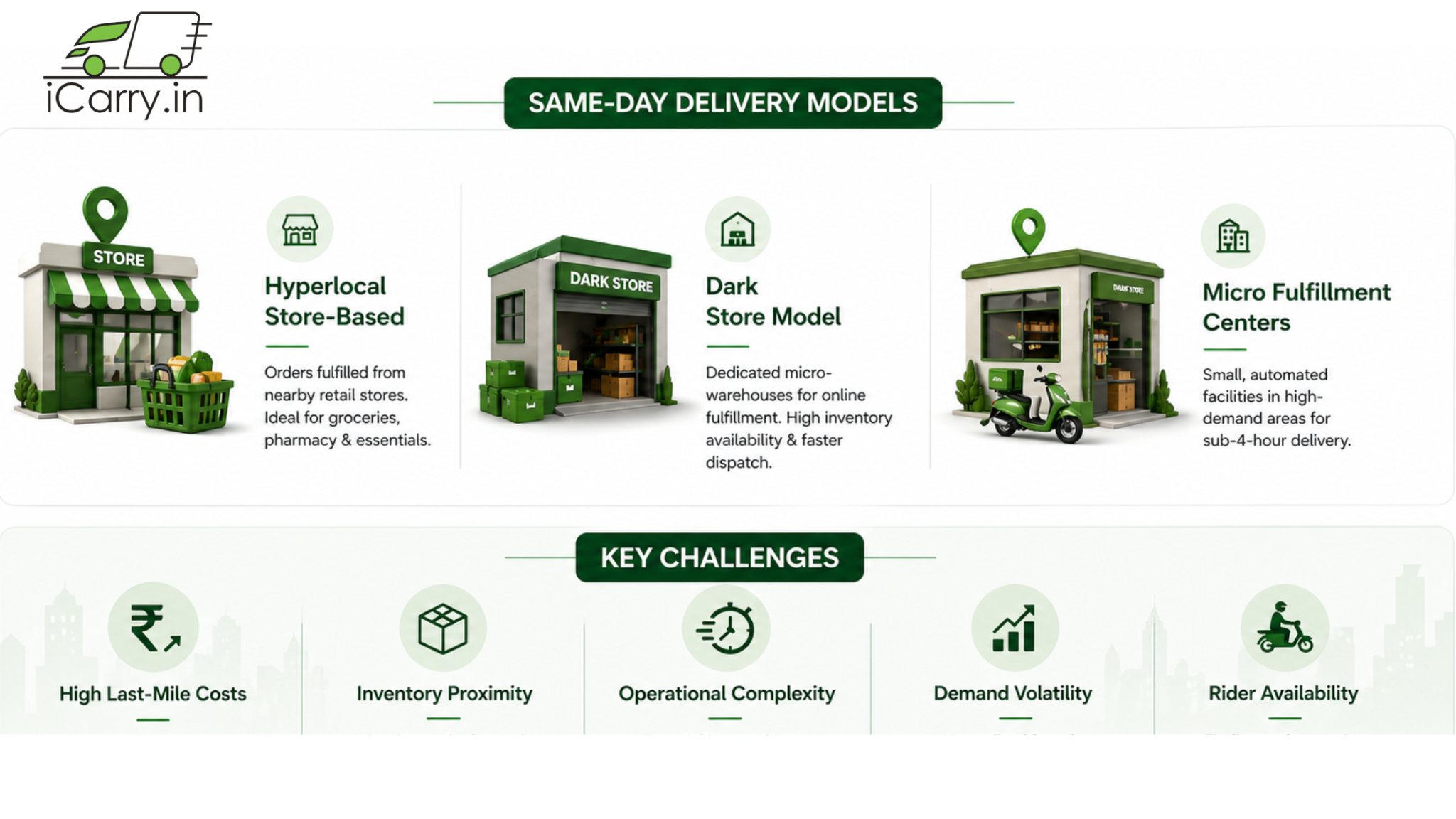
This is one of the most common approaches used by grocery and pharmacy players. Orders are fulfilled from nearby retail stores, making it effective for categories where inventory is already distributed across the city. Since stock is already close to the customer, deliveries can be completed within 2 to 4 hours. This model is explored in depth in the guide on hyperlocal delivery for retail businesses.
Dark Store Model
Dark stores are micro-warehouses dedicated exclusively to online order fulfillment - they are not open to walk-in customers. These facilities are designed purely for speed, with high inventory availability, optimised pick paths, and fast dispatch. Blinkit and Swiggy Instamart use this model to achieve 10-to-30-minute delivery windows in major Indian cities.
Hub-and-Spoke with Priority Routing
This model is built on the hub-and-spoke logistics framework used by large courier and logistics networks. Shipments are routed through centralised hubs with priority handling to ensure faster movement to destination areas. It is used by large courier companies for same-day express lanes in high-density corridors.
Marketplace Fulfillment Model
Large platforms like Amazon and Flipkart use their existing fulfillment networks to offer same-day delivery in select metro cities. Amazon's same-day delivery for Prime members in Bengaluru, Mumbai, Delhi, and Hyderabad uses pre-positioned inventory in dedicated fulfillment centres near city centres.
Step-by-Step Same-Day Delivery Process
Same-day delivery requires a tighter, faster version of the standard fulfillment workflow. Every step has a much shorter time budget.
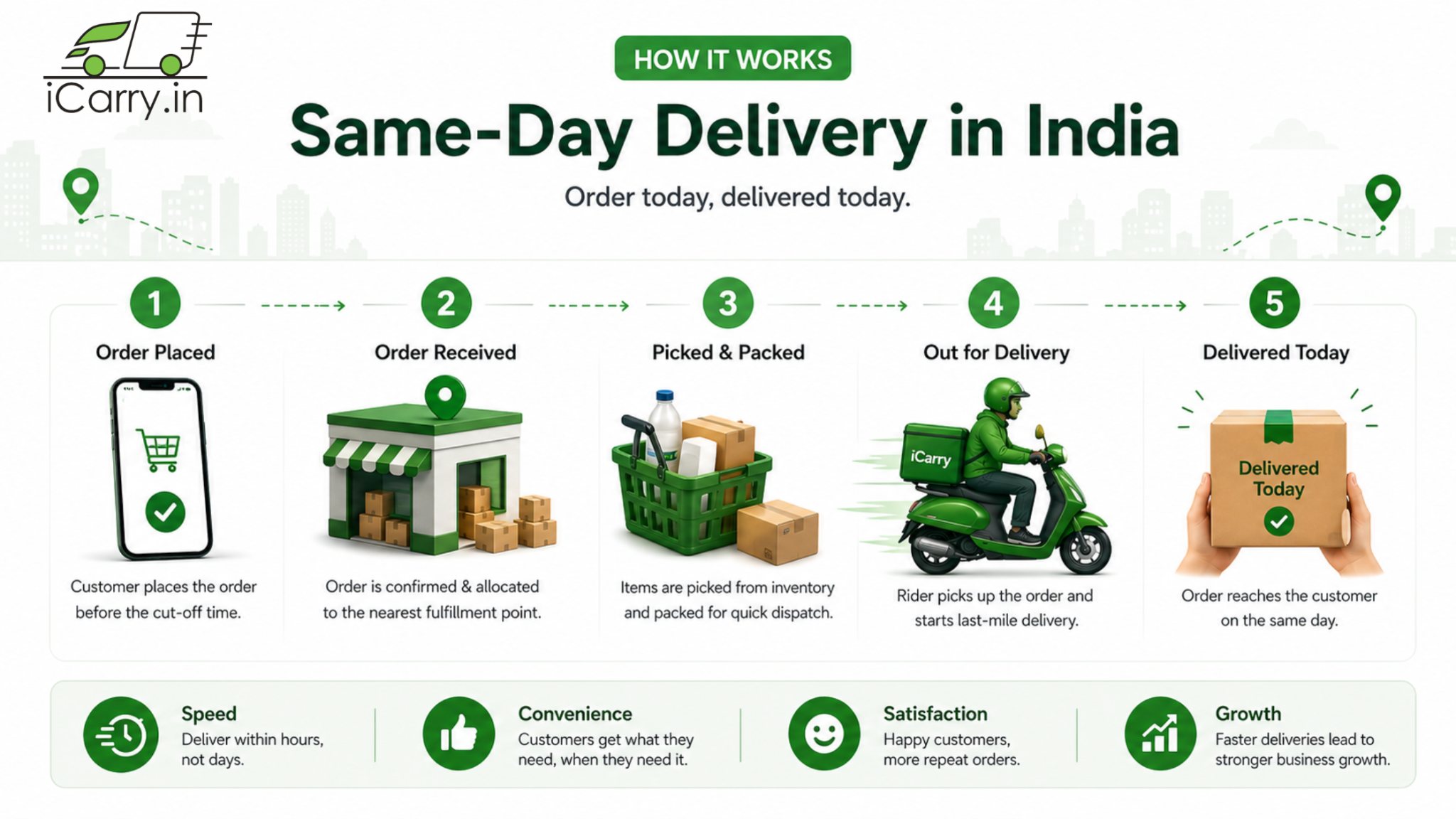
Step 1: Order Placement
The customer places an order before a predefined cutoff time - typically between 12 PM and 2 PM for same-day delivery. Orders placed after the cutoff are automatically moved to next-day delivery. Setting and communicating a clear cutoff time is essential for managing both customer expectations and operational capacity.
Step 2: Order Allocation
The system assigns the order to the nearest fulfillment centre, dark store, or retail store to minimise delivery time and distance. This allocation step must happen in real time - manual allocation cannot scale for same-day operations.
Step 3: Fast Picking and Packing
Items are picked, packed, and prepared for dispatch within minutes. Same-day operations typically target a 15-to-30-minute pick-pack window from order receipt to handover to the delivery rider. This requires pre-organised warehouse layouts, clear SKU mapping, and trained staff.
Step 4: Rider Assignment
Borzo is the supported hyperlocal delivery partner - enabling fast, on-demand rider dispatch for urgent shipments within the city.
Hyperlocal Delivery on iCarry®
Hyperlocal deliveries on iCarry.in are powered by Borzo in 11 cities in India currently. Borzo operates as a bike rider service - a rider comes and picks up the shipment generally within 30 minutes and delivers immediately.
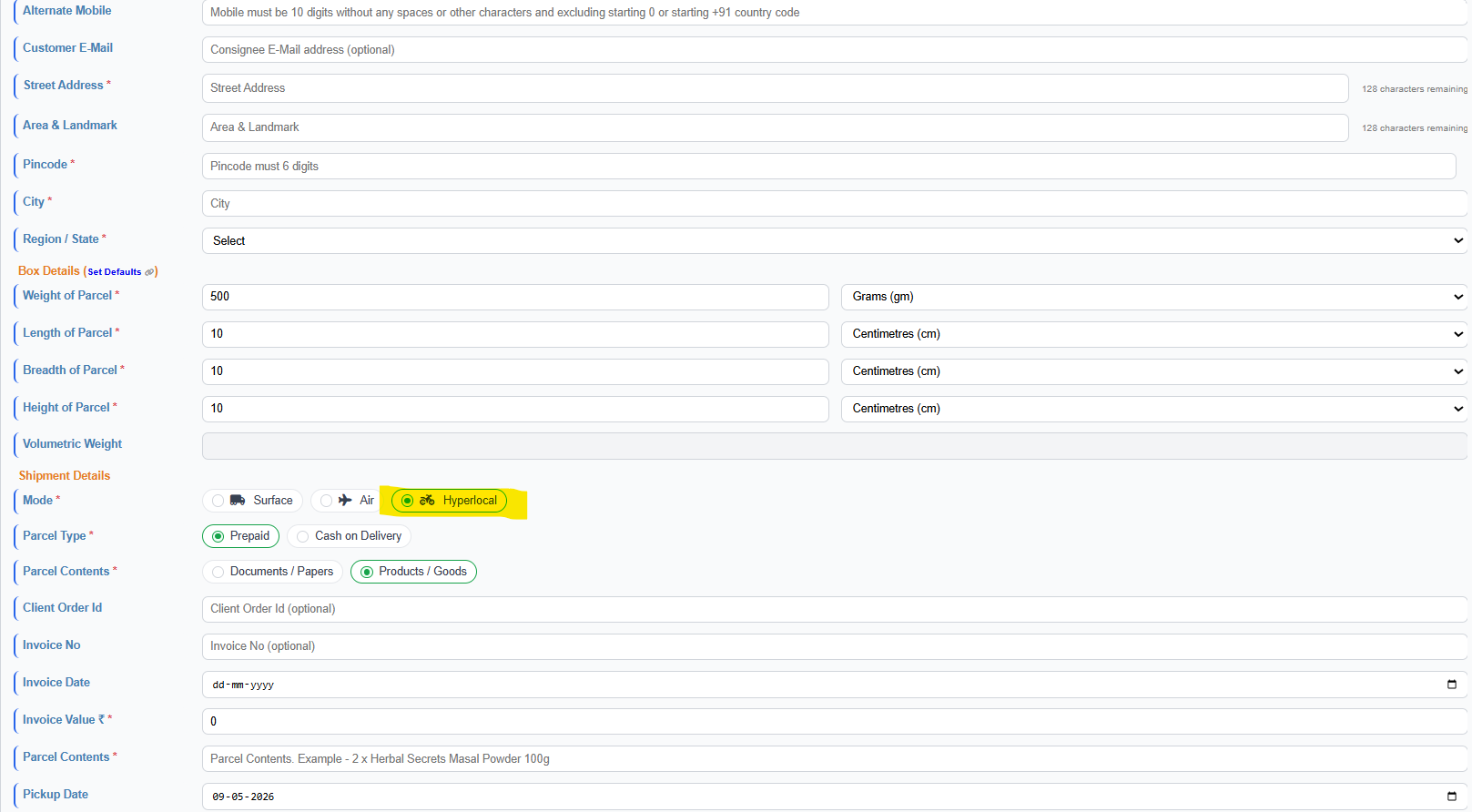
To book shipment for the same city, you need to select Hyperlocal when you are on the booking shipment page as shown below:
Key service details to note for hyperlocal:
Weight limit: Up to 10-15 kg per shipment (bike rider capacity)
Pricing: Charged on a per-kilometre basis
Available in select cities: This service is available in Mumbai, Delhi, Pune, Chennai, Hyderabad, Bangalore, Kolkata, Surat, Ahmedabad, Chandigarh, and Goa currently
Check rates: Use the online calculator to estimate same-day delivery charges before booking
Step 5: Dispatch and Delivery
The order is dispatched and delivered within a few hours, completing the process on the same day. Real-time tracking is shared with the customer immediately on dispatch so they can follow the rider's progress.
Video: How to Track All Shipments in Real Time
Real-World Business Examples
Quick Commerce Platforms
Platforms like Swiggy Instamart and Blinkit deliver groceries within 10 to 30 minutes in major Indian cities, setting new benchmarks for ultra-fast delivery. They use a dark store network - hundreds of small micro-warehouses positioned throughout each city - so that virtually every urban customer is within 2 to 3 kilometres of a fulfillment point.
Marketplace Same-Day Delivery
Amazon offers same-day delivery for selected products in major metro cities through its advanced fulfillment network. Prime members in Bengaluru, Mumbai, and Delhi see same-day delivery options on millions of eligible products, enabled by Prime-dedicated fulfillment centres stocked with fast-moving SKUs.
Retail Hyperlocal Delivery
Local retailers are increasingly partnering with logistics providers to enable hyperlocal delivery within hours, bridging offline and online retail. A local pharmacy or electronics store that offers 2-hour delivery through a hyperlocal platform competes directly with national eCommerce players - and often wins on speed.
Data-Driven Industry Insights
- Same-day delivery is available in approximately 10 to 15 major metro and Tier-1 cities in India as of 2026
- Same-day delivery costs 1.5x to 3x more than standard shipping for equivalent routes
- Order conversion rates improve by 15 to 25% when same-day delivery is offered as an option at checkout
- Quick commerce platforms in India now process millions of orders daily with average delivery times under 20 minutes in dense urban areas
- Demand for same-day delivery is growing fastest in electronics, fashion, and health & beauty categories
Same-Day vs Standard Delivery Comparison
| Factor | Same-Day Delivery | Standard Delivery |
|---|---|---|
| Delivery time | 4 to 12 hours | 2 to 5 business days |
| Cost | 1.5x to 3x higher | Standard rates |
| Inventory location | Must be local / hyperlocal | Centralised warehouse |
| Operational complexity | Very high - real-time execution required | Standard workflow |
| Geographic coverage | Metro and Tier-1 cities primarily | 29,000+ pincodes via aggregators |
| Best for | Groceries, medicines, urgent gifts, fashion | Regular eCommerce, B2B, bulk orders |
| COD availability | Limited in most hyperlocal models | Fully available via courier aggregators |
Cost Structure of Same-Day Delivery
Same-day delivery involves significantly higher costs due to the speed, infrastructure, and coordination required. Understanding each cost component helps businesses model unit economics before committing to a same-day offering.
Last-Mile Delivery Cost
The highest cost component. Immediate dispatch and optimised routing require dedicated riders or fast-turnaround courier partners. Unlike standard last-mile where riders consolidate multiple deliveries over a day, same-day often means near-dedicated delivery per order in the first launch phase.
Inventory Distribution Cost
Products must be stored at multiple hyperlocal points rather than a single centralised warehouse. This increases the total inventory holding cost and requires more sophisticated stock replenishment planning across locations.
Rider and Staffing Costs
Higher turnaround expectations mean more active riders per order volume, especially during peak hours when demand spikes unpredictably.
Technology Investment
Route optimisation software, real-time tracking, demand prediction tools, and automated order allocation systems all add to the cost base - but are non-negotiable for same-day operations at any meaningful scale.
Overall: Same-day delivery typically costs 1.5x to 3x more than standard shipping for the same destination and package size.
For eCommerce sellers evaluating whether same-day delivery makes financial sense, understanding the full picture of shipping costs and how to optimise them is the right starting point before committing to a faster and more expensive model.
Benefits of Same-Day Delivery
Improved Customer Satisfaction: Faster delivery enhances the post-purchase experience and reduces anxiety about order status.
Increased Sales: Same-day drives impulse purchases and conversion for time-sensitive categories where customers would otherwise buy in-store.
Competitive Differentiation: Helps brands stand out in crowded markets where product and price parity is high.
Higher Customer Retention: Consistent same-day delivery builds a level of convenience-based loyalty that is genuinely hard for slower competitors to replicate.
The relationship between delivery speed and repeat purchases is explored in the guide on how shipping experience impacts customer retention.
Challenges in Same-Day Delivery
Despite its benefits, same-day delivery comes with real operational challenges that should be understood before launch.
High Operational Cost
The most significant challenge - same-day costs significantly more per order, and the premium is often difficult to pass entirely to customers without reducing conversion rates. Most businesses absorb some of this cost, which compresses margins.
Inventory Distribution Complexity
Stock must be pre-positioned near customers before orders are placed. Incorrect demand forecasting at the hyperlocal level leads either to stockouts (failed same-day commitments) or overstock (high holding costs at expensive per-square-foot micro-warehouse locations).
Last-Mile Execution
Efficient last-mile optimisation is essential but difficult to execute consistently, especially during demand spikes. Last-mile delivery challenges in India covers why Tier-2 cities and high-density urban areas present structurally different problems that simple route optimisation cannot solve alone.
Demand Fluctuations
Intraday demand spikes are harder to manage than the daily volatility in standard eCommerce. A surge between 12 PM and 2 PM on a Saturday can overwhelm rider capacity if not anticipated through data-driven scheduling.
Limited Geographic Coverage
Same-day delivery is currently viable primarily in metro cities and select Tier-1 locations. Expanding to Tier-2 cities requires local logistics infrastructure that does not yet exist at scale across most of India.
Common Mistakes Businesses Make
- Expanding too quickly without sufficient hyperlocal demand - launching same-day in 10 cities simultaneously before mastering 1 or 2 is a common and expensive mistake
- Poor inventory planning at the hyperlocal level - stockouts on same-day promises damage trust more than slow delivery on standard orders
- Ignoring unit economics before launch - same-day only works financially above a certain average order value; data-driven eCommerce analytics should validate the model before committing to infrastructure
- Building on a single delivery partner - no one provider has consistent coverage and capacity across all areas of even a single metro city
- Setting unrealistic cutoff times that the operation cannot consistently meet, then failing to deliver - which is worse for retention than never offering same-day at all
Practical Optimisation Strategies
To successfully implement and scale same-day delivery, businesses need a strong operational strategy built on data, flexibility, and the right technology. Businesses planning same-day delivery should also understand shipping cost optimization, last-mile delivery challenges, courier allocation strategy, and hyperlocal inventory planning before launch.
Use Hyperlocal Fulfillment
Reduce delivery time by leveraging nearby stores or micro-warehouses rather than centralised facilities. Begin with 1 to 2 dark store locations in your highest-demand neighbourhood before scaling.
Optimise Delivery Routes Through Technology
Use route optimisation software to ensure faster and more efficient operations. Real-time GPS tracking and dynamic reordering of delivery sequences based on traffic conditions can reduce average delivery time by 20 to 30%.
Set Clear Order Cutoff Times
Define and communicate cutoff times clearly on your website and app. This manages operational load and customer expectations simultaneously - and protects your team from impossible commitments.
Use Data Analytics for Demand Prediction
Predict demand patterns and optimise hyperlocal inventory placement using advanced eCommerce analytics tools. Knowing that Saturday afternoons see 40% higher demand in certain neighbourhoods lets you pre-position stock rather than scrambling to fulfil after orders arrive.
Partner with Multiple Delivery Providers
Using a multi-courier allocation strategy improves coverage, capacity, and reliability. If one partner is at capacity during a peak hour, routing overflow to a secondary provider ensures continuity. For same-day and hyperlocal delivery specifically, iCarry® partners with Borzo - a dedicated on-demand hyperlocal delivery platform - alongside its standard courier network of partners for regular B2C and B2B shipments. This means sellers using iCarry® can handle both same-day city deliveries and pan-India standard shipping from one account.
Video: How to Compare Courier Options and Book a Shipment with Best Rates
Future of Same-Day Delivery in India
Same-day delivery in India is evolving rapidly with advancements in technology and changing consumer expectations.
Growth of Quick Commerce
The growth of quick commerce is enabling deliveries within 10 to 30 minutes, redefining industry standards. Blinkit, Swiggy Instamart, and Zepto have demonstrated that ultra-fast delivery is operationally achievable at city scale when the infrastructure investment is made upfront.
AI-Based Route Optimisation
AI-powered route planning is improving efficiency in real time - adjusting delivery sequences dynamically based on live traffic, rider location, and new orders arriving mid-route. This reduces average delivery time and fuel cost simultaneously.
Micro-Fulfillment Centres
Micro-fulfillment centres are enabling faster dispatch at lower real estate cost than traditional fulfillment centres. Purpose-built for automated picking in small footprints, they are becoming viable for mid-sized retailers as automation costs fall.
Drone and Autonomous Delivery
Emerging innovations such as drone delivery and autonomous vehicles may further transform last-mile logistics in the coming years, as highlighted in the emerging technology research by the World Economic Forum. Regulatory frameworks in India are still evolving, but several pilots are underway in controlled environments.
Conclusion
Same-day delivery is changing what Indian customers expect - and what eCommerce sellers have to deliver. For Indian eCommerce brands, same-day delivery is quickly becoming a competitive advantage rather than a premium differentiator. It's not magic. It needs the right inventory placement, a fast pick-and-pack process, and the right delivery partners. Get those three things right, and it works well.
As hyperlocal logistics continues to evolve, same-day delivery is only going to become more common in India. Customers are already used to it in groceries. That expectation is spreading to fashion, electronics, and everything else. The sellers who build this capability now will have a real head start.
Want to Offer Same-Day Delivery Without Building Your Own Fleet?
Same-day delivery requires strong coordination between inventory, fulfillment, and delivery networks. Businesses that leverage data and optimise logistics workflows can significantly improve delivery performance.
Use iCarry® to manage standard shipping across 29,000+ pincodes through multiple courier partners and hyperlocal same-day deliveries - all from one dashboard.
You also get real-time rate comparison, bulk booking, NDR management, and full shipment tracking from one platform - with no minimum volume required.
Video: How to Sign Up and Start Shipping with iCarry®
Frequently Asked Questions (FAQs)
What is same-day delivery in eCommerce?
Same-day delivery is a logistics service where orders are placed and delivered to customers within the same calendar day, typically within 4 to 12 hours.
How fast is same-day delivery in India?
Delivery typically occurs within 4 to 12 hours for standard same-day services. Quick commerce platforms like Blinkit and Swiggy Instamart deliver within 10 to 30 minutes in metro cities using dark store networks.
Why is same-day delivery more expensive?
It requires faster processing, localised inventory pre-positioned near customers, dedicated or near-dedicated rider capacity, and real-time technology infrastructure - all of which cost significantly more than standard centralised-warehouse shipping.
Which businesses use same-day delivery in India?
Grocery, food delivery, pharmacy, electronics, and fashion retailers most commonly use same-day delivery. Quick commerce platforms, marketplace fulfillment services, and hyperlocal retail delivery networks are the primary operators.
Is same-day delivery available across India?
It is currently available primarily in metro cities - Bengaluru, Mumbai, Delhi NCR, Hyderabad, Chennai, Pune - and select Tier-1 locations. Coverage is expanding but remains concentrated in high-density urban areas.
How can businesses optimise same-day delivery operations?
Use hyperlocal fulfillment points to reduce distance, optimise routes through real-time technology, set clear order cutoff times, forecast demand at the neighbourhood level using eCommerce analytics, and partner with multiple delivery providers using a multi-courier allocation strategy to ensure capacity and coverage redundancy.
What is the difference between same-day delivery and quick commerce?
Same-day delivery means delivery within the same calendar day, usually 4 to 12 hours. Quick commerce is a sub-category promising delivery within 10 to 30 minutes using dark stores and dedicated hyperlocal rider networks. Quick commerce is a more intensive operational model with higher infrastructure requirements.
Same-day delivery works when three things are in place: inventory close to the customer, a pick-and-pack process that dispatches within 30 minutes, and a reliable rider network. Get those right in one city before expanding to others - most same-day failures come from scaling before the foundation is solid.