You confirmed 500 orders this week. 320 of them are COD. By the time deliveries play out, 90 come back as RTOs - and you have paid forward and return freight on every single one of them.
Cash on Delivery is the backbone of Indian eCommerce. More than 60% of online orders in India are still placed on COD - a figure driven by low digital payment trust, buyer caution, and the comfort of paying only when the product arrives in hand.
But COD comes at a real cost. Sellers absorb double freight on every failed delivery, wait 7 days or more for their money, and carry the weight of 25 to 35% RTO rates in high-COD categories like fashion, footwear, and consumer electronics.
COD to prepaid conversion is one of the most effective strategies Indian eCommerce sellers use to reduce RTO, improve cash flow, and lower Cash on Delivery order costs. This practice of shifting COD orders to digital payment before dispatch does not mean eliminating COD entirely. It means converting the right orders at the right moment, using the right triggers.
This guide explains exactly how to do that. For context on how COD payment cycles affect your working capital, the guide on working capital management covers the full financial picture.
Quick Checklist - Are You Managing COD Strategically?
Most sellers accept high COD rates as unavoidable. These 7 checks tell you where the easiest gains are:
- Are you showing a prepaid discount at checkout? Even ₹20 to 30 can shift 15 to 25% of customers to prepaid
- Are you sending a WhatsApp payment link within 30 minutes of COD order placement?
- Do you have COD eligibility rules for high-RTO pin codes? NDR data by pincode tells you exactly which pincodes to restrict
- Are you tracking your COD%, prepaid%, and RTO rate weekly - not just when a complaint comes in?
- Do you offer at least one prepaid-only benefit beyond just discount - faster dispatch, extended returns, or loyalty points?
- Are you running a conversion nudge at the NDR re-engagement stage?
- Have you enabled early COD remittance to manage cash flow while your prepaid mix improves? Working capital management for eCommerce explains when and why this makes financial sense
What Is COD to Prepaid Conversion?
COD to prepaid conversion is the process of moving a customer who placed an order on Cash on Delivery to a digital payment method - UPI, net banking, card, or wallet - before the order is dispatched or picked up by the courier.
It can happen at multiple points in the order journey:
- Immediately at checkout, via incentive messaging
- After order placement, via WhatsApp or SMS payment link
- During order confirmation, via IVR or chatbot flow
- At re-attempt stage, after a failed first delivery
The goal is not to force prepayment. It is to make prepayment the obvious, rewarding choice for customers who are genuinely interested in their order.
Why COD Is Expensive for Sellers
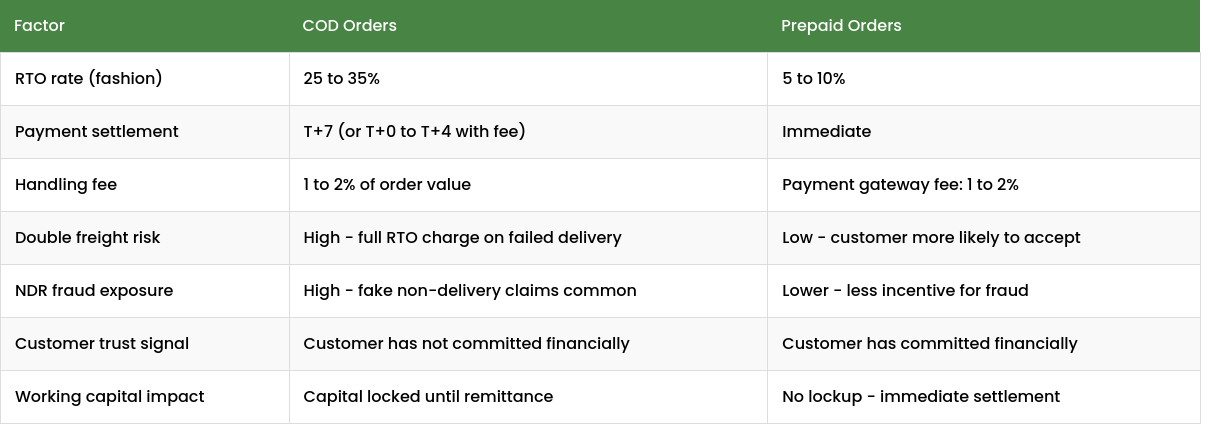
The visible cost of COD is the handling fee - typically 1 to 2% of the order value charged by the courier. But the real cost runs much deeper.
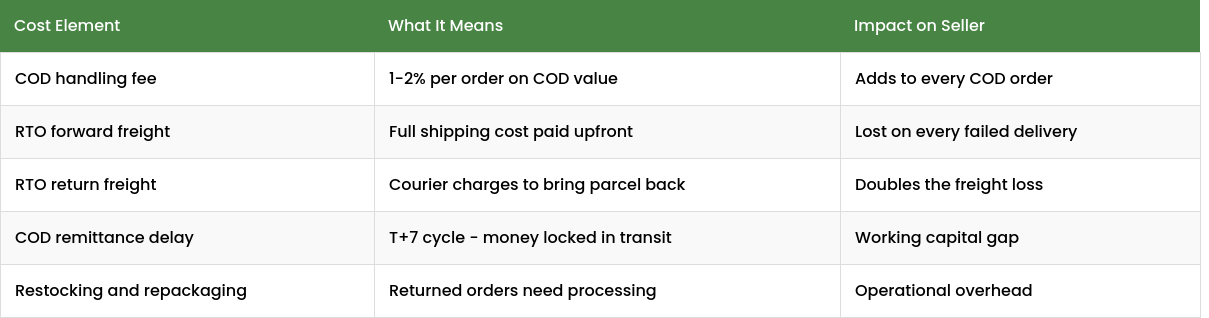
At a 30% RTO rate with an average order value of ₹600 and a two-way freight cost of ₹120, a seller shipping 100 COD orders per day absorbs ₹3,600 in pure RTO freight loss - every single day. The unit economics of shipping for D2C brands guide models this in full detail.
Video: How to Estimate Shipment Cost and Compare Couriers
Benefits of Converting COD Orders to Prepaid
1. Dramatically Lower RTO Rates
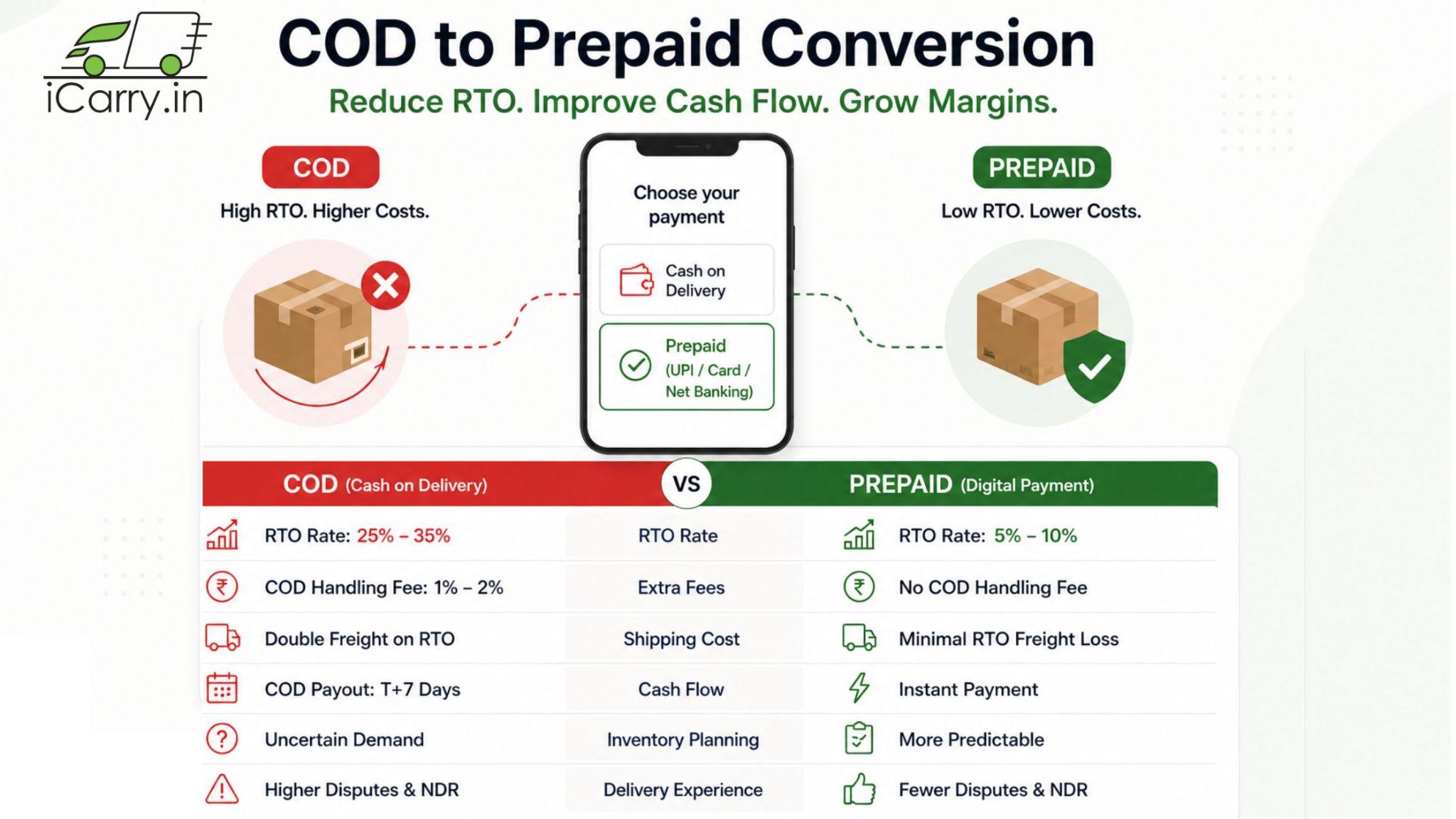
Prepaid orders see RTO rates of 5 to 10% compared to 25 to 35% for COD. A customer who has already paid is much more likely to be present and accept delivery. Commitment increases when money has already changed hands.
2. Immediate Cash Flow
Prepaid orders settle immediately - no T+7 wait, no working capital gap. This is especially valuable during festive season restocking cycles. For sellers still on COD, early COD remittance options can bridge the gap until conversion rates improve.
Video: How COD Remittance Works - T+0 to T+7 Options
3. Lower Shipping Costs Per Order
Without the COD handling fee and with a dramatically reduced RTO freight burden, the effective cost per delivered order drops. That saving can be passed to the customer as a shipping discount - or kept as margin. The guide on reducing shipping costs for eCommerce without killing margins covers the full cost reduction framework.
4. Better Inventory Planning
Prepaid orders are more predictable. Sellers can plan restocking and warehouse operations with greater confidence when the ratio of confirmed-payment orders is higher.
5. Reduced Courier Disputes
Fake delivery attempts and NDR fraud are far more common on COD orders. When orders are prepaid, the financial risk of a disputed non-delivery shifts. Read more about how fake delivery attempts affect COD sellers in India.
How to Convert COD Orders to Prepaid: 7 Proven Strategies
1. Offer a Prepaid Discount at Checkout
The most direct method. Show customers a ₹20 to 50 discount or free shipping offer if they switch to UPI or card payment. According to NPCI data on UPI adoption in India, UPI transactions have crossed 17 billion monthly - customers are comfortable paying digitally. The friction is not ability - it is motivation. A small incentive provides that motivation.
Best practice: Show the discount prominently next to the COD option at checkout - not buried in fine print. The visual comparison (COD: ₹599 vs UPI: ₹549) converts far better than text-only messaging.
2. Send a Payment Link via WhatsApp After Order Placement
After a COD order is confirmed, send the customer a WhatsApp message with a payment link and a compelling reason to switch - faster dispatch, an exclusive discount, or priority delivery. Two-way WhatsApp communication for order management is one of the most effective tools available to Indian eCommerce sellers today.
Timing matters: Send the payment link within 30 minutes of order placement, while purchase intent is highest.
iCarry®'s WhatsApp Engagement feature sends automated, two-way delivery communications from iCarry's official WhatsApp Business number (+91-63621-82961). Sellers can configure these messages to include payment links for pending COD orders, converting the standard order notification into an active conversion touchpoint.
3. Use COD Eligibility Filters
Not all customers should be offered COD. Use data signals to restrict COD for high-risk orders:
- Pin codes with RTO rates above 30%
- Order values above a threshold value - for example for clothing category, above ₹1,500, customers are more likely to be genuine, but high-value COD orders also carry high freight risk
- Repeat non-delivery history for the same mobile number or address
- Newly registered accounts with no order history
iCarry®'s Address Quality Scoring assesses the delivery address and assigns a risk band before dispatch. You may want to set up rules in your processes such as automatically call to verify address or trigger a COD restriction on your system for low-quality address scores. Or set up a conversion prompt stopping high-RTO shipments before they leave your warehouse.
4. Offer Prepaid-Only Benefits
Create a prepaid-first value proposition beyond just discounts:
- Priority order processing and same-day dispatch for prepaid
- Extended return windows for prepaid orders
- Free gift wrapping or personalisation for prepaid
- Loyalty points or cashback exclusively for digital payments
5. Run a COD Confirmation Call or IVR
For high-value orders, run a brief confirmation step - IVR call or WhatsApp message - that asks the customer to confirm delivery intent. During this interaction, offer the payment link as an upgrade option. This dual function simultaneously reduces fake COD orders and creates a conversion opportunity.
6. Target Repeat Customers With Prepaid Nudges
Customers who have received and accepted multiple COD deliveries from your brand are the easiest conversion targets. They already trust you. A simple message explaining that prepaid orders ship faster and get priority handling is often enough to convert this segment.
7. Retry Conversion After NDR
When a first delivery attempt fails, the re-engagement message is a second conversion opportunity. Rather than simply rescheduling delivery, include a payment link in the NDR communication. A customer who wants their order but missed the delivery agent is often willing to switch to prepaid to guarantee the next attempt.
Video: How to Monitor and Act on NDR Shipments
Realistic Conversion Benchmarks: What to Expect
COD to prepaid conversion rates vary by category, order value, and channel. Here is what sellers typically achieve with active conversion efforts:
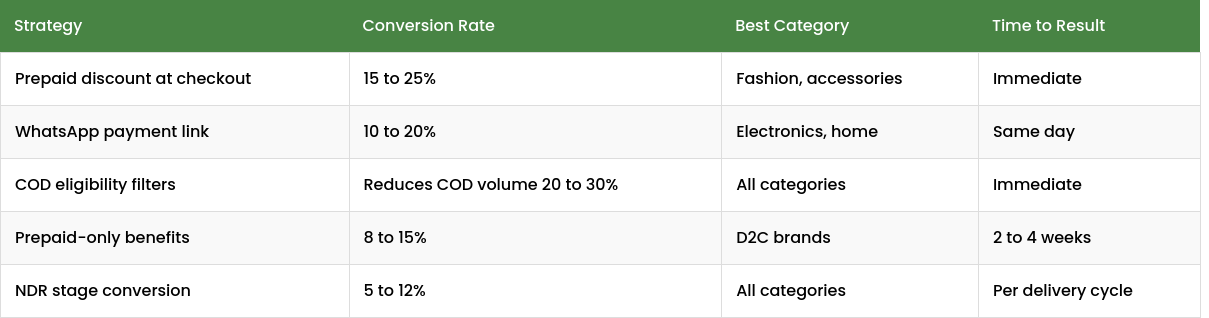
Combined, a seller running 3 to 4 of these strategies simultaneously can realistically shift 30 to 40% of their COD order volume to prepaid within 60 days. That shift alone typically reduces overall RTO rates by 8 to 12 percentage points.
COD vs Prepaid: Full Cost and Risk Comparison
Common Mistakes That Kill COD Conversion Rates
Removing COD entirely: Eliminating COD without a warm transition plan loses customers. Conversion works through incentives and nudges - not force.
Poorly timed payment links: Sending a payment link 6 hours after order placement - when purchase intent has cooled - converts far worse than sending within 30 minutes.
Generic messaging: 'Pay now and save' is weak. 'Pay now via UPI and get free express delivery - dispatched today' is specific, urgent, and value-linked.
Ignoring high-value order risk: High-value COD orders have the most to gain from conversion. Many sellers focus only on low-value order volume and leave the highest-risk segment untouched.
No measurement: If you are not tracking your COD-to-prepaid conversion rate weekly, you cannot improve it. Set a baseline and monitor it actively.
COD to Prepaid Conversion: Quick-Start Checklist
- Show a prepaid discount at checkout - minimum ₹20 to 30 to be visible and effective
- Configure WhatsApp payment link messages triggered 20 to 30 minutes after COD order placement
- Activate address quality scoring to auto-restrict COD on high-risk delivery addresses
- Create a prepaid-only benefit - free shipping, priority dispatch, or loyalty points
- Set COD eligibility rules for high-risk pin codes and order values above your RTO threshold
- Build an NDR re-engagement flow that includes a payment link in the first follow-up message
- Track weekly: COD%, prepaid%, and RTO rate by segment to measure conversion impact
The Numbers Behind COD Dependence in India
COD remains dominant in Indian eCommerce for structural reasons. According to Economic Times reporting on Indian eCommerce payment trends, trust, return convenience, and the lack of digital payment habit in Tier-2 and Tier-3 markets continue to drive COD preference. For sellers in these markets, the goal is not to fight this preference - it is to gradually shift the economics in their favour.
Last-mile delivery infrastructure in India also contributes to COD persistence. The unique challenges of last-mile delivery in India - including address ambiguity, customer unavailability, and courier behaviour - all compound the RTO risk that makes COD expensive.
Four iCarry® Features That Cut COD RTO
WhatsApp Engagement
iCarry®'s WhatsApp Engagement feature sends automated, two-way delivery communications from iCarry's official WhatsApp Business number. Messages go out at key shipment milestones - booking confirmation, pickup, out for delivery, and NDR - and customers can reply directly. Sellers can configure these touchpoints to include payment links for pending COD orders, turning every delivery notification into a conversion opportunity.
Video: How to Enable WhatsApp Engagement
Address Quality Scoring
Before an order is dispatched, iCarry®'s Address Quality Scoring system assesses the delivery address and assigns a risk band. Low-quality address scores can automatically trigger a COD restriction.
Video: How to use Address Quality Scoring
Delivery Boost
iCarry®'s Delivery Boost feature proactively communicates with customers before delivery attempts to confirm availability and intent - reducing fake NDRs and increasing first-attempt success rates. Higher first-attempt delivery rates mean less COD fraud exposure and stronger grounds for encouraging prepaid on future orders. Video: How To Enable Delivery Boost
Early COD Remittance
For orders that remain on COD, iCarry®'s early remittance tiers (T+0 through T+4) reduce the working capital pressure that makes high-COD operations financially stressful. Combined with active conversion strategies, sellers can progressively shift their order mix while managing cash flow through the transition. Working capital management for eCommerce businesses explains how to calculate which remittance tier makes financial sense for your volume.
Video: How COD Remmitance Works
Post-Dispatch Conversion Support via Tickets
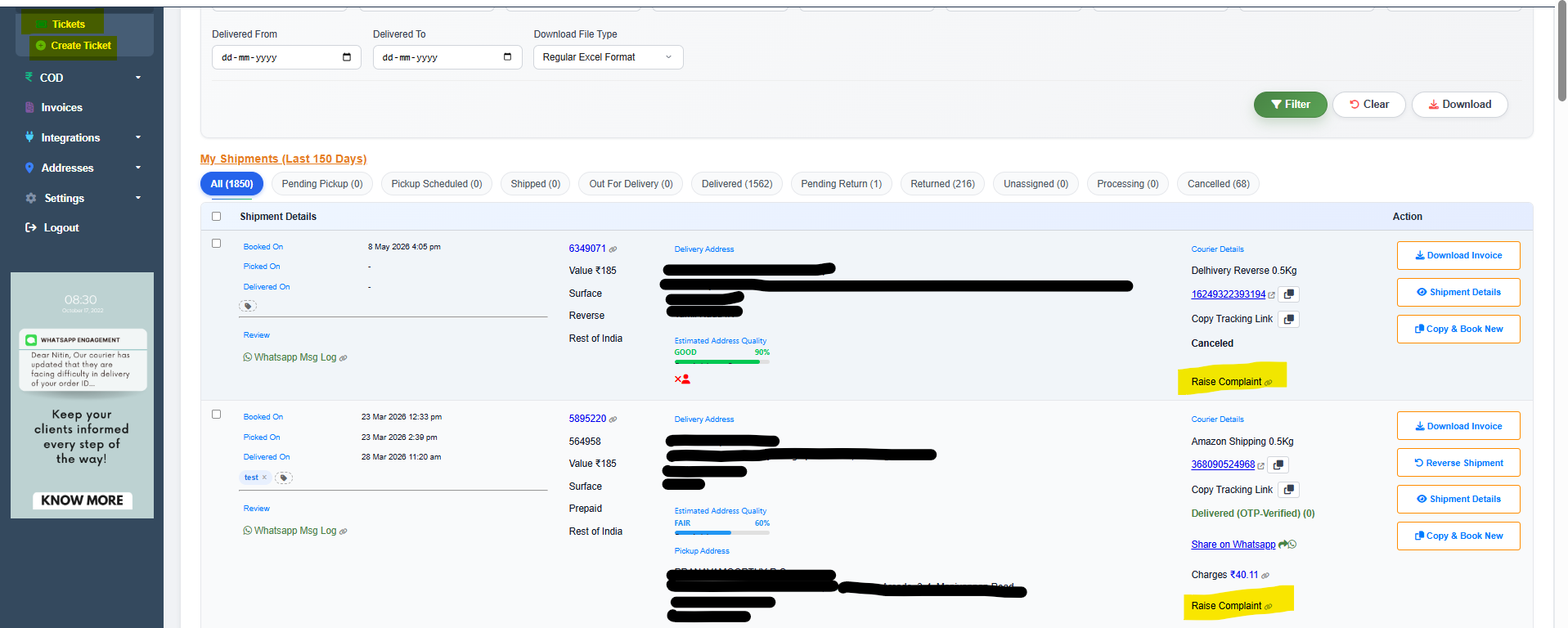
For edge cases where a COD order needs to be converted after it has been picked by the courier, iCarry®'s support team can coordinate with the courier partner on your behalf. All you need to do is raise a ticket from your dashboard with the details and the team handles the rest.
Final Thoughts
COD will remain a part of Indian eCommerce for the foreseeable future. The sellers who win are not those who eliminate it - they are those who manage it strategically while progressively building a stronger prepaid base.
The conversion playbook is not complicated. A checkout discount, a well-timed WhatsApp message, a COD eligibility filter, and a delivery infrastructure that makes prepaid the obvious choice - together, these can shift 30 to 40% of your COD volume within two months.
Start with the strategies that match your current order volume and tech stack. Track the results weekly. Each percentage point you shift from COD to prepaid reduces your RTO exposure, improves your cash flow, and compresses your cost per delivered order.
Want to reduce COD losses and improve prepaid conversion? Compare courier rates and explore iCarry®'s WhatsApp Engagement, Address Quality Scoring, Delivery Boost, and early COD remittance tools.
Frequently Asked Questions (FAQs)
What is COD to prepaid conversion in eCommerce?
It is the process of shifting a customer who placed an order on Cash on Delivery to a digital payment method - UPI, card, or wallet - before the order is dispatched. The goal is to reduce RTO risk and improve cash flow by securing payment upfront.
Why should I convert COD orders to prepaid?
Prepaid orders have much lower RTO rates (5 to 10% vs 25 to 35% for COD in fashion), settle immediately, carry no COD handling fee, and reduce the double freight loss that comes with every failed COD delivery.
What is the best way to convert COD orders to prepaid in India?
A prepaid discount at checkout combined with a WhatsApp payment link sent 20 to 30 minutes after order placement is the highest-performing combination for most Indian eCommerce sellers. Adding COD eligibility filters for high-risk pin codes and addresses compounds the impact. Last option is to manually request a conversion from COD to Prepaid by raising a help desk ticket with your courier partner.
How much discount should I offer to convert COD to prepaid?
A flat discount of ₹20 to 50, or free shipping on prepaid orders, is enough to create visible value for most customers. The key is making the comparison clear at checkout - show both options with the discount applied so customers can see the saving immediately.
Will restricting COD reduce my order volume?
Applied correctly, COD eligibility filters reduce order volume by less than 5% while eliminating 20 to 30% of high-risk shipments. The orders you lose are disproportionately those that would have resulted in RTOs anyway. Net margin per order typically improves.
What RTO rate should I target after optimising for prepaid?
A blended RTO rate below 15% is achievable for most categories with active prepaid conversion, address validation, and NDR management in place. Fashion and high-COD categories may take longer but can sustainably reach 18 to 22% with consistent effort.
Is COD still relevant for Tier-2 and Tier-3 customers in India?
Yes - and it will remain so. COD conversion does not mean eliminating the option for customers who genuinely need it. The strategy is to convert where conversion is easy and profitable, not to force prepayment on customers who would not complete the order otherwise. Regional logistics challenges also play a role - the guide on last-mile delivery in India explains why Tier-2 and Tier-3 delivery infrastructure shapes COD behaviour.
How do I reduce COD RTO in India?
The most effective ways to reduce COD RTO in India include converting eligible COD orders to prepaid, restricting COD for high-risk pin codes, using address validation, automating NDR follow-ups, and sending payment links through WhatsApp after order placement.
COD to prepaid conversion is not about forcing customers to change - it is about making prepayment the obvious, rewarding choice through well-timed incentives, smart eligibility filters, and delivery infrastructure that reduces risk. With the right combination of checkout discounts, WhatsApp payment links, address validation, and NDR re-engagement, Indian eCommerce sellers can realistically shift 30 to 40% of COD volume to prepaid within 60 days - reducing RTO exposure, improving cash flow, and compressing the cost per delivered order.