You are shipping 200 orders a month and paying ₹75 per shipment. Another seller on the same platform with 2,000 monthly orders is likely paying ₹48 for the same route. Same weight. Same courier. Same destination. Different rates.
That gap is bulk shipping discounts at work. And it is not only accessible to large businesses. Bulk shipping discounts in India help businesses reduce courier costs significantly as order volume grows.
Shipping is one of the largest operational costs for Indian eCommerce sellers. India's logistics sector growth continues to accelerate, but the cost pressure on per-order shipping margins is real and growing. The good news: even small and mid-sized businesses can unlock bulk shipping rates without waiting to become large - if they approach it strategically.
This guide explains how bulk shipping discounts work in India, what affects courier pricing, how volume-based slabs are structured, and the practical steps to reduce your per-shipment cost starting now.
What Are Bulk Shipping Discounts?
Bulk shipping discounts are reduced courier rates offered to businesses that ship consistently high volumes of orders. The principle is straightforward: couriers allocate network capacity to high-volume shippers and in exchange offer lower per-shipment rates.
In simple terms: the more you ship regularly, the less you pay per shipment. Global logistics efficiency research by the World Bank consistently shows that volume aggregation is the primary mechanism through which businesses - of any size - access logistics cost advantages.
For Indian eCommerce sellers, bulk discounts typically come through two routes: direct volume contracts with individual couriers, or accessing pre-negotiated aggregated rates through a courier aggregator platform from day one.
Why Bulk Shipping Discounts Matter for Indian Sellers
- Lower cost per order: Even a ₹15 reduction per shipment on 500 monthly orders saves ₹7,500 per month - ₹90,000 per year
- Competitive pricing: Lower logistics costs let you offer free shipping thresholds or competitive product pricing that higher-cost competitors cannot match
- Margin protection at scale: As order volume grows, per-shipment cost should decrease - not stay flat or increase
- Better working capital: Reduced per-order spending improves cash flow available for inventory and marketing
How Courier Pricing Works in India
Understanding what drives courier pricing is the foundation of any discount negotiation. Indian couriers price on the following factors:
- Shipment volume: Monthly order volume is the primary driver. Higher consistent volume unlocks lower per-slab rates
- Weight - actual vs volumetric: Billed on whichever is higher. Volumetric weight = L x B x H (cm) / 5000. Volumetric weight billing explained covers how this silently inflates cost.
- Delivery zone: Local Zone A is cheapest, national Zone D/E the most expensive. Zone mix in your order profile directly affects your average rate
- COD ratio: COD orders carry additional handling and collection charges. Higher COD ratio raises effective per-order cost
- Service type: Express and air shipments cost significantly more than standard surface
- RTO rate: While not a direct pricing factor, high RTO doubles your freight cost by triggering return charges. Reducing RTO is the most direct cost lever for COD-heavy sellers
Volume-Based Discount Slabs in India
Most Indian couriers structure discounts in monthly shipment slabs. Here are indicative rate ranges for surface B2C shipping from most origin cities:
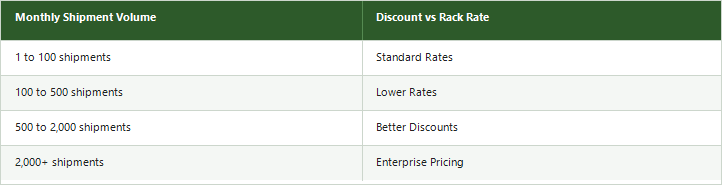
Key insight: Most growing eCommerce businesses start seeing meaningful savings after 500 monthly shipments. But courier aggregators like iCarry® give sellers access to pre-negotiated aggregator-level rates from shipment one - so you do not have to wait to reach 500 orders to save.
How Shipping Operations Mature as Order Volume Grows
100 - 500 orders/day: Building the foundation - At this stage, the biggest challenge is reducing manual effort and improving courier selection. Businesses typically move from individual shipment booking to bulk processing, connect their sales channels for automated order sync, access multiple courier partners, and gain better visibility into shipment status and performance.
500 - 2,000 orders/day: Optimising the operation - As volumes increase, operational gaps start impacting margins. The focus shifts to reducing RTOs, improving courier performance, managing NDRs efficiently, and introducing automated workflows. Shipment analytics and performance tracking become essential to identify issues by courier, pincode, and delivery stage.
2,000 - 10,000 orders/day: Building scalable logistics infrastructure - At enterprise volumes, managing logistics manually becomes increasingly complex. Businesses need deeper automation through API integrations, performance-based courier routing, multi-channel shipment management, and structured logistics controls to maintain delivery quality while scaling.
Direct Courier vs Courier Aggregator - Rate Comparison
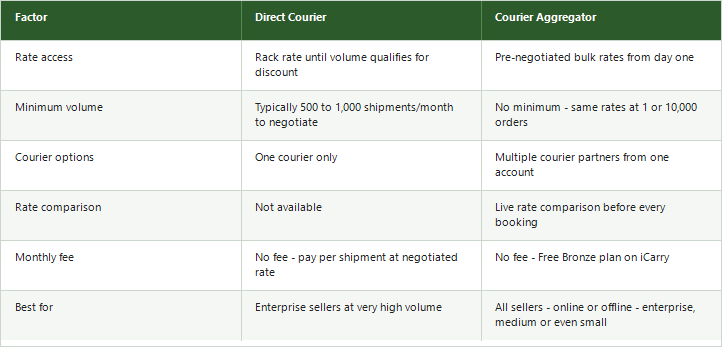
The practical implication: for most Indian eCommerce sellers below 5,000 monthly orders, a courier aggregator gives better rates than a direct courier contract without the volume requirement or negotiation overhead. Multi-courier allocation explains how routing each order to the best-rate courier further reduces blended shipping cost.
Types of Bulk Shipping Discounts in India
Volume-Based Discounts
The most common model. As monthly shipment count crosses defined thresholds, the per-shipment rate decreases. Consistent monthly volume is more important than occasional peaks - couriers reward predictability.
Contractual Pricing
Businesses with 1,000+ consistent monthly shipments can negotiate fixed-rate contracts directly with couriers. Provides cost predictability and protection from periodic rate revisions. Typically reviewed quarterly or annually.
Zone-Based Discounts
Some couriers offer preferential rates on specific regional corridors where they have excess network capacity. Sellers whose order profile is heavy on particular zones can negotiate zone-specific discounts on top of volume pricing.
Aggregator Pre-Negotiated Rates
Courier aggregators like iCarry® aggregate shipment volume across thousands of sellers and negotiate bulk rates that individual sellers cannot access at low volume. These rates are available from the first shipment - no minimum commitment, no contract negotiation required.
Step-by-Step: How to Reduce Your Per-Shipment Cost
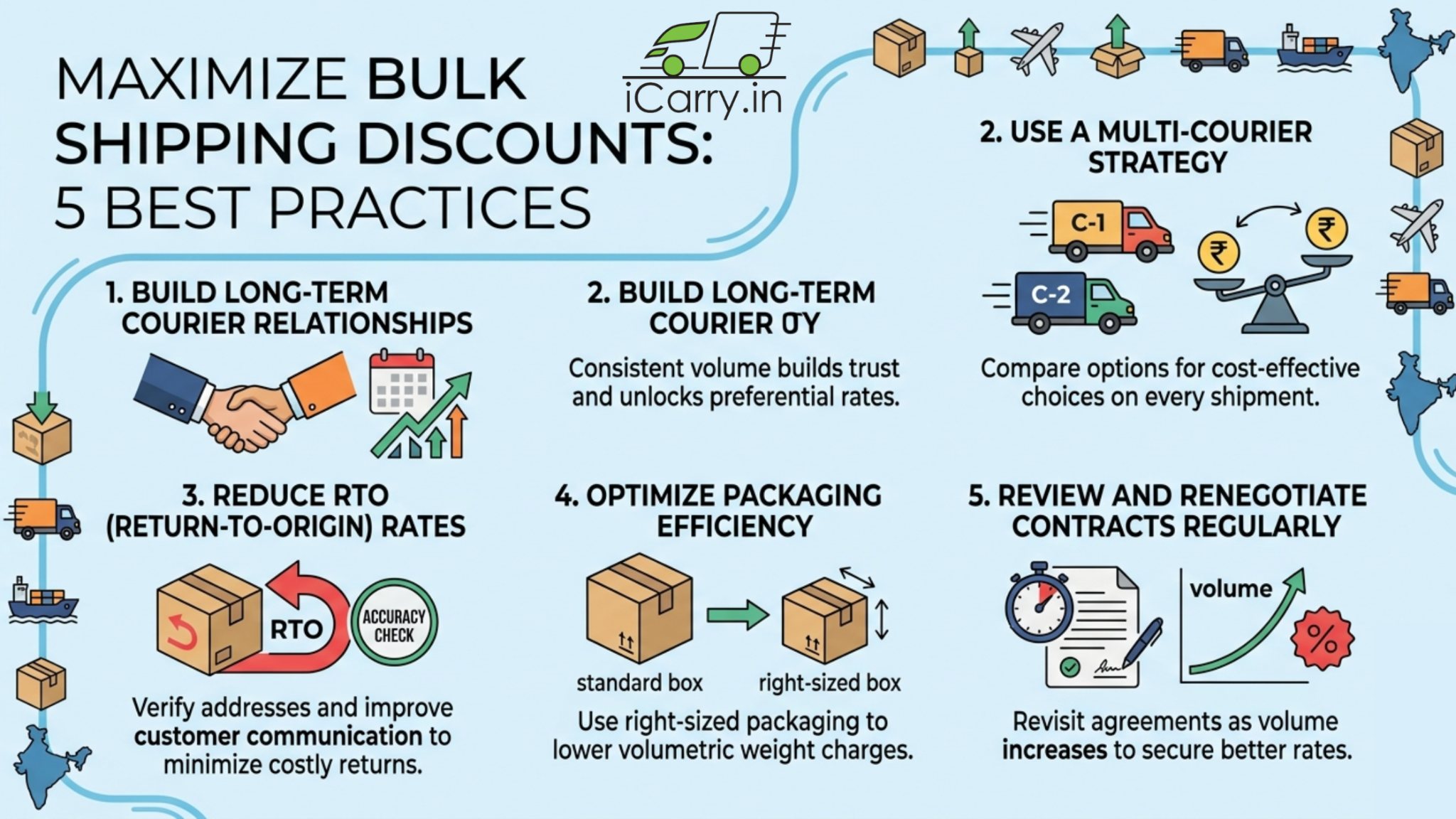
- Step 1 - Baseline your costs: Calculate your current average per-shipment cost including base freight, COD fees, RTO return charges, and weight discrepancy charges. This is your starting number.
- Step 2 - Join a courier aggregator: If you are not already on one, joining iCarry® on the free Bronze plan immediately gives you pre-negotiated rates across multiple courier partners. Compare rates at iCarry before your next booking.
- Step 3 - Right-size your packaging: Reduce volumetric weight by using right-sized boxes and poly mailers. This single change typically reduces per-shipment cost by ₹15 to ₹45 on light products shipped in oversized boxes.
- Step 4 - Reduce RTO: Each prevented RTO saves double freight. At ₹80 round-trip freight, 50 fewer RTOs per month saves ₹4,000 - more than most rate negotiations deliver. Enable Delivery Boost for high-risk COD orders and use Address Quality Scoring before dispatch.
- Step 5 - Compare before every booking: Different couriers have different rates by zone and weight. Comparing rates before each booking - not defaulting to one courier - consistently saves ₹10 to ₹20 per order.
- Step 6 - Review and renegotiate quarterly: As your volume grows, your negotiating position improves. Review rates every 3 months and renegotiate any direct courier contracts to reflect your current volume.
Track the results using logistics KPIs - on-time delivery rate, RTO rate, and cost per delivered order are the three metrics that tell you whether your cost reduction efforts are working.
Watch Overview of My Account > My Shipments to see how iCarry® tracks all shipment performance data across all couriers from one dashboard.
Real-World Examples of Bulk Shipping Savings
D2C Brand - Volume Discount
A growing D2C brand reached 600 monthly shipments and used their volume data to negotiate a direct contract with courier. Per-shipment cost dropped by 18%. They used this saving to offer free shipping above ₹499 - which increased average order value by 14% within two months.
Small Seller - Aggregator Advantage
A small eCommerce seller shipping 80 orders per month joined iCarry® on the free Bronze plan. Immediately accessed pre-negotiated rates that were 22% lower than their previous direct-booking rack rates. No volume minimum required. Monthly shipping cost dropped by ₹4,200 without any operational change.
Packaging Optimisation
An online home decor brand found that 60% of their products were being billed at volumetric weight in oversized boxes. Switching to right-sized boxes for their top 8 SKUs reduced average chargeable weight by 35%. Combined with aggregator rates, effective per-order shipping cost dropped from ₹95 to ₹61.
Common Mistakes That Cost Sellers on Shipping
- Not comparing courier rates before booking: Defaulting to one courier means missing the 15 to 25% rate difference that often exists between couriers for the same route
- Ignoring volumetric weight: The most common invisible cost driver. Right-sizing packaging is free to implement and often saves more than rate negotiations
- Not tracking RTO separately from return rate: RTO and customer-initiated returns have different causes and different cost implications. Blending them hides which intervention to apply
- Not disputing weight discrepancy charges: Most sellers absorb these without challenging them. Pre-dispatch parcel photos with AWB number visible and a 5-day dispute window recover real money every month
- Single courier dependency: Relying on one courier limits negotiating power and creates operational risk when that courier's performance dips on specific pincodes
Final Thoughts
Bulk shipping discounts in India are not reserved for large businesses. Pre-negotiated aggregator rates, right-sized packaging, RTO reduction, and consistent rate comparison give sellers of any size access to meaningful per-order cost savings.
The difference between a seller paying ₹95 per shipment and one paying ₹55 is not always volume - it is often just better tooling, better habits, and a platform that gives them rate options before every booking.
iCarry® gives Indian businesses access to pre-negotiated bulk rates across multiple courier partners from the free Bronze plan - no minimum volume, no monthly fee, no contract negotiation required. Compare live shipping rates across multiple couriers and reduce your shipping cost at iCarry.in.
Frequently Asked Questions (FAQs)
What are bulk shipping discounts in India?
Bulk shipping discounts are reduced per-shipment courier rates offered to businesses that ship consistently high volumes. Discounts are structured in monthly volume slabs - the higher the monthly shipment count, the lower the rate per shipment.
How can small businesses get bulk shipping rates in India?
Small businesses can access pre-negotiated bulk rates immediately by joining a courier aggregator like iCarry® - no minimum volume required. Aggregators negotiate rates across thousands of sellers and pass those rates to every seller on the platform from the first shipment.
What is the minimum volume needed for bulk shipping discounts?
For direct courier contracts, most couriers require 500 to 1,000 consistent monthly shipments before offering meaningful discounts. Through a courier aggregator, pre-negotiated bulk rates are available from the first shipment with no minimum volume.
How much can businesses save with bulk shipping discounts?
Businesses can typically save 10 to 25% on base freight rates through volume discounts. Combined with packaging optimisation (reducing volumetric weight) and RTO reduction, total per-order shipping cost can be reduced by 30 to 45% versus unoptimised operations.
Should I use a direct courier contract or a courier aggregator?
For most businesses, a courier aggregator gives better rates without the volume requirement or negotiation overhead. Above 5,000 monthly shipments, a combination - direct contracts for primary routes plus an aggregator for flexibility - typically delivers the best blended rate.
Does iCarry® offer bulk shipping discounts?
iCarry® provides access to pre-negotiated bulk rates across multiple courier partners from the free Bronze plan. Rates start from ₹21* per 500g with no monthly fee and no minimum shipments - giving every seller access to aggregated volume pricing from day one.
Can small sellers access bulk shipping discounts without a direct courier contract?
Yes. A courier aggregator pools shipments across thousands of sellers, so even businesses shipping 20 to 50 orders a day access pre-negotiated volume rates from day one - without signing a direct contract with any courier. Manufacturers, boutique sellers, and Instagram brands all qualify from their first shipment with no minimum volume commitment.
What is a rate slab and how do I know which one I am currently on?
A rate slab is a pricing tier based on monthly shipment volume. For example: 0-500 shipments at ₹55 per shipment, 500-2,000 at ₹47, and 2,000+ at ₹38. Your slab determines your per-shipment cost. Check your courier contract or aggregator dashboard - iCarry® shows your current rate and the next threshold so you can plan volume to unlock a better tier.
Bulk shipping discounts in India are accessible to businesses of any size - not just large enterprises. Courier aggregators like iCarry® give sellers pre-negotiated volume rates from the first shipment. Combined with right-sized packaging, RTO reduction, and consistent rate comparison before every booking, most sellers can reduce per-order shipping cost by 20 to 35% without waiting to grow into high volume.