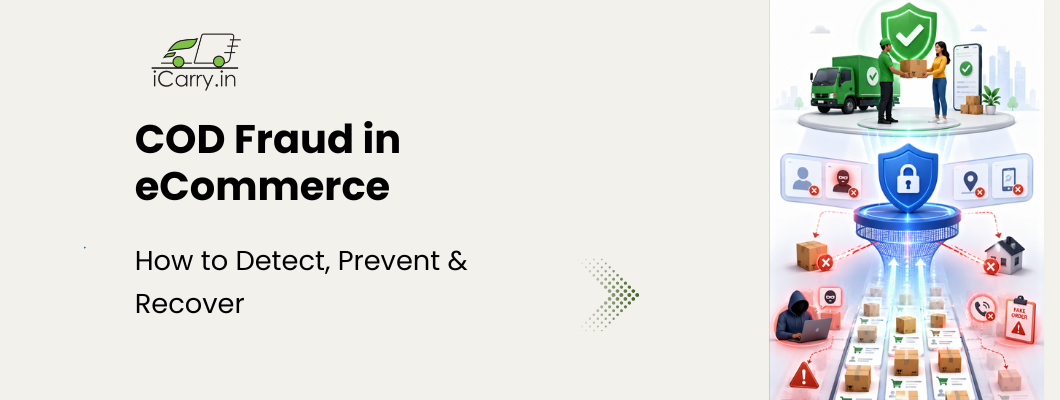
Cash on Delivery (COD) built Indian eCommerce. For a market where digital payment trust took years to develop, COD was the bridge that let millions of first-time online shoppers buy without fear. But that same trust gap that made COD necessary also makes it the single most exploited weak point in the order lifecycle.
Every seller who has shipped COD orders at scale has eventually faced some version of the same problem: an order placed with no intention of paying, a customer who orders repeatedly only to refuse at the doorstep, or a competitor placing fake orders to disrupt operations. This is COD fraud - and unlike a one-time scam, it is a recurring, structural cost that quietly erodes margins for COD-heavy sellers across India.
This guide breaks down exactly what COD fraud looks like, the patterns to watch for, the tools that genuinely reduce it, and what to do when fraud has already cost you money. If you ship COD orders regularly, understanding how courier scams target eCommerce sellers alongside COD fraud gives you the full picture of where fraud risk concentrates in the order lifecycle.
What Is COD Fraud?
COD fraud refers to any deliberate misuse of the Cash on Delivery payment model to cause financial loss to a seller, courier, or platform. It is distinct from a genuine NDR (Non-Delivery Report) caused by an unavailable customer or a wrong address - COD fraud involves intent.
The financial mechanics make COD uniquely vulnerable. With a prepaid order, the seller has already been paid before the shipment leaves the warehouse - any failed delivery is an operational cost, not a revenue loss. With COD, the seller fronts the entire cost of production, packaging, and forward freight on the promise of payment at the doorstep. If that payment never materialises - whether through fraud or simple refusal - the seller absorbs the full loss.
This single difference is why choosing the right courier for COD orders carries more weight than it does for prepaid sellers - the courier's fraud detection, NDR handling, and delivery verification processes directly determine how much fraud actually reaches your bottom line.
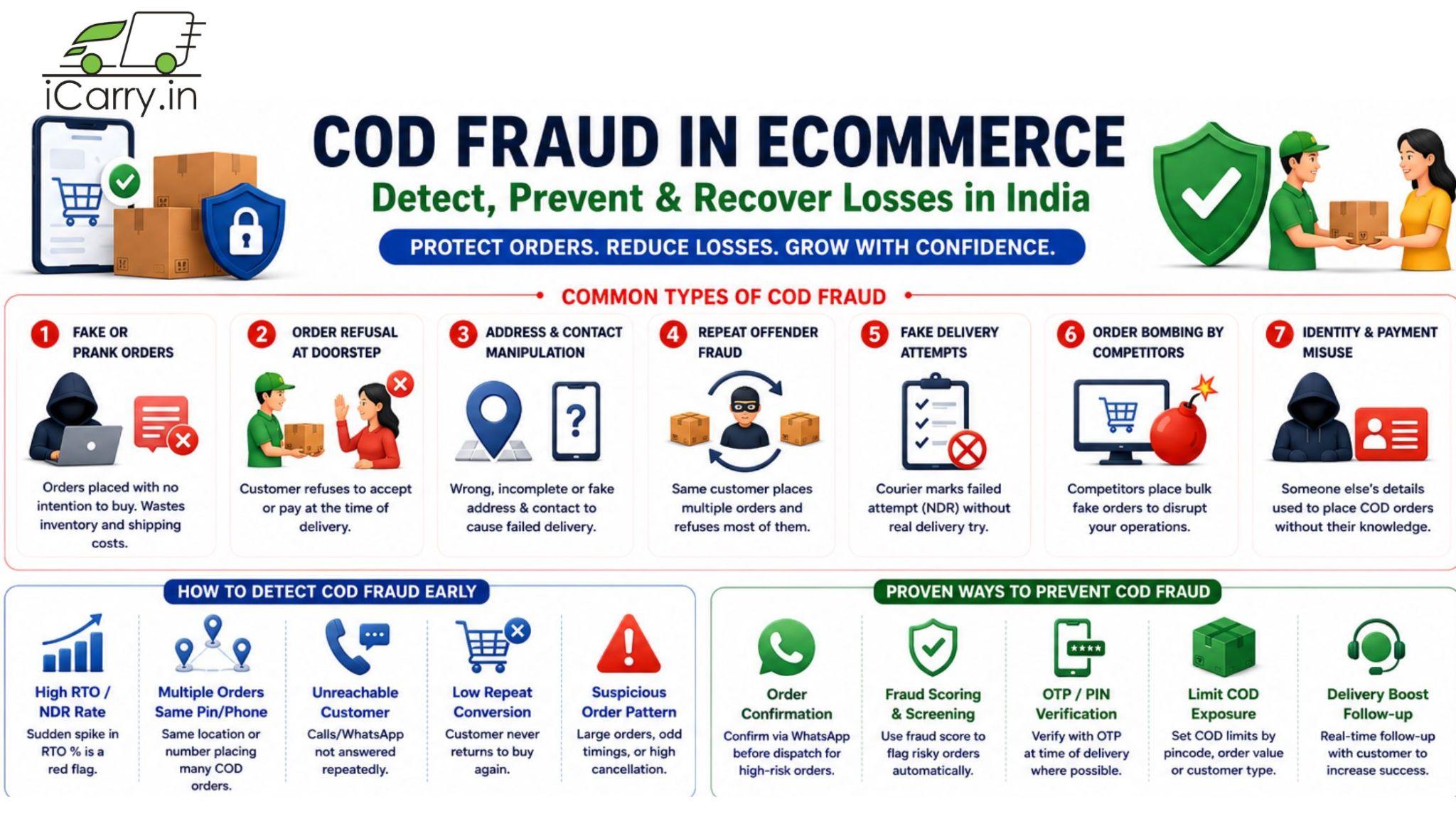
Common Types of COD Fraud in Indian eCommerce
1. Fake or Prank Orders
The most common and lowest-effort form of COD fraud. A customer places an order with a real or fake phone number and address, with no intention of accepting delivery. The motivation ranges from boredom to deliberately disrupting a seller's inventory and operations. Sellers see this disproportionately on new SKU launches, viral social media posts, and during sale periods when order volume - and scrutiny per order - drops.
2. Order Refusal After Delivery Attempt
The customer genuinely placed the order but refuses to pay or accept it when the delivery executive arrives - sometimes claiming they "changed their mind," sometimes citing a price difference noticed elsewhere, sometimes with no explanation at all. This is technically a refusal rather than fraud in the strict sense, but it carries the same financial consequence: forward freight cost, return freight cost, and zero revenue.
3. Address and Contact Manipulation
Fraudulent or careless customers provide incomplete, incorrect, or deliberately vague addresses, knowing this increases the chance of a failed delivery attempt that gets logged as an NDR rather than an outright refusal - making it harder for sellers to flag the pattern or hold the customer accountable across multiple orders.
4. Repeat Offender Fraud
A single customer (or a small group operating from one location) places multiple orders across different sellers, accepts a small percentage to appear legitimate, and refuses the rest. Without shared fraud intelligence across sellers, this pattern is invisible to any single business - each seller sees only their own RTO rate rising without understanding why.
5. Fake Delivery Attempts by Courier Executives
Not all COD fraud originates from the customer side. Some delivery executives mark a shipment as a failed delivery attempt (NDR) without genuinely attempting delivery - either to reduce their own workload or due to route inefficiency, then report a false reason such as 'customer not available' or 'address not found.' Fake delivery attempts explains exactly how this pattern works and why it disproportionately affects COD shipments in Tier-2 and Tier-3 pincodes.
6. Order Bombing by Competitors
In competitive categories - particularly fashion, beauty, and FMCG - some sellers report waves of suspicious orders that correlate suspiciously with competitor product launches or ad campaigns. While difficult to prove conclusively, the pattern of high-volume fake orders concentrated around a specific SKU or campaign window is a recognised risk in high-CAC categories.
7. Identity and Payment Detail Misuse
In rarer but more damaging cases, fraudsters use someone else's name, phone number, or address to place COD orders without that person's knowledge. The genuine account holder, when contacted by the courier, denies the order entirely - leaving the seller with a confirmed-then-disputed shipment and no clear party to recover the loss from.
How Much Does COD Fraud Actually Cost?
The direct cost is the easiest to calculate but the smallest part of the picture. The indirect costs compound far beyond the freight loss on a single failed order.
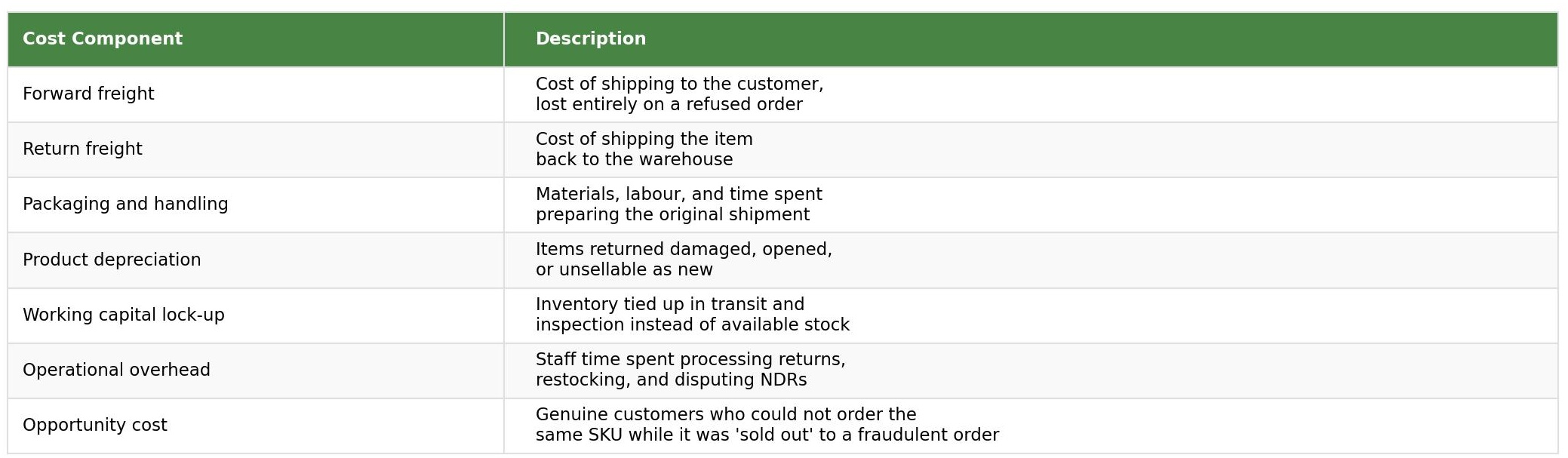
For a seller shipping 1,000 COD orders a month at a 20% RTO rate where even a third is attributable to deliberate fraud or refusal rather than genuine delivery issues, the monthly cost runs into tens of thousands of rupees - money that systematic RTO reduction can recover without touching pricing or product margins. This concentration of losses among COD-heavy sellers is consistent with the broader return-rate patterns documented in Shopify's analysis of eCommerce returns, and reflects the scale challenges highlighted in IMARC's overview of the India eCommerce market.
How to Detect COD Fraud Before It Costs You
Order Confirmation Before Dispatch
The single highest-leverage fraud prevention step is confirming the order before it is ever packed and shipped. A genuine customer will confirm within minutes of a WhatsApp or call prompt. A fraudulent or prank order is far more likely to go unanswered or get an evasive response.
iCarry®'s WhatsApp COD Confirmation feature automatically sends a WhatsApp message to the customer with full order details before the shipment is dispatched. The seller proceeds with packing and dispatch only after the customer confirms through WhatsApp. This single step eliminates a significant share of fake and prank orders before any cost is incurred - no freight spent, no inventory tied up, no return to process.
Address Quality Scoring
Fraudulent and careless orders disproportionately have low-quality addresses - missing landmarks, incomplete pincodes, or inconsistent location data. iCarry®'s Address Quality Scoring evaluates every shipment address from 0 to 100 before dispatch, flagging addresses in the Poor or Very Poor bands. While not every low-scoring address indicates fraud, the correlation between address quality and delivery failure - fraudulent or otherwise - is strong enough that this single signal helps sellers triage which orders deserve manual review before shipping.
Phone Number and Pattern Verification
Sellers shipping at volume should track repeat phone numbers and addresses across orders - particularly ones associated with high refusal rates. A customer who has refused three of their last five orders is a far higher fraud risk on their sixth than a first-time buyer. Most order management and courier dashboards allow filtering NDR and RTO history by customer phone number; reviewing this regularly catches repeat offenders before they cause significant damage.
Watch for Velocity Spikes
A sudden spike in order volume immediately after a social post, influencer mention, or paid campaign launch deserves extra scrutiny - particularly if it correlates with a higher-than-normal share of low-quality addresses or first-time customers from a narrow geographic cluster. This is one of the more reliable early signals of either order bombing or coordinated prank ordering.
Monitor RTO Rate by SKU and Channel
Track RTO rate broken down by product and by acquisition channel. A specific SKU or marketing channel with a disproportionately high RTO rate relative to your average is worth investigating - sometimes it reflects a genuine product issue (size confusion, unclear description), but sometimes it points to a fraud pattern concentrated on that listing.
How to Prevent COD Fraud: A Practical Framework
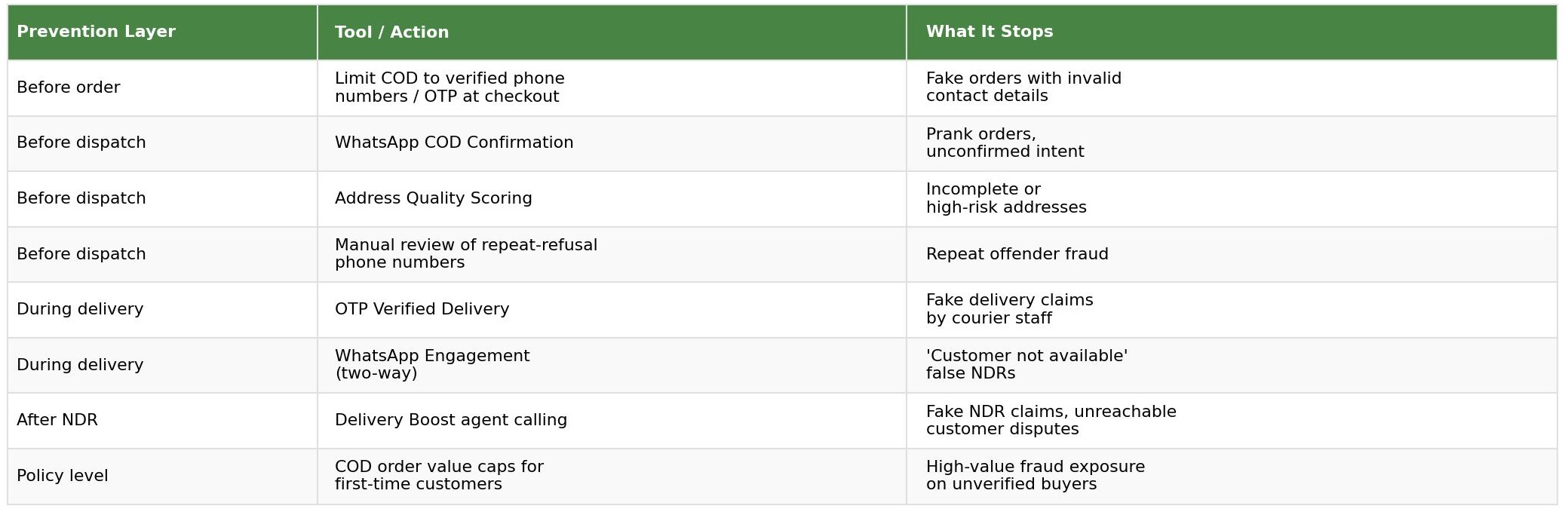
Each layer in this framework addresses fraud at a different stage of the order lifecycle - which is why no single tool eliminates COD fraud on its own. The combination of confirming intent before dispatch, scoring address quality, and intervening actively when delivery fails is what reduces fraud-related RTO meaningfully over time. Using NDR data effectively goes deeper into building this kind of layered defence from your existing shipment data. This layered approach also aligns with the broader shift toward AI-assisted fraud detection discussed in Economic Times CIO's coverage of AI in India's fintech ecosystem.
OTP Verified Delivery: Closing the Courier-Side Fraud Gap
Most sellers focus fraud prevention entirely on the customer side and overlook that some fraud and disputed deliveries originate from the courier execution side - a delivery executive marking a parcel delivered without it actually reaching the customer, or a customer falsely claiming non-receipt after genuinely accepting the parcel.
iCarry®'s OTP Verified Delivery closes this gap from both directions. The delivery executive cannot mark a shipment as delivered without the consignee providing a one-time password sent to their registered mobile number. This creates an unambiguous, time-stamped record that the parcel reached the right person - eliminating disputes where a customer claims non-receipt of a genuinely delivered order, and eliminating fake delivery markings by courier staff in the opposite direction.
This feature is currently available for Delhivery B2C shipments at a nominal cost per shipment, irrespective of how many OTP messages are sent.
WhatsApp Engagement: Reducing Fraud-Adjacent NDRs
A significant share of what looks like COD fraud is actually a communication failure - the courier could not reach the customer to confirm a delivery slot, and the resulting NDR gets attributed to the customer rather than a coordination gap.
iCarry®'s WhatsApp Engagement gives customers a direct, two-way channel to reschedule, update their address, or confirm availability at delivery stage - removing the ambiguity that lets genuine delivery failures get miscategorised as fraud, and giving sellers a clear, recorded conversation trail when a dispute does need to be escalated.
Delivery Boost: Active Intervention When Fraud Is Suspected
When an NDR is flagged and a seller suspects the customer is not genuinely unavailable, manual follow-up consumes time most sellers do not have at scale. iCarry®'s Delivery Boost feature deploys trained agents who call the customer directly on the seller's behalf, across multiple attempts and multiple days, covering all major Indian languages. Call recordings are retained as evidence - which becomes critical when disputing a courier's NDR claim or building a case against a repeat-offender customer.
This intervention layer is what separates passive fraud monitoring from active fraud reduction.
What to Do When COD Fraud Has Already Cost You
Step 1: Document Everything
Retain the order confirmation message, delivery attempt logs, courier remarks, call recordings (if Delivery Boost was active), and any customer communication. Documentation is the difference between a recoverable dispute and an unrecoverable loss.
Step 2: Raise a Dispute With the Courier
If the courier executive marked a fake delivery attempt or there is reasonable evidence of courier-side mishandling, raise a Helpdesk Ticket with your courier or partner or an aggregator immediately - most platforms have a window of 3 to 5 business days to investigate NDR and POD disputes effectively.
Step 3: Flag the Customer Internally
Maintain an internal blocklist or flag for phone numbers and addresses with confirmed fraud or repeat refusal history. Apply COD restrictions (prepaid-only, or a confirmation call requirement) for flagged customers on future orders rather than blocking them outright, which avoids false positives from shared family phone numbers or address changes.
Step 4: Consider Prepaid-Only for High-Risk Categories or Order Values
For SKUs or order values with disproportionately high fraud history, consider removing COD as a payment option entirely, or offering a partial prepaid deposit with COD for the balance. This is a blunt instrument and should be used selectively rather than store-wide, since it does reduce conversion for genuine COD-preferring customers.
Step 5: Report Significant or Repeated Fraud
For serious cases - identity misuse, organised order bombing, or large repeated losses from a single source - filing a complaint with local cyber crime authorities creates a formal record, even if direct recovery is unlikely. This matters more for pattern documentation and potential future legal action than for immediate loss recovery.
Building a Long-Term COD Fraud Reduction Strategy
COD fraud is not a problem solved once - it is a pattern that has to be monitored and adjusted continuously as fraud tactics evolve and your order volume grows. The sellers who manage it best treat fraud reduction as an ongoing operational metric, not a one-time fix.
- Review RTO and fraud-flagged rate monthly, broken down by SKU, channel, and pincode cluster
- Keep WhatsApp COD Confirmation and Address Quality Scoring active on every order, not selectively
- Maintain a documented process for flagging and restricting repeat offenders
- Reassess prepaid-only thresholds quarterly as fraud patterns shift
- Train customer support to recognise fraud-adjacent language in delivery disputes (claims of non-receipt with no supporting evidence, repeated rescheduling requests, inconsistent address details)
Combining these operational habits with iCarry®'s platform-level tools like Address Quality Scoring, WhatsApp Engagement, Delivery Boost and OTP Verified Delivery - creates layered protection that reduces fraud exposure without adding friction for the overwhelming majority of genuine COD customers who make up the backbone of Indian eCommerce.
Final Thoughts
COD fraud will not disappear from Indian eCommerce - the same accessibility that makes COD essential for reaching first-time online shoppers also makes it structurally exploitable. The goal is not eliminating fraud entirely, which is unrealistic, but reducing it to a manageable, predictable cost rather than letting it silently erode margins month after month.
Enable WhatsApp Engagement and Delivery Boost together from your iCarry® dashboard for the combined effect on fraud-adjacent RTO.
Frequently Asked Questions (FAQs)
What is COD fraud in eCommerce?
COD fraud refers to the deliberate misuse of Cash on Delivery orders to cause financial loss to a seller - including fake or prank orders placed with no intent to pay, repeat order refusal, address manipulation to trigger NDRs, and in some cases identity misuse to place orders under someone else's name and contact details.
How can I detect COD fraud before shipping an order?
The most effective detection method is confirming order intent before dispatch through a WhatsApp or call-based confirmation - genuine customers respond quickly, while fraudulent or prank orders typically go unanswered. Checking address quality, reviewing repeat-refusal history by phone number, and watching for velocity spikes after marketing campaigns are additional early signals.
Does WhatsApp COD Confirmation actually reduce fraud?
Yes. By requiring customer confirmation through WhatsApp before a shipment is dispatched, fake and prank orders are filtered out before any freight cost, packaging, or inventory is committed. Sellers using this feature typically see a meaningful reduction in COD refusal rates since only confirmed, intentional orders proceed to dispatch.
What is OTP Verified Delivery and how does it relate to fraud?
OTP Verified Delivery requires the consignee to provide a one-time password sent to their registered mobile number before the delivery executive can mark the shipment as delivered. This prevents two types of fraud: courier staff falsely marking undelivered parcels as delivered, and customers falsely claiming non-receipt of a parcel they did actually accept.
Can I get my money back if a COD order turns out to be fraudulent?
Direct financial recovery from a fraudulent COD customer is rare in practice, since there is usually no payment to reverse - the loss is the freight and product cost already incurred. The realistic goal is documentation (call recordings, order confirmation logs, courier remarks) to dispute courier-side errors where applicable, and to flag the customer internally to prevent repeat losses going forward.
Should I stop offering COD to reduce fraud?
For most Indian eCommerce categories, removing COD entirely sacrifices a significant share of genuine first-time buyers who do not yet trust prepaid online shopping. A more effective approach is layered fraud prevention - WhatsApp confirmation, address scoring, and selective prepaid-only restrictions for specific high-risk SKUs or flagged repeat-refusal customers - rather than eliminating COD as a payment option store-wide.
How does Delivery Boost help with COD fraud specifically?
Delivery Boost deploys trained agents to call customers directly when an NDR is raised, verifying whether the customer is genuinely unavailable or the NDR is a fraud-adjacent false claim from either side. Call recordings are retained as evidence, which strengthens any dispute raised with the courier and helps build a documented history for repeat-offender customers. Enable WhatsApp Engagement and Delivery Boost together from your iCarry® dashboard for the combined effect on fraud-adjacent RTO.
COD fraud is a structural cost of Indian eCommerce rather than a one-time problem - fake orders, order refusal, address manipulation, repeat offenders, and courier-side fake delivery attempts all erode margins for COD-heavy sellers, but a layered defence of WhatsApp COD Confirmation, Address Quality Scoring, OTP Verified Delivery, and Delivery Boost intervention reduces fraud-related RTO significantly without sacrificing the genuine first-time buyers who rely on COD, turning an unpredictable loss into a manageable, monitored operational cost.