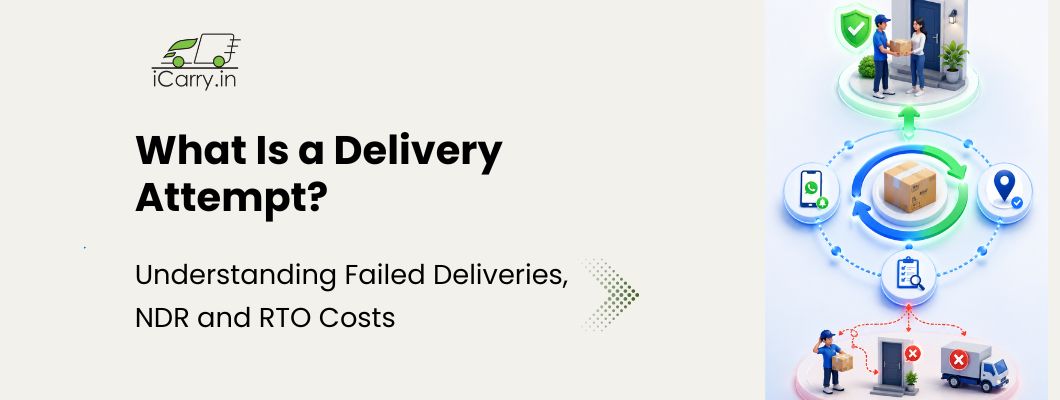
Your shipment tracking says 'Delivery Attempted - Customer Unavailable'. You check the time stamp - 11:23 AM on a Tuesday. Your customer works from home. They say the courier never came.
Who is right?
This is one of the most common and most costly disputes in Indian eCommerce. A delivery attempt - real or fake - is the event that determines whether your order becomes a successful delivery or an expensive RTO. Understanding exactly how attempts work, what triggers an NDR, and what happens after three failed attempts is essential knowledge for any eCommerce seller in India.
With India's eCommerce market growing rapidly, delivery reliability has become one of the most critical factors separating profitable sellers from ones who absorb margin losses on every return.
A delivery attempt in short means a courier executive has tried to deliver a shipment to the customer. If the attempt fails, the shipment usually moves into NDR (Non-Delivery Report) status before another attempt or an RTO.
Quick Checklist - Is Your Delivery Attempt Management Costing You?
- Do you know how many delivery attempts your courier makes before triggering an RTO?
- Are you following up on every NDR within 24 hours - not 48 or 72?
- Do you have WhatsApp notifications active so customers know when their order is out for delivery?
- Are you tracking your first-attempt delivery success rate by courier and pincode?
- Do you have Delivery Boost enabled for COD orders in high-risk zones?
- Are you validating customer addresses before dispatch to prevent address-related failed attempts?
What Is a Delivery Attempt?
A delivery attempt is a record created by the courier when a delivery executive visits the customer's address to hand over a shipment. If the delivery is successful, the shipment is marked Delivered. If it fails for any reason, the courier generates a Non-Delivery Report (NDR) and schedules a reattempt.
In Indian eCommerce, most courier partners make 2 to 3 delivery attempts before marking a shipment as Return to Origin (RTO). Once RTO is triggered, the shipment travels back to the seller's warehouse at the seller's expense.
The problem is that not every recorded 'delivery attempt' in India involves an actual visit to the customer's door. Fake delivery attempts - where courier executives mark a shipment as attempted without making a genuine visit - are one of the most significant sources of avoidable RTO in the Indian logistics ecosystem.
The Delivery Attempt Lifecycle
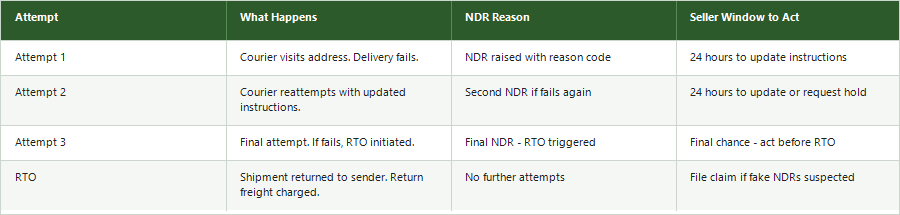
Critical window: Most couriers hold a shipment for 5 to 7 days total from first attempt to RTO. Acting on NDRs within 24 hours of each failed attempt is the only way to protect all three reattempt opportunities. Miss the window and the next event in the sequence happens automatically.
Why Delivery Attempts Fail in India
1. Customer Unavailable
The most genuine reason for a failed attempt. The customer was not home, did not hear the doorbell, or was unavailable at the time of delivery. This is addressable - a WhatsApp notification before delivery significantly reduces this category.
2. Incorrect or Incomplete Address
Missing wing number, wrong flat number, incorrect landmark, or a pincode that does not match the actual address. The delivery executive cannot locate the address and files an NDR. This is preventable with address validation before dispatch.
3. Customer Refused Delivery
Common on COD orders where the customer placed an impulse order and changed their mind, or where the product took too long and they found an alternative. Doorstep refusal is a direct conversion to RTO with no reattempt.
4. Fake NDR - No Genuine Attempt Made
This is the most costly category. The courier executive marks the shipment as 'Attempted - Customer Unavailable' without actually visiting the address. Common causes: executive has too many deliveries, the address is hard to find, or COD fraud where the executive pockets a successful delivery and marks it as failed. This is what iCarry®'s Delivery Boost is specifically designed to prevent. How fake delivery attempts work and how to detect them explains the patterns in full detail.
5. Access Restrictions
Gated communities, corporate campuses, and high-security apartments sometimes prevent courier access during specific hours. The executive cannot reach the door and files an NDR. Proactive communication with the customer before delivery resolves most of these.
The Real Cost of a Failed Delivery Attempt
Each failed attempt is not just an inconvenience - it has a direct financial cost:
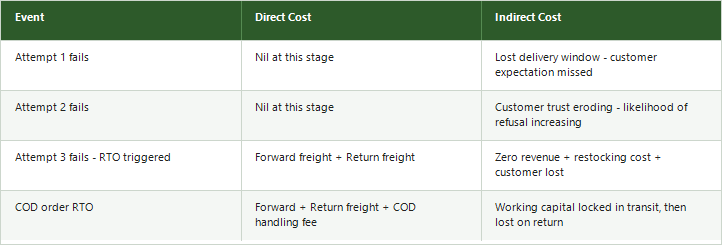
At a 25% RTO rate on 100 COD orders per month with ₹80 average freight, 25 RTOs cost ₹ 4,000 in return freight alone - every month. Reducing that to 15% RTO saves ₹1,600 per month in pure freight recovery.
Here is another example showing the cost of failed delivery:
A seller shipping 1,000 COD orders/month with a 25% RTO rate is not losing only the product sale. They pay forward shipping, return shipping, packaging cost, and blocked inventory.
These costs add up fast. According to Unicommerce's 2024 eCommerce trends report, covered by Business Standard, COD orders in India see return rates as high as 24% - nearly five times higher than prepaid orders. Even at the lower end of that range, the freight math is painful.
NDR vs RTO - Key Differences
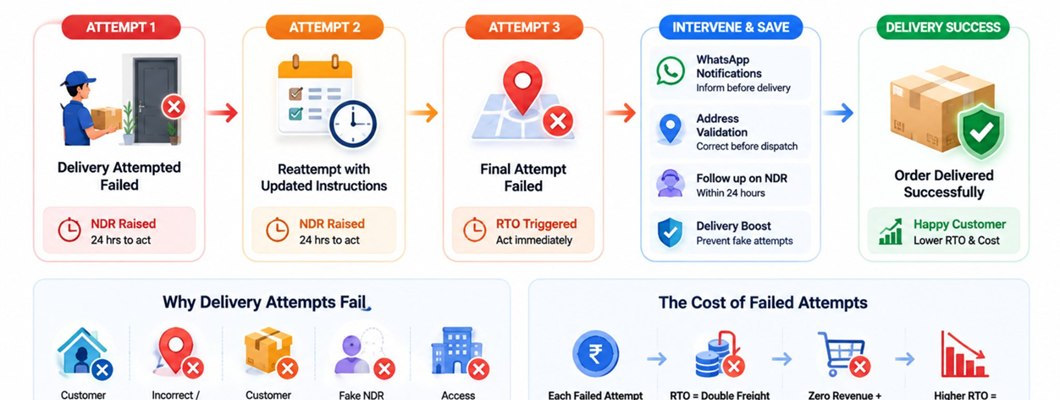
NDR (Non-Delivery Report) is generated after each failed attempt. It is an intermediate status - the shipment is still with the courier and reattempts are possible.
RTO (Return to Origin) is triggered after all attempts are exhausted. The shipment is now on its way back to the seller. No further delivery is possible once RTO is initiated.
The gap between NDR and RTO is your intervention window. Every hour you delay acting on an NDR reduces the probability of successful reattempt. How to use NDR data to improve delivery success rates explains the full NDR management workflow.
How to Reduce Failed Delivery Attempts
Failed delivery attempts are not always caused by the customer being unavailable. In many cases, they happen because of preventable issues - incomplete addresses, poor communication, courier selection mismatch, or delayed action after an NDR is generated.
Reducing failed attempts requires improving the delivery process before the courier reaches the customer's doorstep.
1. Improve Address Accuracy Before Dispatch
Incomplete addresses are one of the biggest reasons for failed first attempts, especially in Tier 2 and Tier 3 cities. Collect additional details during checkout wherever possible:
- Landmark or nearby location
- District and nearest town
- Alternate phone number
- Clear delivery instructions
A small improvement in address quality can significantly improve first-attempt delivery success.
2. Keep Customers Informed
Customers are more likely to miss deliveries when they are unaware of the expected delivery date or courier attempt. Automated notifications through SMS or WhatsApp can remind customers about upcoming deliveries, allow them to confirm availability, and help them update delivery details before a failed attempt happens.
3. Act Quickly on NDRs
When a delivery fails, the shipment usually moves into NDR (Non-Delivery Report) status. The next few hours are important. Review the reason for failure, contact the customer if required, and request a reattempt quickly. Delayed action often converts a recoverable delivery into an RTO.
4. Choose Couriers Based on Actual Performance
The cheapest courier option is not always the most cost-effective. Courier performance can vary significantly by pincode, product type, shipment weight, and delivery location. Using multiple courier partners allows sellers to compare options and route shipments based on delivery performance rather than relying on a single network.
5. Use Delivery Verification for High-Risk Orders
For high-value or COD shipments, additional verification steps can reduce disputes and failed handovers. Options like OTP-based delivery confirmation create stronger proof that the shipment reached the intended customer.
6. Confirm COD Buyer Intent Before Dispatch
COD doorstep refusals are the hardest failed attempts to prevent after dispatch - because the customer has already decided not to accept. An order confirmation process that verifies buyer intent before dispatch eliminates refusal-based RTOs entirely for flagged orders.
Platforms like iCarry® combine courier selection, NDR visibility, customer communication tools, and delivery verification features in one workflow - helping sellers manage failed deliveries before they turn into expensive RTOs.
How iCarry® Helps Reduce Failed Delivery Attempts
1. Address Quality Scoring
iCarry®'s Address Quality Scoring flags incomplete or high-risk delivery addresses before the shipment leaves the warehouse. Catching a bad address at dispatch prevents the failed first attempt and the NDR cycle entirely.
2. WhatsApp Engagement
iCarry®'s WhatsApp Engagement sends customers a WhatsApp message when their order is out for delivery - giving them time to be available or update instructions to the courier via chat. Two-way WhatsApp means customers can reply with gate codes, preferred delivery slots, or alternative contact details before the courier arrives.
3. NDR Dashboard
iCarry® provides a detailed NDR dashboard for all clients. When used properly, this NDR data helps sellers identify patterns and fix root causes. Every failed attempt appears in the My Shipments section with the courier's stated reason. Sellers can update instructions and request reattempt directly from the dashboard. This is the single most impactful operational change most sellers can make. Set a daily NDR review routine - check iCarry®'s NDR section every morning, update delivery instructions for every pending NDR, and request reattempt immediately. Do not wait until the customer complains.
4. Delivery Boost
iCarry®'s Delivery Boost deploys trained agents who call customers before delivery, audit courier NDR claims with GPS and call data, and open tickets for fake non-delivery reports. For COD orders in high-NDR zones, this feature directly converts fake-NDR events into reattempts rather than RTOs.
5. OTP Verified Delivery
OTP Verification feature by iCarry® creates a stronger proof of delivery. Delivery of an order is confirmed only when customer shares the OTP proving that they were present and received the package.
For sellers who want a systematic approach to reducing RTO by fixing the root causes of failed delivery attempts, these five iCarry® features work together to address every category of failed attempt.
Final Thoughts
Every failed delivery attempt is a cost. Every fake NDR is an avoidable RTO. Every RTO is double freight with zero revenue. The sellers who treat delivery attempt management as a daily operational priority - not a reactive afterthought - consistently outperform on margins and customer satisfaction.
Act on every NDR within 24 hours. Validate addresses before dispatch. Notify customers before delivery. Use Delivery Boost for high-risk COD orders. These four habits reduce failed attempts more than any rate negotiation.
iCarry® gives sellers all the tools to implement this - from NDR dashboard to Delivery Boost, WhatsApp Engagement, and Address Quality Scoring. Start free at iCarry.in and start your successful shipping journey.
Frequently Asked Questions (FAQs)
What is a delivery attempt in eCommerce?
A delivery attempt is a record created by the courier when a delivery executive visits the customer's address to hand over a shipment. If delivery fails, a Non-Delivery Report (NDR) is generated. Most Indian couriers make 2 to 3 attempts before initiating a Return to Origin.
How many delivery attempts do Indian couriers make?
Most Indian courier partners make 2 to 3 delivery attempts before triggering RTO. The exact number varies by courier and service level. Sellers should verify the attempt policy with each courier partner they use.
What is the difference between an NDR and an RTO?
An NDR (Non-Delivery Report) is generated after a failed attempt - the shipment is still with the courier and reattempt is possible. An RTO (Return to Origin) is triggered after all attempts are exhausted - the shipment is returning to the seller with no further delivery possible.
What are fake delivery attempts and how common are they in India?
Fake delivery attempts occur when a courier executive marks a shipment as 'Attempted - Customer Unavailable' without making a genuine visit. They are most common in high-density North Indian localities and Tier 2 town franchise courier networks. iCarry®'s Delivery Boost audits NDR claims and opens tickets for suspected fake attempts.
How do I reduce failed delivery attempts on my eCommerce orders?
Send WhatsApp notifications when orders are out for delivery, validate addresses before dispatch using Address Quality Scoring, enable Delivery Boost for COD orders in high-NDR zones, confirm COD buyer intent before dispatching high-value orders, and act on every NDR within 24 hours through iCarry®'s NDR dashboard.
How does Delivery Boost reduce failed delivery attempts?
iCarry®'s Delivery Boost agents call your customers before delivery to confirm availability, audit courier NDR claims against GPS and call data, open tickets for fake non-delivery reports, and upload call recordings as evidence. This converts fake NDRs into reattempts rather than RTOs.
What should I do when I get an NDR on iCarry®?
Log in to iCarry®, go to My Shipments, filter by NDR status, review the courier's stated reason for each failed attempt, update delivery instructions (address correction, alternate contact, gate code), and request reattempt immediately. Complete this within 24 hours of the NDR notification for best results.
Does a failed delivery attempt mean my parcel is lost?
No. A failed delivery attempt usually means the courier could not complete handover. The shipment normally remains with the courier and moves into NDR status for reattempt unless all attempts are exhausted and RTO is initiated.
Every failed delivery attempt is a cost, and fake NDRs are entirely avoidable. With iCarry®'s Delivery Boost, WhatsApp Engagement, and Address Quality Scoring working together, sellers can significantly reduce RTOs and protect margins on every shipment.