It is October. Your Diwali sale goes live at 10 AM. By noon, you have more orders than you shipped in the entire previous month. Your courier partner is not answering. Your warehouse team is overwhelmed. And somewhere in transit, three hundred parcels are sitting at a sorting hub with no movement.
This is what festive season shipping looks like when you have not planned for it. And it happens to sellers at every scale - from small D2C brands to mid-sized eCommerce businesses - every single year.
For Indian eCommerce sellers, festive season shipping is the highest-pressure logistics period of the year - where courier delays, warehouse overload, and rising COD RTO can quickly eat into your margins.
McKinsey research on supply chain resilience shows how peak-season demand surges can put severe pressure on logistics networks - and why advanced supply chain planning is not optional.
Marketplaces such as Amazon (Great Indian Festival) and Flipkart (Big Billion Days) drive massive sales spikes, making logistics performance a critical success factor that directly impacts shipping experience and customer retention. Consumer behaviour studies show that delivery speed and reliability are key drivers of customer satisfaction during high-demand shopping periods.
Festive season shipping is both a major revenue opportunity and a serious logistics challenge. This guide explains festive season demand patterns, logistics challenges, capacity planning strategies, and best practices for ensuring smooth delivery operations during peak periods in India.
Festive Season Shipping Checklist - Do These Before the Sale Goes Live
Most shipping failures during Diwali and festive sales are predictable. Check these 7 things at least 2 weeks before your peak:
- Stock inventory closer to demand - avoid shipping everything from one city
- Connect with at least 2 to 3 courier partners so one slowdown does not stop your fulfilment
- Set realistic delivery timelines - do not promise 2-day delivery if your courier is already stretched
- Pre-validate customer addresses to reduce NDRs and RTO during the surge
- Enable WhatsApp delivery notifications to reduce missed deliveries on COD orders
- Brief your warehouse team on bulk picking and packing workflows
- Track these metrics daily during the sale: delivery success rate, RTO%, transit time. Start with these 7 logistics KPIs
What is Festive Season Shipping?
Festive season shipping refers to the logistics operations required to manage high order volumes and increased delivery demand during peak shopping periods like Diwali, Dussehra, and year-end sales.
In simple terms, when order volumes increase 2 to 5 times, logistics networks face higher pressure - making advanced planning, capacity scaling, and efficient execution essential for smooth operations. Understanding the core components of supply chain management that need to scale during this period helps businesses prepare systematically rather than reactively.
Why Festive Shipping Matters for Businesses
Festive logistics plays a critical role in determining overall business success during peak seasons.
Revenue Growth
Global eCommerce insights indicate that peak shopping seasons contribute a major share of annual online retail revenue. In India specifically, Diwali and Big Billion Days alone can account for 30 to 40% of an eCommerce seller's annual shipment volume.
Customer Experience
Delayed or failed deliveries can negatively impact customer satisfaction and harm brand reputation, especially during time-sensitive festive purchases. A customer who ordered a gift for Diwali and received it after the festival is not coming back.
Operational Efficiency
Well-planned logistics ensures seamless order fulfilment, reducing delays, errors, and operational chaos during the highest-volume period of the year.
Competitive Advantage
Brands that deliver faster and more reliably during peak seasons gain a strong edge over competitors and build long-term customer loyalty. In categories like fashion, electronics, and gifting where multiple sellers compete on similar products, shipping speed becomes the deciding factor.
Demand Surge During Festive Season
Festive periods are characterised by sharp spikes in order volumes, requiring businesses to prepare in advance.
Typical Demand Patterns
- Pre-festive phase (2 to 4 weeks before): Gradual increase in order volume as customers begin gifting and shopping early
- Sale days (Navratri, Dhanteras, Diwali, Big Billion Days): Peak surge, often 2 to 5 times higher than normal - this is when logistics breaks if unprepared
- Post-festive phase: Stabilisation of demand, but returns and RTO management become the priority
High-Demand Product Categories in India
- Electronics - smartphones, earbuds, laptops
- Fashion and apparel - ethnic wear, footwear
- Home decor - lighting, furniture, furnishings
- Gifts and accessories - dry fruits, sweets, jewellery
- Beauty and personal care
Core Components of Festive Logistics
To handle peak demand effectively, businesses must optimise the following key logistics components:
Inventory Planning
Accurate demand forecasting helps ensure stock is pre-positioned across locations to avoid stockouts. In India, this means splitting inventory between metro-area warehouses and regional hubs serving Tier-2 and Tier-3 demand clusters.
Warehouse Capacity
Warehouses must be equipped to handle increased order volumes through better space utilisation and workforce scaling. Batch picking during high-volume periods cuts the time per order picked and packed.
Courier Network Capacity
Logistics partners must expand their delivery capacity to manage higher shipment loads. This is why using a multi-courier allocation strategy during the festive season is essential - if one courier partner is overwhelmed, you can route orders to another without disruption.
Last-Mile Delivery
Last-mile delivery challenges in India are amplified during festive periods - congestion in metros, high COD volumes in smaller towns, and stretched delivery staff all converge at the same time.
How to Prepare Logistics for Diwali Sale Season in India
Step-by-Step Festive Shipping Workflow
A structured logistics workflow ensures smooth execution during peak seasons:
Step 1: Demand Forecasting
Analyse historical sales data and trends to predict order volumes. Look at last year's festive orders by product category, pincode, and payment type. COD vs prepaid ratios matter here - higher COD volume in festive periods means higher RTO risk. For most Indian sellers, Diwali logistics planning starts 4 to 6 weeks before the sale period, not after order volume spikes.
Step 2: Inventory Allocation
Distribute inventory strategically across multiple warehouses to reduce delivery time. Prioritise stocking fast-moving SKUs in locations that serve your highest-order-volume regions.
Step 3: Warehouse Preparation
Increase staffing, streamline picking and packing processes, and optimise operations. Set up batch picking workflows for high-volume SKUs to reduce per-order processing time.
Step 4: Courier Capacity Planning
Coordinate with courier partners to ensure sufficient delivery bandwidth. Do not wait until the day before the sale - confirm capacity with multiple courier partners at least 2 weeks ahead. With iCarry®, you can access multiple courier partners from one platform, so switching or splitting volume between couriers during peak is seamless. You can also upload multiple orders in bulk to save time and effort and compare live rates across all courier partners.
Step 5: Order Processing
Implement systems to handle high order volumes efficiently and accurately. Use bulk booking and automated label generation to reduce the time between order receipt and shipment handover.
Step 6: Delivery Execution
Focus on timely and reliable last-mile delivery to meet customer expectations. During the festive season, enable WhatsApp engagement on all COD shipments - a customer who gets a notification that their Diwali gift is out for delivery and can respond to that notification to ensure he is available to receive it is far less likely to miss the delivery or refuse it.
Real-World Examples of Festive Logistics
Marketplace Sales - Amazon & Flipkart
During festive sales, major marketplaces scale their logistics networks to handle millions of daily shipments. Amazon's Great Indian Festival and Flipkart's Big Billion Days both require months of preparation - from pre-positioning inventory in hundreds of fulfilment centres to onboarding thousands of temporary delivery executives.
D2C Brand Strategy
Direct-to-consumer brands prepare by increasing inventory levels and hiring temporary staff to prevent stockouts and delays. The most prepared D2C brands begin restocking for Diwali in August and run delivery readiness audits with courier partners in September.
Courier Network Expansion
Scalable logistics infrastructure and workforce flexibility are essential to handle demand spikes in large and diverse markets like India.
Festive vs Normal Shipping Operations
| Factor | Festive Season | Normal Period |
|---|---|---|
| Order Volume | 2 to 5 times higher | Moderate and predictable |
| Delivery Timelines | Slightly longer due to network pressure | Standard SLAs maintained |
| Logistics Costs | Higher due to scaling and demand | Stable |
| RTO Risk | Higher - especially COD orders | Manageable |
| Operational Complexity | Much higher | Routine |
Key Challenges in Festive Season Shipping
Managing logistics during peak festive periods comes with several operational challenges. Businesses must anticipate and address these issues to ensure smooth order fulfilment and maintain customer satisfaction.
Capacity Constraints
Capacity planning is one of the most critical factors in managing peak logistics operations efficiently. Without it, businesses struggle to process, pack, and ship orders at the volumes festive season demands. Courier pickup delays, warehouse processing bottlenecks, and rider shortages typically begin appearing once daily order volume crosses planned capacity thresholds.
Delivery Delays
Increased shipment loads often lead to longer transit times. Congested logistics networks and higher demand can result in delays, impacting delivery timelines and customer expectations. In India, Tier-2 and Tier-3 delivery hubs are particularly vulnerable to congestion during the festive period.
Inventory Stockouts
Inaccurate demand forecasting can cause inventory shortages, leading to missed sales opportunities and dissatisfied customers. Proper stock planning is essential to avoid running out of high-demand products - especially in the final 48 hours before Diwali.
Higher RTO (Return to Origin) Rates
Managing COD RTO during festive season requires both proactive order confirmation and active NDR follow-up. How to reduce RTO rates systematically and choosing the right courier for COD orders are both essential reads before peak season.
Last-Mile Delivery Bottlenecks
Limited delivery capacity in certain regions, especially in remote or high-density areas, can create bottlenecks. Efficient last-mile planning is critical to ensure timely deliveries. Fake NDRs also spike during peak periods - delivery executives under pressure sometimes mark false non-deliveries to manage workload.
Enabling iCarry®'s Delivery Boost feature during festive season puts trained agents on your side to audit couriers and fight fake NDRs. Learn more about how fake delivery attempts impact your business and what to do about them.
Benefits of Effective Festive Logistics Planning
Businesses that plan well can unlock multiple advantages:
- Increased Sales: Higher order fulfilment rates boost revenue
- Better Customer Experience: Timely deliveries improve satisfaction and drive repeat purchases
- Operational Efficiency: Streamlined processes reduce chaos and error rates during peak
- Stronger Brand Reputation: Reliable festive delivery builds the kind of trust that converts first-time buyers into loyal customers
Common Mistakes Businesses Should Avoid
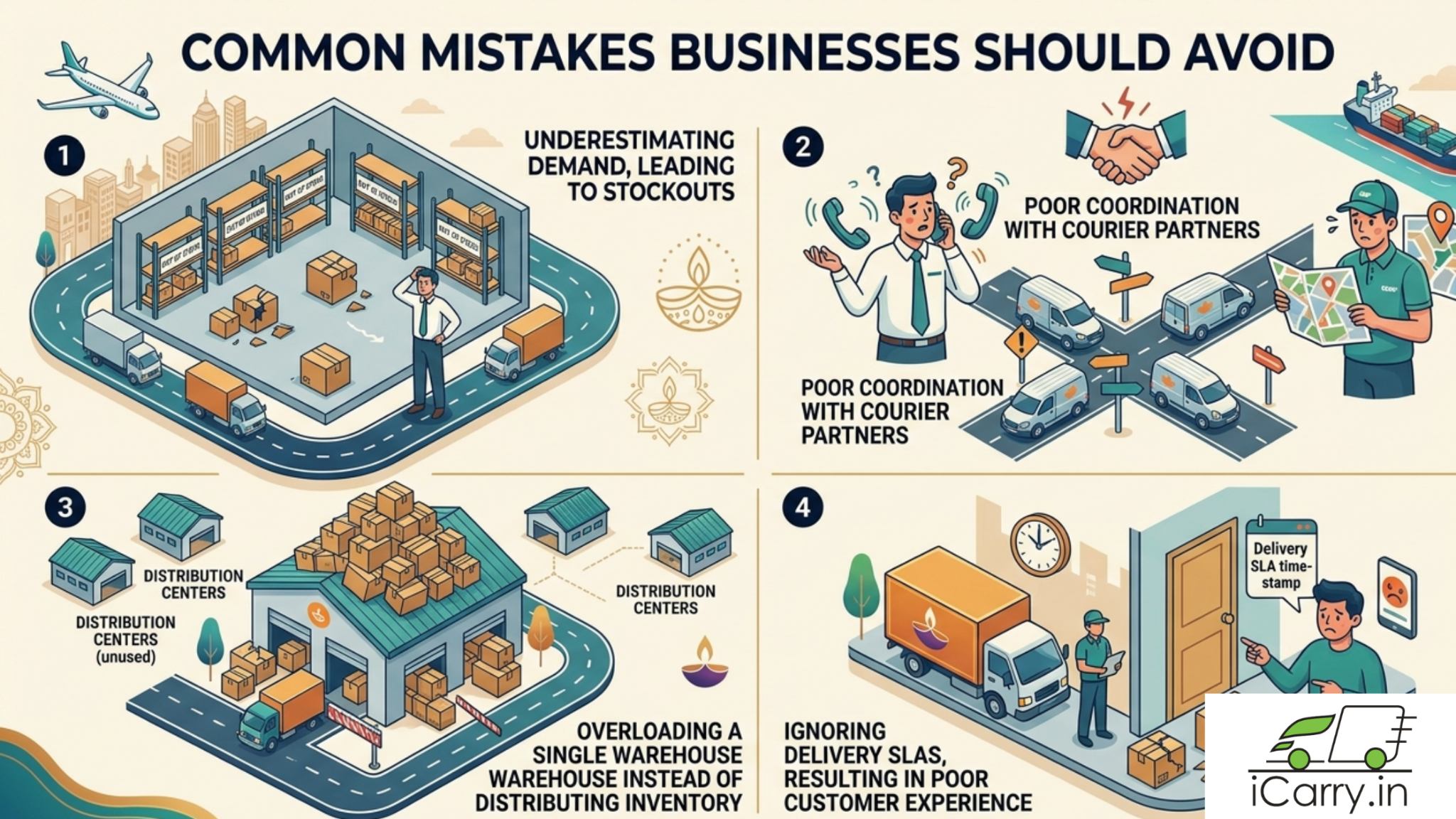
Many businesses struggle during festive seasons due to avoidable errors:
- Underestimating demand - use last year's data and add a buffer of at least 20 to 30% on top of forecasts
- Poor coordination with courier partners - confirm capacity weeks ahead, not days
- Overloading a single warehouse instead of distributing inventory closer to demand clusters
- Ignoring delivery SLAs and not tracking NDRs in real time - using NDR data effectively is especially critical during high-volume periods when failed deliveries accumulate fast
- Offering blanket free shipping during peak without a minimum order value threshold
Practical Strategies to Optimise Festive Shipping
To handle peak-season demand efficiently, businesses need a well-planned logistics strategy. Implementing the right approaches can help ensure faster deliveries, reduced delays, and a seamless customer experience during festive periods.
Forecast Demand Accurately
Use historical sales data, seasonal trends, and predictive analytics to estimate order volumes. Accurate forecasting helps in better inventory planning and prevents stockouts or overstocking. Build in a demand buffer of 25 to 30% above your forecast - it is easier to manage surplus than stockouts during Diwali.
Adopt a Multi-Warehouse Strategy
Distribute inventory across multiple warehouses or fulfilment centres. This reduces delivery distances, speeds up shipping, and minimises the risk of regional bottlenecks. Even splitting stock between two locations - one serving North India and one serving South - makes a significant difference in transit times.
Partner with Multiple Courier Services
Relying on a single logistics partner can be risky during peak demand. Multi-courier allocation ensures better coverage, higher capacity, and improved delivery reliability. With iCarry®, you get to access multiple courier partners from one dashboard and can route each shipment to the best available option for that pincode.
Scale Workforce Temporarily
Hire temporary staff for warehouse operations, packaging, and delivery support. A larger workforce helps manage increased workloads and maintains operational efficiency. Brief all temporary staff on your packaging standards and dispatch workflows before the surge begins.
Set Realistic Delivery Expectations
Clearly communicate accurate delivery timelines to customers. During festive peaks, add 1 to 2 days to your standard ETA rather than promising the usual window and missing it. Setting the right expectations reduces complaints and improves customer satisfaction even when delivery takes slightly longer.
Monitor Logistics KPIs
- Order processing time
- Delivery success rate
- Transit time by courier and zone
- RTO rate by courier partner
- NDR rate and resolution time
Tracking these in real time lets you spot a deteriorating courier and reroute volume before losses compound. This covers exactly what to measure and what benchmarks to compare against.
Video: How to Navigate the iCarry Dashboard and Track Orders Efficiently
Data-Driven Industry Insights for Festive Logistics
- Order volumes can increase by 2 to 5 times during peak festive periods
- Delivery delays typically increase by 1 to 2 days during the highest-volume days
- Logistics costs may rise by 10 to 20% due to scaling requirements
- COD RTO rates often increase by 5 to 10 percentage points during festive sales compared to off-peak months
- Businesses that plan 4 to 6 weeks ahead see far fewer fulfilment disruptions
Future Trends in Festive Logistics
AI-Based Demand Forecasting
Improves accuracy in inventory planning and reduces stockouts. AI models trained on past festive data can predict demand spikes at the SKU and pincode level, reducing both over-stocking and missed sales.
Warehouse Automation
Speeds up order processing through robotics and smart systems. Automated picking systems are reducing per-order fulfilment time in large warehouses and will become more accessible to mid-market brands over the next few years.
Hyperlocal Delivery Expansion
Enables faster deliveries, especially in urban areas. Same-day and next-day delivery windows that are currently metro-exclusive will expand to Tier-2 cities as logistics infrastructure matures.
Flexible Delivery Networks
Dynamic courier allocation helps optimise efficiency during peak demand. Platforms that can automatically shift shipment volume between courier partners based on real-time performance data will deliver a structural advantage during festive surges.
Conclusion
Festive season shipping in India is a high-stakes period for eCommerce businesses. While it presents significant revenue opportunities, it also requires careful planning, strong logistics coordination, and efficient execution.
Businesses that invest in demand forecasting, inventory optimisation, and multi-courier strategies can successfully manage peak demand and deliver a seamless customer experience.
In a competitive market, the ability to handle festive logistics efficiently can become a key differentiator for long-term success. Sellers who nail festival shipping such as that around Diwali season, do not just survive the peak - they build the kind of customer trust that sustains sales through the rest of the year.
Optimise Festive Logistics with Smarter Shipping
Planning festive season shipping this Diwali? Use iCarry® to compare courier rates, split volume across multiple partners, manage NDRs, track every shipment in real time, and handle bulk festive orders - all from one platform, with no minimum volume requirement.
Frequently Asked Questions (FAQs)
What is festive season shipping?
Festive season shipping refers to managing logistics operations during peak demand periods like Diwali, Navratri, Dhanteras, and major eCommerce sale events such as Amazon's Great Indian Festival and Flipkart's Big Billion Days.
Why does shipping get delayed during festive seasons?
High order volumes, stretched courier capacity, and congested last-mile networks all contribute to delays. In India, Tier-2 and Tier-3 delivery hubs face the most pressure during festive peaks.
How can businesses prepare for festive season logistics?
Forecast demand using historical data, pre-position inventory across multiple locations, partner with multiple courier companies, set realistic delivery ETAs, and enable NDR tracking and WhatsApp engagement before the sale begins.
How much does order volume increase during festive sales?
Order volumes can increase by 2 to 5 times compared to normal periods. Categories like electronics, fashion, and gifting see the steepest spikes.
Do shipping costs increase during festive seasons?
Yes, logistics costs typically rise by 10 to 20% due to higher demand and the additional capacity needed across warehouses, courier networks, and last-mile operations.
How can businesses reduce delivery delays during peak seasons?
Forecast demand at least 4 to 6 weeks ahead, distribute inventory across multiple warehouse locations, confirm courier capacity before the sale goes live, monitor NDR rates daily during peak, and set realistic delivery timelines so customers know what to expect. Using NDR data effectively and reducing RTO cover the full operational detail.
Festive season shipping failures are almost always predictable - and preventable. Start planning 4 to 6 weeks before Diwali: forecast demand with a 25-30% buffer, distribute inventory across locations, lock in capacity with multiple courier partners, and enable WhatsApp engagement on all COD shipments before the sale goes live.