At 100 orders a day, your founder or a small ops team handles everything. You know every courier executive by name. You book shipments one by one. You follow up on RTOs personally. It works.
At 500 orders a day, this starts breaking. Delays compound. RTOs spike. The team is doing data entry instead of solving problems. Your seller score on marketplaces starts slipping.
At 2,000 orders a day, if you have not rebuilt your logistics infrastructure, you have a crisis every week.
Scaling a business's shipping operations whether it is a D2C brand, online seller, or manufacturer - is not the same as scaling marketing or production. Every order volume milestone requires specific operational changes - to technology, to courier strategy, to team structure, and to cost management. Missing any of them means the business grows in revenue but shrinks in margin.
India's D2C market is projected to continue strong growth through 2026 and beyond. This growth is increasingly coming from beyond metro cities - with Tier II and Tier III markets becoming a major driver of new customer demand. A recent analysis highlighted that these cities contributed a significant share of new D2C orders in FY26, showing why brands need logistics systems built for a geographically distributed customer base. The brands that capture sustainable growth are those who build logistics infrastructure ahead of the growth curve - not scrambling after it.
This guide covers exactly what needs to change at each growth stage - and what iCarry® gives you at each level.
What Is D2C Shipping Operations Scaling?
D2C shipping operations scaling is the process of upgrading your logistics infrastructure - courier partners, technology, workflows, and team structure - as your order volume grows. What works at 100 orders a day breaks at 1,000. Each growth stage requires a different set of systems, integrations, and courier strategies to protect delivery quality and unit economics.
Quick Checklist - Where Are You in Your Logistics Maturity?
- Are you still booking shipments manually, one by one?
- Do you have automated courier rate comparison running before every booking?
- Is your RTO rate tracked weekly by courier, pincode, and product category?
- Do you have NDR follow-up happening within 24 hours automatically or with a dedicated person?
- Is your COD remittance cycle creating working capital pressure?
- Do you have SLA agreements with courier partners - and are you tracking compliance?
- Has your logistics cost per delivered order been calculated in the last 30 days?
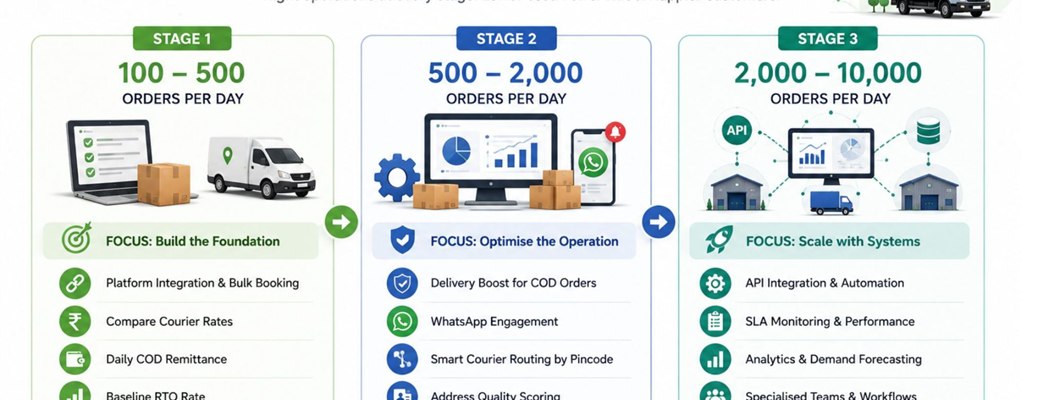
Stage 1: 100 to 500 Orders Per Day - Build the Foundation
The Core Problem at This Stage
At this volume, the problem is efficiency. Manual booking is slow. Errors in address entry cause failed deliveries. No rate comparison means you are paying more than you should. And there is no visibility into which couriers are performing and which are not.
What to Fix
1. Move to an aggregator with platform integration.
Stop booking directly with couriers. Connect your Shopify, WooCommerce, Wix store, Zoho store or other custom stores to iCarry® so that your orders sync automatically. Book in bulk rather than one by one. The time saved goes from data entry into operations.
Watch How to Upload Bulk Shipment Files on iCarry® to see how bulk order processing works at this stage.
2. Start comparing courier rates before every booking.
Different couriers have different rates by zone and weight. Comparing before booking - not defaulting to one courier - saves ₹10 to ₹25 per order at this volume. On 300 orders per day, that is ₹90,000 to ₹2,25,000 per month in recoverable cost.
3. Enable daily COD remittance.
At 300 to 500 COD orders per day averaging ₹700 order value, you have ₹21 to ₹35 lakh permanently locked in T+7 remittance float. iCarry®'s free daily T+7 remittance ensures cash moves daily without plan upgrades.
Early remittance from T+0 to T+4 is available for brands where this float is creating inventory purchasing pressure, with iCarry® advancing payment from its own working capital. Here, T refers to the day of delivery. For example, T+0 means the payment is processed on the next day after delivery, T+1 means on the following business day, and T+7 means after seven business days. The amount is credited to the seller's wallet or account as selected.
4. Baseline your RTO rate.
If you do not know your current RTO rate by courier and pincode, you cannot improve it. Set a weekly RTO review as a non-negotiable operational meeting. Unit economics of shipping shows how to calculate cost per delivered order - the number that tells you what RTO is actually costing you in rupees per month.
Recommended Logistics Setup at This Stage
At this stage, most growing brands benefit from a shipping platform that provides multi-courier access, automated booking, COD visibility and RTO management. Platforms like iCarry® provide these capabilities without requiring enterprise-level setup.
- Free Bronze plan - no monthly overhead at this volume
- Shopify/WooCommerce connector for automatic order sync
- Bulk booking to process 200+ orders in under 10 minutes
- Live rate comparison across multiple courier partners before every booking
- Free T+7 - daily COD remittance - for all plans
- NDR dashboard for daily RTO management
Why Logistics Automation Becomes Mandatory After 500 Orders/Day
At 100 orders per day, manual shipping processes can still work. But after crossing 500 orders per day, the same approach starts creating delays, errors, and unnecessary costs.
Teams spend more time on manual order entry, courier selection, tracking updates, COD reconciliation, and NDR follow-ups instead of improving operations.
At this stage, logistics automation becomes essential:
- Orders sync automatically from sales channels
- Shipments can be processed in bulk
- Courier selection can be optimised by pincode, cost, and performance
- Tracking, NDR follow-ups, and customer updates become structured workflows
- Logistics data helps identify RTO, courier, and cost problems early
The goal of automation is not just faster shipping - it is building a logistics system that can handle higher volumes without adding the same level of manual effort and reduces room for error.
Stage 2: 500 to 2,000 Orders Per Day - Optimise the Operation
The Core Problem at This Stage
At this volume, the operational leaks that were manageable at 300 orders per day become expensive. A 20% RTO rate on 1,500 daily COD orders at ₹80 round-trip freight is ₹24 lakh per month in pure freight loss. Fake NDRs that went unchallenged at 100 orders a day are now costing serious money.
What to Fix
1. Activate Delivery Boost for high-risk COD orders.
At this volume, you can identify which pincodes generate your worst RTO rates. For those pincodes, Delivery Boost pays for itself within weeks. iCarry® agents call your customers before delivery, audit NDR claims, and open tickets for fake non-deliveries - at a nominal cost per shipment.
2. Enable WhatsApp Engagement across all shipments.
Automated out-for-delivery notifications can reduce missed delivery attempts by 10 to 15% across most businesses. At 1,500 daily orders, even a 5% improvement in first-attempt success rate saves significant return freight cost monthly. With iCarry®'s two-way WhatsApp engagement, customers can reply, reschedule deliveries, or share updates directly, and every interaction between iCarry® and the customer is recorded and visible to the seller within the iCarry® panel.
3. Implement courier routing rules by pincode.
Not all couriers perform equally across all pincodes. At 1,500 orders, you have enough data to know which pincodes generate your worst RTO rates and with which couriers. Multi-courier allocation - routing each order to the best performing courier for that specific destination can reduce blended RTO rate by 8 to 15 percentage points when done systematically.
4. Address Quality Scoring before dispatch.
At 1,500 daily orders, even 2% bad addresses are 30 failed first attempts every day. iCarry®'s Address Quality Scoring flags these before the parcel leaves the warehouse - preventing the first NDR from ever being generated.
5. Build a dedicated logistics function.
At this stage, logistics needs at least one dedicated person whose sole job is NDR follow-up, weight discrepancy disputes, courier performance review, and daily COD reconciliation. One good logistics operations person at this volume typically saves 3x their cost in recovered freight and prevented RTOs.
Watch Overview of My Account > My Shipments to see how iCarry®'s dashboard surfaces all the data this person needs to work effectively - NDR status, weight discrepancies, shipment tracking, and COD remittance in one view.
Recommended Logistics Setup at This Stage
- Enable iCarry®'s Delivery Boost feature on COD orders in high-RTO pincodes
- WhatsApp Engagement - two-way delivery notifications in regional languages
- Address Quality Scoring - pre-dispatch address validation
- Multi-courier routing by pincode and product type
- Weight discrepancy dashboard with auto-dispute for products with pre-uploaded images
- Early COD remittance T+0 to T+4 for working capital management
Stage 3: 2,000 to 10,000 Orders Per Day - Build Enterprise Infrastructure
The Core Problem at This Stage
At this volume, every percentage point of inefficiency costs lakhs per month. Manual processes anywhere in the chain create bottlenecks. Single-courier dependency creates risk during peak periods when any courier's network gets stretched. And the complexity of managing shipping across multiple sales channels - Shopify, Amazon, Flipkart, WooCommerce, B2B - requires a unified logistics platform.
What to Fix
1. Migrate to full API integration.
At 5,000+ daily orders, connector-based integrations may not scale to your required speed. Move to iCarry®'s full REST API with 17 endpoints - shipment booking, label generation, status updates, and webhook callbacks all automated. Orders flow from your OMS to courier in under 30 seconds without any manual action.
2. Multi-courier strategy with performance-based routing.
At this volume, you have deep enough data to build courier routing rules that go beyond zone - routing by product category, COD vs prepaid, day of week, and pincode-level performance. Delhivery for high-volume surface, Blue Dart for high-value express, Xpressbees and ekart for Tier 2 COD, Shadowfax for same-day metro via Borzo. All from one iCarry® account.
3. Regional inventory placement.
At 5,000 to 10,000 daily orders, storing all inventory in one location makes most of your orders Zone C, D, or E - with correspondingly high freight rates and transit times. Splitting inventory between two or three city-level locations dramatically reduces average zone distance and brings transit time down for a large share of your order volume.
4. SLA compliance with courier partners.
At enterprise volume, you have negotiating leverage to define SLA terms with courier partners - pickup adherence, first-attempt delivery rate, NDR response window. Tracking logistics KPIs weekly gives you the data to enforce these SLAs and reroute volume away from underperforming couriers before the problem compounds.
5. COD remittance optimisation across destination accounts.
At 5,000+ COD orders daily, COD remittance management becomes a treasury function. iCarry®'s three destination account options - bank only, auto-split bank and wallet, wallet only - give your finance team the tools to manage COD float as a working capital instrument rather than a passive cycle.
Recommended Logistics at This Stage
- Full REST API - 17 endpoints for complete programmatic control
- Unicommerce integration with iCarry® for multi-channel order management
- B2B LTL shipping alongside B2C
- Enterprise account management and dedicated support
- Weight discrepancy management at scale - auto-dispute across thousands of monthly shipments
- International shipping via FedEx and Aramex as business expands cross-border
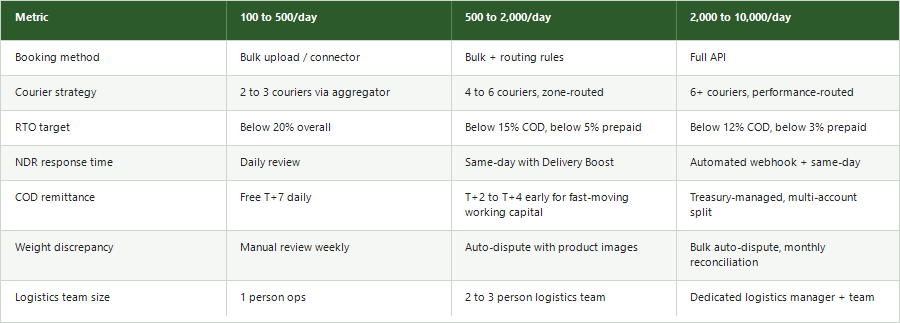
The Shipping Operations Scorecard by Growth Stage
7 Logistics Mistakes That Stop D2C Brands From Scaling
- Staying with one courier
- Manual AWB generation
- Ignoring RTO analytics
- No COD strategy
- No NDR ownership
- No API integration
- No shipping cost dashboard
Final Thoughts
The brands that scale from 100 to 10,000 orders per day without destroying margins share one characteristic: they invest in logistics infrastructure ahead of volume, not in response to it.
At every stage, the problems are predictable. The interventions are known. The cost of inaction - in RTO freight, in COD float, in fake NDRs going unchallenged, in manual processes that do not scale - compounds every day you delay.
iCarry® is built to scale with D2C brands at every stage - from free Bronze plan at 100 orders per day to full REST API and enterprise account management at 10,000. Same platform. Same features. Zero monthly fees. Start free and build the logistics foundation your growth deserves.
Frequently Asked Questions (FAQs)
When should a D2C brand switch from manual booking to an aggregator?
From day one. Even at 10 orders per day, using an aggregator gives you better rates, multiple courier options, and a dashboard for tracking - all things you would otherwise have to build piecemeal. There is no volume floor for using iCarry® - the free Bronze plan has no minimum, allowing businesses of any size to start shipping and scale operations without fixed commitments.
What is the biggest logistics mistake D2C brands make when scaling?
Waiting too long to fix manual processes. At 100 orders a day, manual booking is slow but survivable. At 500 orders a day, it is expensive. At 2,000 orders a day, it is a crisis. The right time to automate is 6 months before you need to - not when you are already underwater.
At what order volume should I hire a dedicated logistics person?
Around 500 orders per day is the inflection point. One person focused solely on NDR follow-up, weight discrepancy disputes, and courier performance review typically recovers 3x their cost in prevented RTOs and disputed charges at this volume.
How does iCarry® scale with my business from 100 to 10,000 orders?
iCarry® supports every growth stage - connector-based bulk booking at 100 to 500 orders, Delivery Boost and multi-courier routing at 500 to 2,000, and full REST API with enterprise account management at 2,000 to 10,000.
What is the right COD remittance setup as order volume scales?
At 100 to 500 orders/day, free T+7 daily remittance is sufficient. At 500 to 2,000 orders/day, early remittance at T+2 or T+3 reduces working capital pressure during fast-growth periods. At 2,000+ orders/day, manage remittance across destination accounts - bank, wallet split - as a treasury function. Working capital management for scaling D2C brands covers the financial modelling in detail.
How do I calculate my cost per delivered order at each growth stage?
Add all logistics costs for the month: forward freight + return freight on RTOs + COD handling fees + weight discrepancy charges + platform fees. Divide by orders actually delivered (total shipped minus RTOs). This is your true cost per delivered order - the number that tells you how logistics efficiency is tracking as you scale.
Can I start D2C shipping without a warehouse?
Yes. Most D2C brands and online sellers start shipping directly from home, workshop, or production unit - a courier aggregator picks up from any address. A dedicated warehouse typically becomes necessary at 500 to 1,000 orders per day, when multi-location stocking meaningfully reduces transit time and freight cost.
What is cost per delivered order and why does it matter?
Cost per delivered order (CPDO) is total logistics spend divided by successfully delivered orders - not total orders shipped. It is the most important logistics metric because it captures forward shipping cost AND the hidden cost of RTOs and failed deliveries. Cutting RTO rate from 20% to 15% on 1,000 daily orders can reduce CPDO by ₹40 to ₹60 per order.
Which product categories have the highest RTO rates in Indian D2C?
Fashion and apparel - especially size-sensitive COD orders - consistently see the highest RTO rates, often 25% to 40% in Tier 2 and 3 cities. Bulky low-value COD items also carry elevated rates. Electronics and wellness products shipped prepaid typically have the lowest. COD confirmation calls and WhatsApp buyer intent verification before dispatch are the most effective interventions across all categories.
The brands that scale from 100 to 10,000 orders without destroying margins invest in logistics infrastructure ahead of volume. At every stage, the problems are predictable and the interventions are known - iCarry® gives you the tools to execute them from day one.