What Is Fashion D2C Shipping?
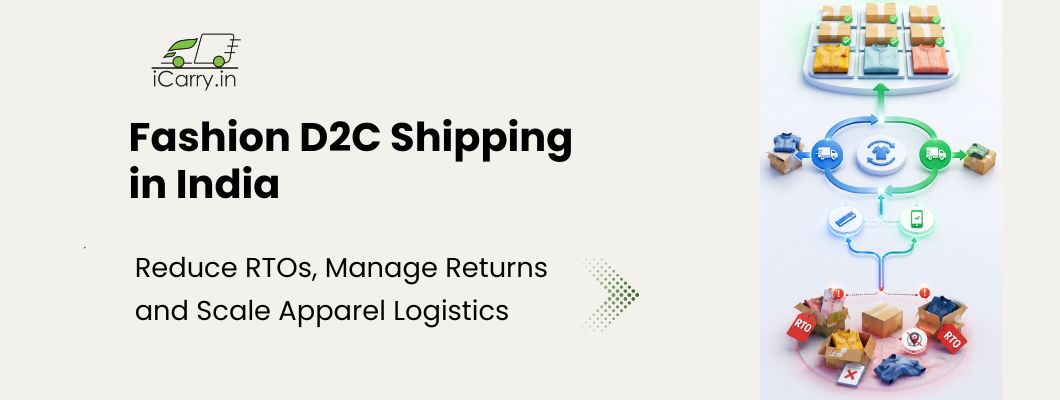
Fashion D2C shipping is the logistics process of fulfilling direct-to-consumer apparel orders from Indian brands to buyers across the country. It differs from general eCommerce shipping because of two structural challenges: high size-related return rates (customers ordering multiple sizes and returning the rest) and elevated COD RTO rates in Tier 2 and 3 cities where prepaid adoption is lower.
Introduction
You launched a kurta brand. Photography was beautiful. Your Instagram grew. Orders started coming in from Jaipur, Patna, Kochi, Surat. Then the returns started.
Size M ordered. Size M delivered. Customer says it runs small. Return requested. You process the reverse pickup. The replacement goes out. Three days later it comes back too - the customer found something else.
Fashion and apparel - whether sold by D2C brands, boutiques, or Instagram sellers - is among the highest-return, highest-RTO category in Indian eCommerce. Return rates of 25% to 40% are common in Tier 2 and 3 cities. RTO rates of 30%+ on COD orders are not unusual. Most returns are not due to defects, instead they are size, fit, and preference-driven. That changes how you manage them entirely.
India's fashion eCommerce market is growing rapidly - but margins are thin and logistics costs are the primary lever separating profitable fashion D2C brands from ones that run at a loss. Getting the logistics right is not optional in this category.
Quick Checklist - Fashion D2C Logistics Health Check
- Is your size chart image on every product page - not just a link to a generic page?
- Are you tracking returns by reason - size, fit, quality, or preference? Each needs a different fix.
- Do you have a structured exchange workflow - not just 'contact us'?
- Are you running COD order confirmation for high-value fashion orders before dispatch?
- Is your return inspection and restock happening within 48 hours of return receipt?
- Do you know your RTO rate by courier and pincode? Fashion RTO varies dramatically by geography.
- Are you using Delivery Boost on COD fashion orders in high-RTO zones?
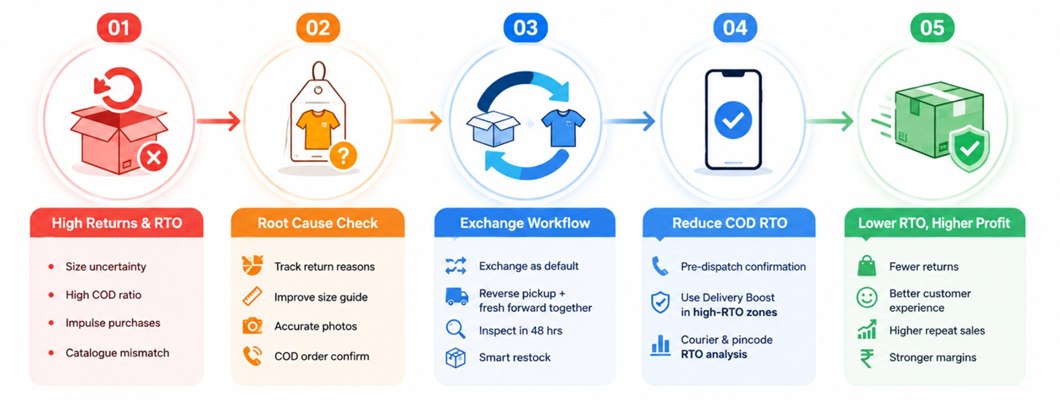
Why Fashion Has the Highest Return Rates in India
Size and Fit Uncertainty
India does not have a standardised sizing system. Size M from one brand is different from Size M from another. Customers buying online cannot try before purchasing - and Indian consumers have been trained by marketplace experiences to expect free returns as a consequence. The result is high size-related return rates that no courier intervention can fully fix.
The only sustainable fix for size returns is better sizing information at the listing level - detailed measurements, fit description, model size disclosure, and size recommendation tools. Every percentage point you reduce in size-related returns is a direct margin improvement.
High COD Ratio
Fashion has one of the highest COD ratios of any eCommerce category - often 65 to 80% for Tier 2 and Tier 3 market brands. COD fashion orders have significantly higher doorstep refusal rates, because the purchase commitment was lower at the time of ordering.
Impulse Purchasing Behaviour
Fashion is highly impulse-driven, particularly from social commerce (Instagram, WhatsApp). A customer who bought from a Reel on a Sunday night and received the order on Thursday may have already moved on. COD doorstep refusals from impulse orders with no genuine intent are a structural feature of fashion logistics.
Catalogue Discrepancy
Colour rendering differences between product photography and actual product colour, fabric texture that is hard to convey in images, and embellishment that looks different in person are all common fashion-specific return drivers. Accurate colour calibration and multi-angle photography reduce this category of returns.
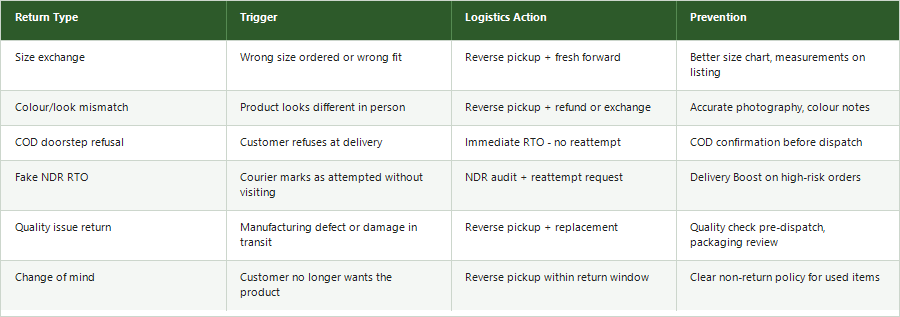
The Fashion Return Lifecycle - What Sellers Need to Manage
Building an Exchange Logistics Workflow for Fashion D2C
Most fashion D2C brands in India have a return workflow. Very few have a structured exchange workflow. The difference matters - an exchange retains the sale. A return loses it.
Step 1: Make Exchange the Default Option at Return Initiation
When a customer initiates a return, present exchange as the primary option before refund. 'Exchange for a different size' should be the first button they see. Many customers who click return will take an exchange if the friction is low enough.
Step 2: Book Reverse Pickup and Fresh Forward Simultaneously
The biggest exchange experience gap in Indian fashion D2C is the delay between return pickup and replacement dispatch. Customers expect both to happen together.
Step 3: Set a Return Inspection SLA
Once the returned item arrives, inspect and grade it within 48 hours. Grade A items (unused, tags intact) restock immediately. Grade B items (opened but unworn) relist at a discount. Grade C items (worn or damaged) write off. Speed of restocking directly affects your inventory availability for the replacement order.
Step 4: Communicate the Exchange Timeline
Tell the customer exactly when the reverse pickup will happen and when the replacement will ship. Keeping the customer informed prevents cancellation mid-exchange.
How Much Does It Cost to Ship Fashion Products in India?
Fashion shipping costs depend on product weight, delivery zone, COD handling, courier partner, and return rates. Packaging decisions also affect shipping costs because courier billing often considers volumetric weight, not just actual weight. Understanding dimensional weight calculations is important for businesses shipping lightweight but bulky products
Typical benchmarks:
- Single apparel shipment: 500g - 1kg is the most common weight range
- Forward shipping: Varies by zone and courier, with COD shipments usually costing more
- Reverse logistics: Returns and exchanges often cost more than the original delivery due to additional pickup and handling
- Packaging impact: Right-sized packaging and lightweight courier bags help reduce volumetric weight charges
For fashion brands, the real cost is not just shipping - it is the combined impact of forward freight, RTOs, and reverse shipments. Optimising courier selection and reducing failed deliveries has a direct impact on margins.
Reducing Fashion RTO - The Systematic Approach
COD Confirmation Before Dispatch
An order confirmation process that verifies buyer intent before dispatching high-value fashion COD orders eliminates doorstep refusals on orders that were never genuine. A simple WhatsApp message asking the customer to confirm - sent within 30 minutes of order placement while purchase intent is highest - converts a significant share of low-intent COD orders to confirmed before they ever ship.
Delivery Boost for High-RTO Fashion Zones
Fashion RTO in India is heavily geographic. Certain pincodes in UP, Bihar, and Rajasthan consistently generate 40%+ RTO rates on fashion COD orders - particularly in smaller towns where courier franchise accountability is weaker.
Delivery intervention services such as pre-delivery calling and NDR audits can help reduce failed attempts. iCarry®'s Delivery Boost deploys trained agents who call your customers before delivery, audit fake NDRs, and open tickets for fraudulent non-delivery reports. How fake delivery attempts inflate fashion RTO rates explains the pincode-level patterns this feature addresses.
Route COD Orders to the Right Courier
Not all couriers perform equally on fashion COD orders. A courier with 85% first-attempt success in Delhi might have a 60% rate in UP. Choosing the right courier for COD fashion orders by RTO rate and first-attempt success - not by price alone - is one of the highest-leverage decisions a fashion D2C brand makes on a weekly basis.
Prepaid Conversion for Fashion Orders
A ₹30 to ₹50 prepaid discount shown at checkout converts a meaningful share of fashion COD orders to prepaid. Prepaid fashion orders have 5 to 8% RTO rates vs 25 to 35% for COD. Even shifting 20% of COD volume to prepaid dramatically changes the blended RTO rate.
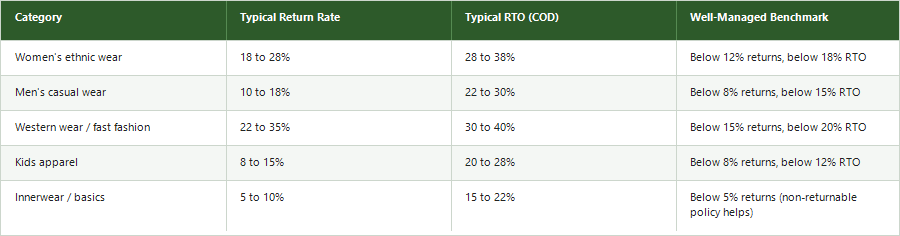
Fashion Return Rate Benchmarks India 2026
Packaging for Fashion - Protecting Margins
Fashion apparel is one of the categories where packaging optimisation has the most impact. Most garments do not require rigid boxes - a poly bag or a branded courier bag significantly reduces volumetric weight billing. Hidden shipping charges in fashion often trace directly to oversized packaging that inflates volumetric weight beyond actual product weight.
Specific tips:
- Use courier bags (poly mailers) for single garment orders - volumetric weight drops to near zero
- For multi-item orders, use right-sized boxes - not your warehouse's default box size
- Include a branded size exchange insert in every order - reduces support contact volume significantly
- Mark the outer packaging with size information so customers can identify a size issue before opening
How iCarry® Supports Fashion D2C Logistics
- Delivery Boost: Reduces fake NDR RTO on COD fashion orders. Agents call customers and audit courier claims in all Indian languages
- WhatsApp Engagement: iCarry®'s WhatsApp Engagement sends automated updates via WhatsApp at each stage - reverse pickup scheduled, replacement dispatched, out for delivery. Reduces doorstep refusals by keeping customers informed.
- Address Quality Scoring: Flags bad addresses before dispatch - prevents first-attempt failures on fashion orders where the return rate is already high
- Reverse Shipment Booking: Book reverse pickup for exchanges and returns directly from My Shipments. iCarry® allows sellers to book the reverse pickup and the fresh forward shipment in the same session - from the My Shipments dashboard.
- COD remittance: Free daily T+7 remittance for all plans. For fashion brands with high COD volume, daily cash flow matters. Early remittance from T+0 to T+4 is available at a nominal fee, with iCarry® advancing payment from its own working capital. Here, T refers to the day of delivery. For example, T+0 means the payment is processed on the next day after delivery, T+1 means on the following business day, and T+7 means after seven business days. The amount is credited to the seller's wallet or account as selected.
- Multiple courier partners: Route COD fashion orders to the courier with the lowest RTO rate for each specific pincode - not the same courier for every order
New to iCarry®? Watch How to Sign Up and Activate Your iCarry® Account and start shipping fashion orders the same day.
Final Thoughts
Fashion logistics in India is genuinely hard. High returns, high RTO, low margins, and customers who are used to marketplace-level return convenience from brands a fraction of the size of those marketplaces.
The brands that build sustainable fashion D2C businesses do four things well: better size information at the listing level, structured exchange workflows that retain the sale, COD confirmation before dispatch, and courier selection by RTO performance not by price.
iCarry® gives fashion D2C brands the tools to execute all of this from one platform - Delivery Boost, WhatsApp Engagement, Address Quality Scoring, multi-courier routing, and free daily COD remittance. Start free - no monthly fee, no minimum volume.
Frequently Asked Questions (FAQs)
What is the average RTO rate for fashion D2C brands in India?
Fashion COD orders in India typically see RTO rates of 25 to 38% depending on the category and target market. Well-managed brands with active NDR management, COD confirmation workflows, and prepaid conversion strategies bring this below 18%.
How do I reduce size returns for my fashion brand?
Add detailed size charts with actual measurements (chest, waist, length in cm) to every product listing, disclose the model's height and size worn, include fit descriptions (true to size, runs small, relaxed fit), and consider a size recommendation tool. These changes address the root cause rather than managing the return after it happens.
How do I manage exchanges efficiently for a fashion D2C brand?
Present exchange as the primary option at return initiation. Book the reverse pickup and replacement dispatch simultaneously. Set a 48-hour inspection and restock SLA. Use WhatsApp Engagement to keep the customer updated at every exchange stage - scheduled pickup, replacement dispatched, out for delivery.
Why is COD RTO so high in fashion?
COD fashion purchases have lower commitment at order time - particularly impulse orders from social media. Doorstep refusals happen when delivery timing does not match customer availability or when the customer has changed their mind. COD order confirmation before dispatch and WhatsApp delivery notifications are the two most effective interventions.
Does iCarry® support reverse pickup for fashion returns and exchanges?
Yes. iCarry® allows sellers to book reverse shipments directly from the My Shipments dashboard. For exchanges, the reverse pickup and fresh replacement forward shipment can be booked in the same session. Multiple courier partners are available for reverse pickup across 29,000+ pincodes.
How does Delivery Boost help fashion D2C brands?
Fashion COD orders in high-RTO pincodes are particularly vulnerable to fake NDRs - where the courier marks a delivery as attempted without actually visiting. Delivery Boost agents call your customers before delivery, audit NDR claims, and open tickets for fake non-delivery reports - converting fake NDRs into reattempts rather than RTOs.
Can small boutiques and Instagram sellers use a courier aggregator?
Yes. A courier aggregator has no minimum volume requirement - you can ship your first order the same day you sign up. Whether you are shipping 5 orders a day from a home studio or 5,000 orders from a warehouse, the platform and pricing work the same way. The free Bronze plan at iCarry® suits small boutiques and Instagram sellers starting out.
What return rate should I expect for fashion D2C in India?
Industry benchmarks for fashion D2C in India show overall return rates of 20% to 35%, with COD-heavy Tier 2 and 3 cities at the higher end. Size-related returns account for 40% to 60% of total returns in most apparel categories. Brands that add size guides, customer fit reviews, and pre-dispatch COD confirmation calls consistently bring rates below 20%.
How do I handle exchanges when my courier does not support them directly?
Book a reverse pickup for the return first, then create a fresh forward shipment for the replacement - both from the same courier aggregator dashboard. The key is to confirm the exchange request in writing (WhatsApp or SMS), set clear timelines, and proactively notify the customer when the replacement ships. This reduces exchange abandonment and prevents NDRs on the second delivery attempt.
Fashion D2C logistics in India is won or lost on four decisions: size information quality at listing level, structured exchange workflows that retain the sale, COD confirmation before dispatch, and courier selection by RTO performance. iCarry® gives fashion brands the tools to execute all four from one platform.