
A customer orders a kurta for Diwali. It arrives four days after the festival. She messages your support asking for a return. You check your website and realise your shipping policy says nothing about delivery timelines or return windows for delayed shipments. Now you are in a dispute with no written terms to fall back on. This scenario plays out thousands of times a day across Indian eCommerce. Not because sellers don't care about their customers - but because most sellers write a shipping policy once, never update it, and never think about it again until something goes wrong.
India's eCommerce market is growing rapidly, and with it, consumer expectations and regulatory scrutiny are both increasing. The Consumer Protection (E-Commerce) Rules 2020 require Indian eCommerce businesses to disclose shipping terms clearly. Not doing so is not just a customer experience failure - it is a compliance gap.
This guide explains what a shipping policy is, what Indian businesses are legally required to include, what best-practice clauses look like, and how to write one that serves both your customers and your business.
What Is a Shipping Policy?
A shipping policy is a written document - published on your website, typically accessible from the footer - that sets out the terms and conditions of how you fulfil and deliver orders to customers. It defines what customers can expect, what you commit to, and what happens when things don't go as planned. A good shipping policy answers three fundamental questions: When will my order arrive? How much does shipping cost and what do I pay for COD? What happens if my order is delayed, damaged, or lost?
Quick Checklist - Does Your Shipping Policy Cover These?
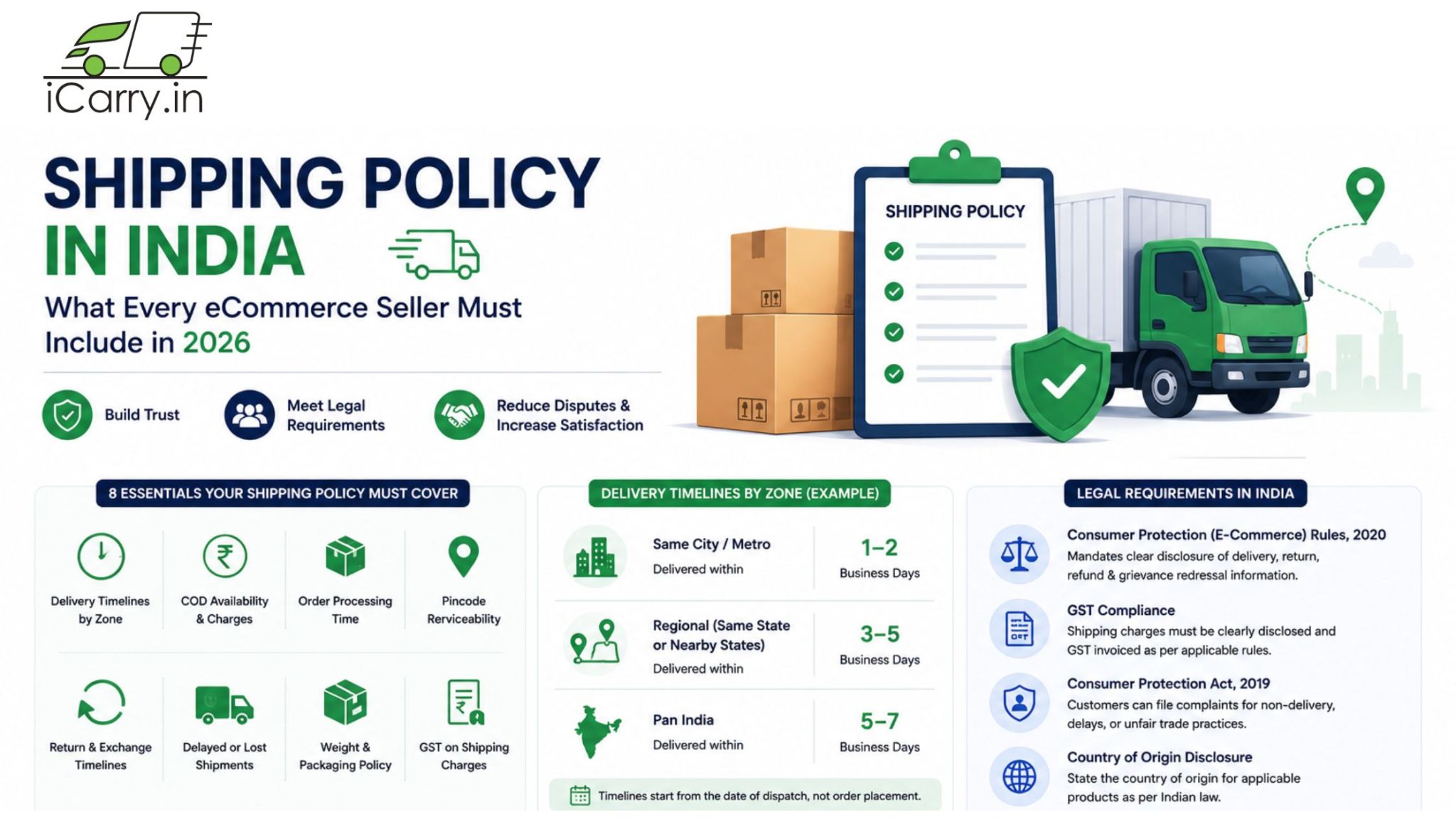
Most Indian eCommerce shipping policies are missing at least 3 of these 8 essential elements:
- Delivery timelines by zone - same city, regional, and national - with specific business day ranges
- COD availability, COD charges, and what happens if payment is refused at delivery
- Order processing time - how many hours or days before the order is dispatched after placement
- Pincode serviceability - which areas you ship to and how customers can check before ordering
- Return and exchange timelines - how many days the customer has and what condition the product must be in
- What happens if a shipment is delayed or lost - your liability and the customer's recourse
- Weight and packaging policy - how products are shipped and who bears damage risk
- GST on shipping charges - are they included or added separately, and how is the invoice generated
A good shipping policy answers three fundamental customer questions before they ask:
- When will my order arrive?
- How much does shipping cost and what do I pay for COD?
- What happens if my order is delayed, damaged, or lost?
Beyond customer service, a shipping policy is part of the broader compliance framework that Indian eCommerce businesses must maintain. The Consumer Protection (E-Commerce) Rules 2020 and the Information Technology Act both place disclosure obligations on online sellers - and shipping terms are a core part of what must be disclosed.
Legal Requirements for Shipping Policies in India
Indian eCommerce sellers are not operating in a regulatory vacuum. Several laws and rules create specific obligations around what shipping and returns information must be disclosed:
Consumer Protection (E-Commerce) Rules 2020
These rules require eCommerce platforms and marketplace sellers to provide clear, accurate information about:
- Delivery timelines before order confirmation
- Return, refund, and exchange policies in an accessible format
- Grievance redressal mechanism - a named contact for customer complaints
- Country of origin for goods - relevant for products with import duty implications
Non-disclosure or misleading disclosure of these terms can result in complaints before the District Consumer Disputes Redressal Commission and financial penalties.
GST Compliance on Shipping
GST treatment of courier and logistics services requires that shipping charges be either included in the product price (with GST calculated on the composite value) or disclosed separately with the applicable GST rate. The GST invoice must be generated and available to the customer by the 2nd of the following month.
Sellers should also review official GST e-way bill guidelines for compliance requirements related to shipment documentation and movement of goods.
For sellers who do not have a GSTIN, the guide on shipping products without GST in India explains the legal thresholds and practical options available.
Consumer Protection Act 2019
The Consumer Protection Act 2019 expanded consumer rights significantly in India. Under this Act, a customer can pursue a complaint if:
- Goods are not delivered within the promised timeline
- The product received differs materially from what was advertised
- Refunds are not processed within committed timelines
A clear, accurate shipping policy that sets realistic expectations and is actually followed is your primary defence against consumer complaints under this Act.
Essential Sections Every Indian eCommerce Shipping Policy Must Include
1. Order Processing Time
This tells customers how long it takes from when they place an order to when it is dispatched. Most Indian sellers process orders within 1 to 2 business days. Be specific:
Example: Orders placed before 2 PM on working days are dispatched the same day. Orders placed after 2 PM or on weekends are dispatched the next working day.
Processing time is different from delivery time. Many sellers confuse these or omit processing time entirely - leading to customers expecting delivery timelines that start from order placement, not dispatch.
2. Delivery Timelines by Zone
Every Indian eCommerce shipping policy must include estimated delivery times by geographic zone. Use specific business day ranges, not vague language like 'a few days'.
| Delivery Zone | Example Coverage | Estimated Delivery Time |
|---|---|---|
| Same city (Zone A) | Within your dispatch city | 1 to 2 business days |
| Regional (Zone B) | Within approx. 500 km | 2 to 3 business days |
| Metro to metro (Zone C) | Major cities pan-India | 2 to 4 business days |
| Rest of India (Zone D) | Tier-2 and Tier-3 cities | 4 to 7 business days |
| Special regions (Zone E/F) | J&K, North East India | 5 to 10 business days |
Always add a note: Delivery timelines are estimates and may vary during festive periods, weather disruptions, or areas with limited courier access.
3. Shipping Charges
State clearly what shipping costs the customer pays and under what conditions:
- Is shipping free above a minimum order value?
- Is there a flat rate for standard delivery?
- Are there different rates for express vs standard delivery?
- Are remote area surcharges applied for Zone E/F pincodes?
Also disclose any charges customers may not expect. Hidden shipping charges in Indian eCommerce - like COD fees, fuel surcharges, and dimensional weight billing - are common sources of customer disputes when not disclosed upfront.
4. COD Policy
Cash on Delivery requires its own section in your shipping policy because it creates additional terms that customers need to understand:
- Is COD available for all products, all pincodes, and all order values?
- Is there a COD handling charge? What is the amount or percentage?
- What happens if the customer is unavailable at delivery - how many attempts are made before the order is returned?
- What happens if the customer refuses COD payment at the door?
An order confirmation process for COD orders - where you verify buyer intent before dispatching - reduces RTO significantly and is worth mentioning in your policy as a step you take to ensure successful delivery.
5. Pincode Serviceability
Not every pincode in India is serviceable by every courier. Your policy should explain how customers can check whether their pincode is covered before placing an order - and what happens if it is not:
Example: We ship to 29,000+ pincodes across India through our courier partners. You can check pincode serviceability at checkout before placing your order. For areas not currently covered, we will notify you within 24 hours of order placement and issue a full refund.
6. Return and Exchange Policy
This is arguably the most important section from a consumer rights and trust perspective. Your return policy must state:
- How many days the customer has to initiate a return from date of delivery
- What conditions the product must be in - unused, original packaging, tags intact
- Which products are not eligible for return - food items, personalised goods, unsealed hygiene products
- Who bears the return shipping cost - seller, customer, or split
- How long refund processing takes from the date the return is received
India standard: Most Indian eCommerce sellers offer 7 to 15 days return windows. Marketplace policies (Flipkart, Amazon) set the benchmark that customer expectations are calibrated against - your policy should be at least as clear, even if the window differs.
7. Damaged or Lost Shipment Policy
Customers need to know what to do if their order arrives damaged or does not arrive at all:
- Report damaged shipments within 48 hours of delivery with photographs
- Do not accept visibly damaged parcels - photograph before accepting and note on POD
- Lost shipments are defined as orders not delivered or returned within 45 days
- Claim process: open a support ticket with AWB number and order ID
For sellers using iCarry®, all B2C shipments come with insurance coverage from Rs. 1,000 to Rs. 5,000 depending on plan - at no extra cost. This is worth mentioning in your shipping policy as a customer reassurance. Additional insurance can be purchased per shipment at booking for high-value orders. The guide on how to reduce RTO and manage delivery failures covers the full operational framework behind failed delivery management.
8. Non-Delivery Report (NDR) and Re-Attempt Policy
Most Indian sellers do not include NDR terms in their shipping policy - which leads to confusion when delivery fails:
Recommended clause to include in your shipping policy: If a delivery attempt fails, our courier partner will make up to 3 delivery attempts over 3 business days. If delivery is unsuccessful after all attempts, the shipment will be returned to us. Customers will be notified via the contact number provided at checkout. To reschedule delivery, please contact us within 24 hours of the missed attempt.
Proactive NDR management - using delivery notifications to keep customers informed and giving them a simple way to reschedule - is the most effective way to convert NDRs into successful deliveries rather than RTOs. How to use NDR data to improve delivery success explains the systematic approach.
9. Special or Restricted Zones
For orders to J&K, North East India, Andaman and Nicobar, and other remote areas:
- Longer delivery timelines - typically 7 to 14 business days
- Some couriers may not service all pincodes in these zones
- Additional handling charges may apply for ODA (Out of Delivery Area) pincodes
10. International Shipping (if applicable)
If you ship internationally from India, include:
- Supported destination countries
- Estimated international delivery timelines - typically 7 to 15 business days
- Who is responsible for customs duties and import taxes - typically the recipient
- Documents required for export shipments (commercial invoice, IEC code if applicable)
Common Shipping Policy Clauses (Copy-Paste Examples)
1. Delivery Timeline Clause
Estimated delivery timelines are:
Metro cities: 2-4 business days
Tier-2 and Tier-3 cities: 4-7 business days
Remote areas: 5-10 business days
Delivery timelines are estimates and may vary due to weather, operational delays, or courier disruptions.
2. COD Clause
Cash on Delivery (COD) is available for eligible pincodes and order values. Additional COD handling charges may apply. Orders refused at delivery may result in future COD restrictions.
3. Failed Delivery / NDR Clause
Our courier partner will make up to 3 delivery attempts. If delivery remains unsuccessful after all attempts, the shipment will be returned to us.
4. Lost Shipment Clause
Orders not delivered or returned within 45 days from dispatch are treated as lost shipments. Customers may contact support for replacement or refund assistance.
5. Damaged Shipment Clause
If your order arrives visibly damaged, please photograph the parcel before opening and contact us via email within 48 hours of delivery with the photos and order details.
6. Return Shipping Clause
Return shipping charges are borne by the customer unless the return is due to a damaged, defective, or incorrect product.
7. Delayed Delivery Clause
While we strive to meet estimated timelines, delays may occur during festive periods, extreme weather, strikes, or unforeseen courier disruptions.
8. Pincode Serviceability Clause
We currently ship to 29,000+ pincodes across India. Serviceability can be checked during checkout.
Download Free Shipping Policy Template (Word, PDF Version)
Need a ready-to-edit version?
Download the free eCommerce Shipping Policy template for Indian online sellers in Word format.
Includes:
- Delivery timeline clauses
- COD terms
- Return and exchange wording
- Lost shipment clauses
- NDR and re-attempt policy
- GST and shipping charge wording
Designed for Shopify, WooCommerce, Wix, any custom stores and D2C brands in India.
Shipping Policy Template for Indian eCommerce Sellers (Copy-Paste from Here)
Here is a ready-to-adapt template covering all essential sections. Replace bracketed terms with your specific details:
SHIPPING POLICY - [Your Store Name] | Last updated: [Month Year]
Order Processing Time
Orders are processed within [1 to 2] business days of placement. Orders placed before [2 PM] on working days are typically dispatched the same day. We do not process orders on Sundays and public holidays.
Delivery Timelines
Estimated delivery times after dispatch:
- Same city: 1 to 2 business days
- Regional (within 500 km): 2 to 3 business days
- Metro to metro: 2 to 4 business days
- Rest of India: 4 to 7 business days
- J&K, North East, remote areas: 7 to 14 business days
Timelines are estimates and may vary during festive periods or due to factors outside our control.
Shipping Charges
[Free shipping on orders above ₹X / Flat ₹Y for standard delivery / Free for prepaid, ₹Z for COD orders]
Cash on Delivery
COD is available for orders up to ₹[X] at select pincodes. A COD handling fee of ₹[Y] applies per order. If payment is not made at delivery, the order will be returned. [Number] delivery attempts will be made before the shipment is returned.
Returns and Exchanges
You may initiate a return within [7/10/15] days of delivery. Products must be unused, in original packaging, with all tags intact. [List any non-returnable categories.] Return shipping is [paid by seller / customer / free above Rs. X]. Refunds are processed within [7] business days of receiving the returned product.
Damaged or Lost Shipments
If your order arrives damaged, please photograph the parcel before opening and contact us within 48 hours. Do not accept visibly damaged parcels without noting the damage on the courier's POD. For lost shipments (not delivered within 45 days), please contact us at [support email/phone].
Non-Delivery
If delivery fails, our courier will attempt [3] deliveries over [3] business days. If all attempts are unsuccessful, the shipment will be returned. Please ensure your contact number is reachable during delivery hours.
Contact Us
For any shipping queries you may reach us at : [Email] | [Phone] | [WhatsApp]
Common Shipping Policy Mistakes Indian Sellers Make
Using vague delivery language: 'Ships within a few days' or 'delivery soon' are not policy terms - they are promises that cannot be enforced or measured. Use specific business day ranges by zone.
Not distinguishing processing time from delivery time: A customer who places an order on Friday expecting 2-day delivery expects it Sunday. If your policy says '2-day delivery' but processing takes until Monday, you have a dispute waiting to happen.
Not updating the policy after changing courier partners: If you switch from one courier to another and timelines change, your published policy must reflect the new reality.
Missing COD terms entirely: COD creates additional complexity that generic shipping templates do not cover. Indian eCommerce shipping policies must address COD specifically - charges, failed delivery attempts, and refusal consequences.
No grievance contact: Under Consumer Protection (E-Commerce) Rules 2020, you must provide a named contact for customer grievances. An anonymous 'contact us' form does not satisfy this requirement.
How Your Shipping Policy Affects Delivery Operations
A shipping policy does not just manage customer expectations - it shapes your internal operations too. When you commit to specific timelines in your policy, you create internal SLAs that your logistics operation must honour.
This means:
- Your dispatch cutoff time must align with your processing time commitment
- Your courier partner SLAs must support your published delivery timelines
- Your NDR management process must align with your stated re-attempt policy
- Your return inspection workflow must deliver refunds within your stated window
Tracking whether your operations actually deliver on your policy commitments is a function of logistics KPIs monitoring - on-time delivery rate, first-attempt delivery success, and return processing time are the three metrics most directly tied to policy compliance.
How iCarry® Helps Businesses Deliver on Their Shipping Policy
Writing a good shipping policy is step one. Consistently delivering on it is step two - and that requires the right logistics infrastructure.
Delivery Timelines
iCarry® provides access to multiple courier partners covering 29,000+ pincodes with standard transit times of 1 to 7 business days by zone. Before committing to delivery timeline promises in your policy, verify realistic transit times for your key routes using iCarry®'s free rate calculator.
NDR Management
iCarry®'s NDR dashboard shows every failed delivery with the courier's stated reason. Sellers can update delivery instructions and request reattempts from one view - directly supporting the 3-attempt, 24-hour follow-up commitment that a good shipping policy requires.
WhatsApp Engagement
iCarry®'s WhatsApp Engagement feature sends automated delivery updates to customers at each shipment milestone - pickup, out for delivery, NDR, and delivered - from iCarry's official WhatsApp number. This allows the customers to respond back on the chat if they want any changes in delivery slots or provide more information such as address, landmarks etc. Customers are also well informed before they need to contact support thus reducing the volume of 'where is my order' queries that strain small teams.
Last-Mile Accountability
iCarry®'s Delivery Boost feature deploys trained agents who call customers on your behalf and audit courier delivery claims - directly addressing the last-mile delivery failures in India that cause policy violations sellers cannot control alone.
Weight Discrepancy Protection
Unexpected charges from courier weight discrepancies can affect the net shipping cost customers effectively pay. How to dispute and reduce weight discrepancy charges gives sellers the tools to protect themselves and keep their actual shipping costs aligned with what their policy promises.
Video: How to Monitor All Shipments and Delivery Status on iCarry®
Shipping Policy vs Return Policy vs Refund Policy
| Policy | What It Covers | Where It Lives |
|---|---|---|
| Shipping Policy | Delivery timelines, charges, COD terms, lost/damaged shipments, NDR process | Website footer or FAQ |
| Return Policy | Eligibility window, product conditions, how to initiate a return, who pays return shipping | Website footer or FAQ |
| Refund Policy | Refund timelines, payment method for refund, partial refund conditions | Website footer or FAQ |
| Privacy Policy | How customer data is collected and used | Website footer - legally required |
Many Indian sellers combine these into one document. This is acceptable as long as each topic is clearly addressed. A combined policy that covers shipping, returns, and refunds in detail is better than three separate policies that are each incomplete.
Conclusion
A shipping policy is not paperwork. It is the contract between you and your customer that defines what the purchase experience actually means - from the moment they click Buy to the moment the product is in their hands (or back in yours after a return).
Indian buyers in 2026 are significantly more aware of their rights than they were five years ago. A clear, honest, regularly updated shipping policy builds the kind of trust that reduces disputes, reduces support volume, and increases repeat purchase rates. Write it once. Update it every time your courier partners, pricing, or timelines change. Publish it prominently. And build the logistics operation behind it that actually delivers on what it says. iCarry® makes the logistics side of that commitment easier - with multiple courier partners, NDR management, and delivery notifications from one platform. Get started here for free.
Video: How to Sign Up and Start Shipping with iCarry®
Frequently Asked Questions (FAQs)
Is a shipping policy legally required for Indian eCommerce sellers?
Yes. Under the Consumer Protection (E-Commerce) Rules 2020, Indian eCommerce businesses are required to disclose shipping terms, delivery timelines, and return and refund policies clearly. Non-disclosure can expose sellers to consumer complaints and regulatory action.
What should a shipping policy include in India?
Order processing time, delivery timelines by zone, shipping charges, COD policy and charges, pincode serviceability, return and exchange eligibility and timelines, damaged/lost shipment procedure, NDR and re-attempt policy, and a grievance contact.
How should I handle COD in my shipping policy?
State COD availability by order value and pincode, disclose the COD handling charge, explain how many delivery attempts are made, and state what happens if the customer refuses payment at delivery. Vague COD terms are one of the leading causes of customer disputes in Indian eCommerce.
What is a fair return window for Indian eCommerce?
7 to 15 days from delivery is the Indian eCommerce standard. Marketplace benchmarks (Amazon 30 days, Flipkart 7 to 30 days by category) set the expectation floor. Your return window should be at least as clear as marketplace policies, even if shorter.
Do I need GST on shipping charges?
Courier and logistics services attract 18% GST. If you charge shipping separately, you must collect and remit GST on that amount. If shipping is included in the product price, GST applies on the composite value. Sellers below the GST registration threshold (₹40 lakh for goods, ₹20 lakh for services) may be exempt. Consult the GST portal or your accountant for treatment specific to your business and product category.
How often should I update my shipping policy?
Update it whenever your courier partners change, your delivery timelines shift, your COD charges change, or your return policy is revised. At minimum, review it quarterly and after every major operational change. Add a 'Last Updated' date to the policy so customers know they are reading current terms.
What happens if I do not deliver within my stated timeline?
Consistently failing to meet stated delivery timelines creates grounds for consumer complaints under the Consumer Protection Act 2019. Practically, it also increases support ticket volume, negative reviews, and return rates. Set timelines you can actually meet - with a buffer - rather than the fastest possible window.
How does iCarry® help sellers comply with shipping policy commitments?
iCarry® provides the delivery infrastructure to back up your policy commitments - multiple courier partners for 29,000+ pincodes, NDR management, WhatsApp Engagement, Delivery Boost and more such services to reduce returns or failed deliveries. When your policy promises 3 delivery attempts and a WhatsApp notification on NDR, iCarry® gives you the tools to deliver that consistently.
A shipping policy is the contract between your brand and your customer - from order placement to delivery or return. Indian eCommerce sellers are legally required to disclose delivery timelines, COD terms, return windows, and grievance contacts under the Consumer Protection (E-Commerce) Rules 2020. Use the free template above to cover all 10 essential sections, back it with the right logistics infrastructure, and update it every time your courier partners or timelines change.